

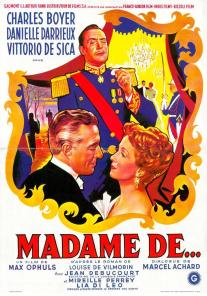
 The Earrings of Madame de… is the English-language title for Madame de…, as it was released in France, which heralds the heart-shaped diamond jewelry — not its owner — as the star of the film. The earrings do indeed play a major role, significantly altering the lives of those who possess them, seemingly propelled by their own willpower from one owner to another and back again. With a pinch more malice this would be The Lord of the (Ear)rings, a fantasy tale about tempting jewelry that instills a deadly pride in those who dare purport to wield such power. But the passionately humanist Max Ophüls ensures that this is always really the story of Madame de…, not simply of her diamonds, and the themes of pride and ownership don’t necessarily involve the earrings at all.
That sleight-of-hand is one of the many reasons Madame de… stands as the most highly-praised work by Ophüls, whose career as a filmmaker was constantly capsized by the onset of World War II. A German-born Jew, Ophüls fled and became a French citizen in 1938, only to have to flee further to the U.S. There he failed to break into Hollywood until an admirer of his work recommended him to Howard Hughes; it helped that the admirer was none other than Preston Sturges. Ophüls directed five Hollywood productions before returning to Europe in 1950, where a new stage of his filmmaking career blossomed. Each of his final films — La ronde (1950), Le plaisir (1952), Madame de… and Lola Montes (1955) — is a masterful achievement in its own right, championed thereafter by the likes of Samuel Fuller, Stanley Kubrick and Paul Thomas Anderson.

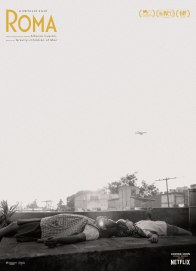 You could call Roma the most colorful black-and-white film ever made. After the Centerpiece screening at the 56th New York Film Festival, writer/director Alfonso Cuarón noted how important the visual presentation was to the overall effect of the movie. Crucial among his points was that this black-and-white is “not a nostalgic black-and-white” but instead “modern” and “pristine,” disabusing the viewer of the notion that this tale is unfolding in a long-forgotten place or time. Despite being assured throughout the film that the place is Mexico City and the year is 1971, Roma simultaneously manages to assure you that what’s happening is happening here and now.






 Motion State Review