
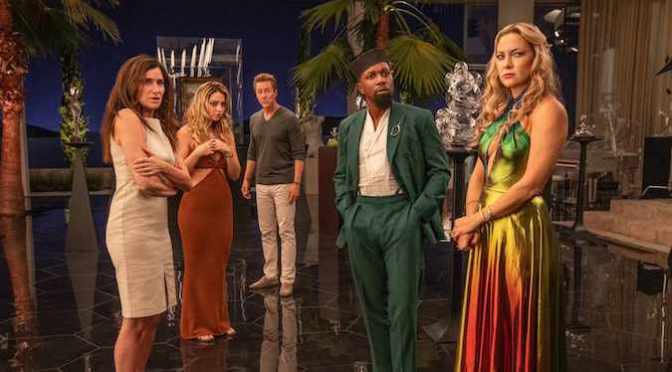
 In our original review of Knives Out, we lauded Rian Johnson’s ability to craft a film with a thematic message that mattered for the story but didn’t eclipse the pure, whimsical fun of the whodunnit. It was never a given that Knives would get a sequel, much less a trilogy (Netflix ordered the second and third films shortly after the success of the first). But here we are: Glass Onion hit theaters for a limited run last week in advance of the Christmastime release on Netflix, continuing the exploits of Benoit Blanc (Daniel Craig) as he accepts an invitation to a murder mystery party on a private island in Greece. But does Onion follow suit in couching a timely theme into the breezy fun?
Yes and no — but it’s worth mentioning up front that Onion is indeed a lot of fun, and a looser brand of fun that’s perhaps natural for a sequel. The protagonist is already known to us and the budget, frankly, is far larger, and so Johnson and Co. cut loose from the jump and never really let up. If there is a lack of thematic heft — we’ll dig into that more in a moment — then I didn’t notice it during the film. Glass Onion is more ambitious than Knives Out on almost every level, from the locales to the special effects to the cameos (in Knives Out it was M. Emmet Walsh, here it’s Ethan Hawke, Hugh Grant, Serena Williams, Yo Yo Ma, etc, etc). That ambition may not automatically make Onion a better film, but it’s refreshing to see Johnson and Co. commit so fully to breaking fresh ground rather than try to rebottle that first lightning strike.

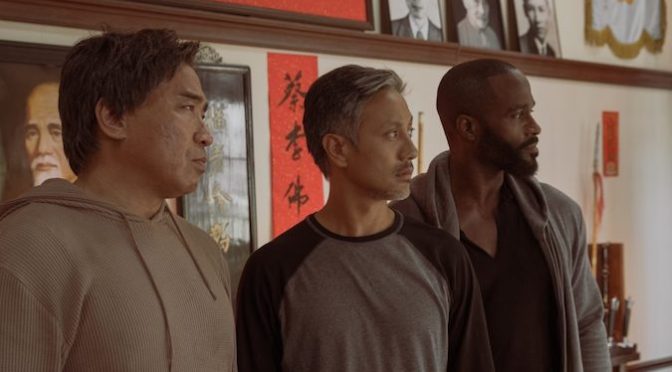
 The Paper Tigers screened as a part of the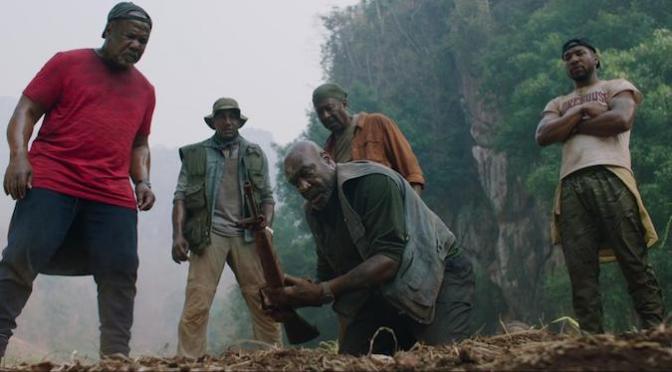
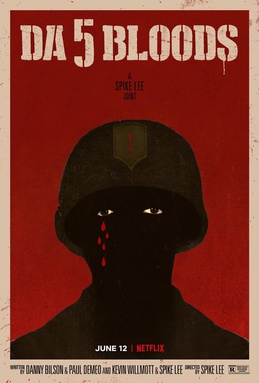 If you threw Spike Lee’s filmography into a pot and cooked it down, stirring occasionally such that all of the ingredients are thoroughly intermingled, you’d be left with Da 5 Bloods. Lee’s new Netflix joint is nothing if not ambitious, and at its shakiest it does feel composed of variations on ideas he’s had in previous films. Take the war-never-ends framing device of Miracle at St. Anna, the style-and-substance mentality of BlacKkKlansman, the epic scope of Malcolm X, a pinch of the melancholy soul-searching of 25th Hour, a dash of the motley cast of Get on the Bus, and Spike’s secret sauce, of course, that blunt intrusion of American history into an otherwise routine narrative. The last ingredient is always a tough one to swallow, but in Da 5 Bloods its sourness is even more noticeable. As with the final scene of BlacKkKlansman, the dark American past we’re witnessing is often only a few months old.
 The Earrings of Madame de… is the English-language title for Madame de…, as it was released in France, which heralds the heart-shaped diamond jewelry — not its owner — as the star of the film. The earrings do indeed play a major role, significantly altering the lives of those who possess them, seemingly propelled by their own willpower from one owner to another and back again. With a pinch more malice this would be The Lord of the (Ear)rings, a fantasy tale about tempting jewelry that instills a deadly pride in those who dare purport to wield such power. But the passionately humanist Max Ophüls ensures that this is always really the story of Madame de…, not simply of her diamonds, and the themes of pride and ownership don’t necessarily involve the earrings at all.
 For a good long while the prestigious mantle of Most Overdone Superhero Story was without a doubt the origin tale. Dead parents, ancient birthrights, Chosen Ones, freak laboratory accidents — after a while people caught on to the fact that all of these were basically following the same formula. We’ve seen Bruce Wayne witness the death of his parents
 Boasting a “return to roots” formula meant to appeal to champions of
 You could call Roma the most colorful black-and-white film ever made. After the Centerpiece screening at the 56th New York Film Festival, writer/director Alfonso Cuarón noted how important the visual presentation was to the overall effect of the movie. Crucial among his points was that this black-and-white is “not a nostalgic black-and-white” but instead “modern” and “pristine,” disabusing the viewer of the notion that this tale is unfolding in a long-forgotten place or time. Despite being assured throughout the film that the place is Mexico City and the year is 1971, Roma simultaneously manages to assure you that what’s happening is happening here and now.
 Motion State Review