Tag Archives: Robert Redford

Apocalypse Now (1979)

Oftentimes our “reviews” here at Motion State aren’t reviews at all, really, but just tangentially-related trivia-night factoids stretched into meandering essays posing as criticism (see here, here, here, here, here, herehere, and here, among others). Think sitting down for dinner and accidentally filling up on appetizers — every now and then it just happens. This is that, essentially, except today we’re filling up on dessert.

During the grueling production of Francis Ford Coppola’s seminal Apocalypse Now, his wife Eleanor took copious notes and video footage with an eventual resolve to distill it all into a documentary about the making of the film. She never found the proper “angle” for a documentary feature, but Notes on the Making of Apocalypse Now was eventually published in 1995. And the unedited, uncensored writings are probably a better peek into Apocalypse Now than a film would have been, because here there is no “angle” — there’s only the experience of being there as the film came together.

Continue reading Apocalypse Now (1979)

Nightingale (2015)

I wanted to love Nightingale unconditionally. We’ve written about one-man-show films here before, from Locke to Buried to Redford‘s All Is Lost to Altman‘s Secret Honor, and Nightingale certainly stands with those true one-man-shows rather than with, say, Cast Away or Gravity or 127 Hours or any other single-character flick that actually has a small supporting cast. Nightingale has no supporting cast, no strange premise wherein the hero is trapped underground or trapped on the high seas or trapped in space. Nightingale‘s Peter Snowden is trapped in his mind, and that’s scarier than any of the aforementioned scenarios.

David Oyelowo is the single actor in question here, and to say he delivers a great performance would be a pathetic understatement. Oyelowo is an absolute force of nature from the first frame of Nightingale to the last. The storyline is unsettling, sure, and we’ll get to that in a minute, but shorn of that Oyelowo’s performance is unsettling in and of itself for the sheer velocity of it all. Not only are Peter’s highs and lows very very high and very very low, but they’re backed up into each other and jumbled up in such a way that Peter switches like a lightbulb from on to off, from calm to manic, from contemplative to downright inconsolable. It’s impressive, but before that it’s incredibly disturbing.

Continue reading Nightingale (2015)

Force Majeure (2014)

Whenever a perfect little family poses for a picture like the one taken in the opening scene of Force Majeure, you pretty much know they’re in for some trouble. It’s an oft-used trope showing how easily people can slip into a display of happiness, showing how perception can sometimes count for everything — we touched on a similar scene in our discussion of Robert Redford’s Ordinary People, a film which is on the whole a good touchstone for the themes of Force Majeure. Though the Swedish film suffers slightly from swaths of introspection that last just a bit too long, Force is still one of the most well-crafted family dramas of the past year.

That family is dad Tomas, mom Ebba, little daughter Vera and littler son Harry. They’re on a weeklong getaway at a beautiful mountainside resort in the French Alps for some skiing and relaxation. It’s family time, which Ebba subtly notes has been a much-needed side effect of Tomas’s busy work schedule. This is precious time, so the family does everything together. They ski together, they brush their teeth together, they sleep together on the big master bed. They eat lunch together. They get engulfed by an avalanche together. Family stuff.

Continue reading Force Majeure (2014)

Ordinary People (1980)

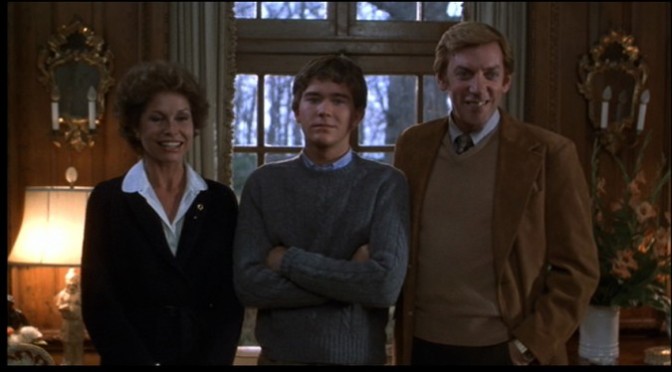
Halfway through Ordinary People, there is a scene in which high schooler Conrad Jarrett’s parents are taking family portraits. His mother and father take turns posing with their only son while his grandparents run the camera. Conrad awkwardly folds his arms, not knowing whether to smile. Father flashes a genuine grin, truly relishing the moment. When it’s Mother’s turn, the two stand together uncomfortably. Father’s trying to take the perfect picture, but Mother doesn’t know how to show Conrad affection, and her fake smile is growing tired. Father takes too long with the camera, Mother gets increasingly frustrated, Grandparents are talking over everyone as usual, and suddenly Conrad explodes. He’s had enough. Not so much with the photo, but with his mother’s inability to stand next to him and smile. Everyone freezes, except Mother. She carries on like nothing happened, hoping to fade back into normality like another ordinary person.

It’s a perfect representation of the family’s dynamic, though not the only one. Ordinary People is made up of small moments like these where characters aren’t saying how they feel, partly to keep up appearances, and partly because they don’t actually understand how they feel. In his directorial debut, Robert Redford proves to be an actor’s director, finding the ticks and gestures that characterize these humans better than any line of dialogue would. This is a movie about a family’s lack of understanding, of each other, yes, but mostly of themselves. They fidget, they pace, they stare blankly, lost in thought. They don’t understand why they feel and act the way they do, so they look to blame each other. After all, Conrad once screams, “It’s gotta be somebody’s fault or there ain’t no goddamn point.”

Continue reading Ordinary People (1980)

The Great Waldo Pepper (1975)

If Robert Redford is the best model of the American Dream in all its smiling, handsome glory (and I think he is), then he must also be its most effective destroyer. Through characters like the Sundance Kid (Butch Cassidy and the Sundance Kid) and Jay Gatsby (The Great Gatsby) who turn themselves into legends, and Bob Woodward (All the President’s Men) who turns politicians into criminals, Redford has made his career a mission to demystify the neatly packaged illusion of American exceptionalism. Yet I don’t think either of those crushes The Dream as brutally as The Great Waldo Pepper does, leaving it burning in the wreckage of a monoplane. And that’s saying something for a movie as lighthearted as this one.

It’s 1926 in down-home Nebraska, and all that’s left of World War I are the daredevil pilots who duke it out in barnstorming competitions right over our heads. Simple Midwesterners search the skies at the sound of a biplane engine while J.P. Sousa-style marches signal the arrival of our hero, Waldo Pepper. There’s only one problem–Pepper is a liar and a cheat. He never fought against the notorious Ernst Kessler in the war (he didn’t fight at all on account of his being a flight instructor), but he’ll say he did if it gets him an easy buck (on account of his being poor and desperate). But despite being a great storyteller and showman, Pepper is actually the real deal. He’s “Great,” not because he’s got money like Gatsby, but because his flying skills are (nearly) unmatched (that pesky Kessler is still alive after all). In this day and age, though, where almost every man and his grand-pappy seems to have a plane, Pepper’s gotta find a way to stand out. Continue reading The Great Waldo Pepper (1975)

Three Days of the Condor (1975)

When people say it’s just like a ’70s spy thriller! or if you like ’70s spy thrillers, you’ll love this!, the movie they’re all referring to whether they know it or not is Three Days of the Condor. This is how we measure the influence that the Pollack-Redford political drama has had on our current film industry: in remakes, spinoffs, tributes, allusions, shoutouts and straight-up copies of the original.

Written as the novel Six Days of the Condor by James Grady, the book translated to the screen so well thanks to the the meticulous aplomb of Sydney Pollack and the solid performances of the entire cast. Three Days of the Condor wasn’t written to be an overtly political film, all appearances to the contrary, and according to Pollack and Redford the “thriller” aspect of “political thriller” was the part they tried to emphasize. It worked. Still, the political associations were all but unavoidable in 1975; Watergate was certainly still fresh, but more immediate was the leaking of highly sensitive CIA documents known as the Family Jewels scandal. This occurrence ended up being one of those Hollywood coincidences where a movie gets made about a particular subject and then that particular subject, one day out of the seeming blue, becomes the particular subject of the day’s news. Three Days of the Condor came out too close to the Family Jewels scandal to be able to say anything explicitly about it, but it managed to wrestle with the issue all the same.

Continue reading Three Days of the Condor (1975)

The Yakuza (1974)

Sydney Pollack’s The Yakuza was released at a time when depictions of Asia in Hollywood films were either simple vehicles for big stars or grossly Westernized misrepresentations. There are notable exceptions, of course, and The Yakuza is probably one of them. Starring Robert Mitchum as a retired detective returning to Japan for a new case, the film manages to give real playing time to actors who aren’t straight from Hollywood. Chief among these is Ken Takakura, who shines as the conflicted brother of a former love interest of Mitchum’s character.

As was the case with several of his films, Sydney Pollack wasn’t the first director to be attached to The Yakuza. Robert Aldrich, best known for The Dirty Dozen and the brilliant Flight of the Phoenix, was initially slated to reteam with Mitchum after their collaboration on The Angry Hills back in 1959. Aldrich, a fine director, would have done fine with The Yakuza, but it just seems more interesting as a part of the early Pollack filmography. Following Jeremiah Johnson and The Way We Were and preceding Three Days of the Condor, the Tokyo- and Kyoto-set noir provides a nice break from the Redford-starrers.

Continue reading The Yakuza (1974)

Jeremiah Johnson (1972)

Starring Robert Redford’s burly mane, Jeremiah Johnson is the story of an absolutely incredible beard and the mountain man who carries it around on his face. The beard just wants to live a quiet life, moving gently in the Rocky Mountain breeze and catching a few snowflakes, but other forces dwelling in the range cause trouble for the beard. As seasons pass in the valleys below, the beard wisens to the truths of the world and becomes a broader, more understanding beard.

Sydney Pollack directed five or six films – five including 1969’s They Shoot Horses, Don’t They?, and six if you count 1968’s The Swimmer, which Pollack eventually took over without an actual directing credit – and plenty of TV before he got to Jeremiah Johnson in 1972. Not long before production began, it was Clint Eastwood in Johnson’s role and Sam Peckinpah set to direct him, but the pair clashed and Eastwood said “Dirty Harry sounds a lot less dangerous” (paraphrased) and Redford was cast in his place. Having worked together on This Property Is Condemned in 1966, it was Redford who secured Pollack as Peckinpah’s replacement. Contrary to what one may think when watching Redford ride around on horseback for two hours Jeremiah Johnson actually cost quite a bit of money, and it was money that the studio wasn’t prepared to give out after advancing Redford a hefty salary. Pollack mortgaged his house and financed parts of the film himself, all the while strictly adhering to the budgetary and time constraints the studio laid down.

In short, you wouldn’t blame Pollack for being a bit sour after such a stressful production. But the director cited it as a great trial-by-fire learning experience, essentially because the money he was risking was his own. It probably helped that Johnson did well and remains a bit of a mountain-man classic today.

The kernel of the film, at least for me, comes when Jeremiah sits by a freshly-killed dinner with his de facto family – a wife he was all but forced to marry and a son he was all but forced to adopt. First, the irony of a man sojourning to the Rockies to live a life of quiet solitude and ending up married with a kid is a rich one. As they sit around munching rabbit or whatever Jeremiah teaches his non-English speaking wife a new word: “Yes”. He then asks her some questions about himself, the last of which is “I am a fine figure of a man, yes?” Now, this lady has no idea what in the hell this guy is talking about. She’s goaded into answering all the same, showing off her new word “yes”. Jeremiah sits back satisfied.

A definition of manhood in any form, validity apparently notwithstanding, keeps cropping up in Jeremiah Johnson. He achieves legendary status among some of the puny town-dwellers, achieves something of a nemesis status among a tribe of Crow Indians, and achieves something that begins as pity but matures into respect with two like-minded mountain men. What of himself? Does “being a man” equal “living a full life”, or is there a gap there somewhere that leaves this manly man’s man ultimately unfulfilled?

Pollack and Redford manage to pull an extremely strong narrative out of what could easily have been a semblance of shots of Jeremiah riding a horse. The beard helps. Tragically, the beard’s career went sharply downhill following Jeremiah Johnson and was hardly ever seen in Hollywood again, sinking into a drunken oblivion and leading a shattered existence that would one day serve as the basis for Leaving Las Vegas.