All posts by hangmantitan

Jauja (2014)

The script for Lisandro Alsonso’s latest film Jauja is reportedly only 20 pages long. Though I haven’t actually read it, that short length wouldn’t surprise me after last night’s NYFF screening. Starring Viggo Mortensen as a Danish military man stranded in a nameless South American desert, Jauja certainly isn’t your typical Main Slate festival offering. If anything, the film walks the tightrope between historical epic and surreal experiment, providing plenty of opportunity for reflection along the way. Unfortunately, the fact that the spaces in which we might take time for reflection vastly outweigh the moments that actually demand interpretation proves to be Jauja‘s downfall.

The film opens with a beautiful shot of Viggo’s Captain Dinesen sitting with his daughter, Ingeborg, and right away we get a taste of Alonso’s directorial style without so much as a hint of what may betide these characters. Mortensen, the only recognizable face in Jauja (or in any of Alonso’s films), is facing away from the camera for the entirety of the motionless opening shot. That’s essentially Jauja in a nutshell: the landscape, the framing, the aesthetic, the emotion generated by the imagery alone  – all of this is much more important than the actors, or the characters they play, or the “plot” they partake in.

And make no mistake: Jauja, visually, is stunning. Every shot is carefully composed and lit, and the locations chosen provide Alonso’s camera with enough lush detail for consumption. Many shots seem to stretch on forever, and where most directors would probably work to keep the foreground characters in focus by blurring the backdrop, the reverse is true here. Rocks and clouds and figures far in the distance are as clear as the whiskers on Viggo’s face. Jauja‘s color palate is equally agreeable, and the blue dresses and bright red pants are captured beautifully aside the damp mossy terrain that makes up so much of the film. In this sense, we should admit, the narrative matters less and less.

Continue reading Jauja (2014)

Killing Them Softly (2012)

In America you’re on your own. One of the most criminally overlooked movies of 2012 was Andrew Dominik’s Killing Them Softly, a rough-and-tumble tale of petty holdup artists, mob enforcers and the suit-and-ties that control them (or think they control them). Dominik’s follow-up to his excellent The Assassination of Jesse James by the Coward Robert Ford retains some of the same cast and makes a few substitutions, and Killing Them Softly is a very different movie from Dominik’s earlier film and from most American crime dramas on the whole.

When two smalltime down-and-outers (played with hilarious gusto by Scoot McNairy and Ben Mendelsohn) hold up a mob-protected card game (run by Ray Liotta’s Markie), the local criminal economy crumbles into chaos. It’s not so much that the robbery is botched as the criminals themselves are botched, making it a fairly simple procedure for Brad Pitt’s Jackie Cogan to arrive in town and put the pieces together. His systematic deconstruction of the situation provides the rest of the drive for Killing Them Softly, but Domnik and Co. enhance the subtleties of every punch and gunshot along the way.

An interesting feature of Killing Them Softly is the way the 2008 presidential election campaign – focused largely on the recession and the floundering economy – plays into the story. Unlike a lot of modern crime dramas, this one is very “bottom-up” – the players we watch are the lowest rungs on the ladder, broke and struggling men desperate to make any kind of score. This isn’t American Gangster or Goodfellas. The highest we go up the totem pole is a glorified messenger played by Richard Jenkins (who is fittingly out-of-place among the rest of the cast), and other than that it’s junkies, drunken hitmen, and enforcers who don’t think twice about shooting a guy. Even Dillon, a world-famous-all-over-New-England enforcer mentioned time and again by nearly every character, appears only once (and happens to be played by Sam Shepard). Addresses from Obama and McCain reach this subfloor of humanity nonetheless, but the blanket statements made by presidential candidates don’t exactly apply way down here.

Continue reading Killing Them Softly (2012)

The Killer Elite (1975)

It’s tough to find defenders of The Killer Elite. Watching the film without any knowledge of the chaotic production or of director Sam Peckinpah’s personal, financial and artistic woes at the time probably makes for a bland and unexciting viewing experience; sadly, a little background on Peckinpah effectively makes it even worse, as it’s hard to watch The Killer Elite without noticing that the gleefully indulgent heart characteristic of his best films seems to have vanished.

The set-up ain’t bad, although that hardly ever matters in the hands of a capable director. James Caan and Robert Duvall star as CIA-contracted assassins and friends who have worked together for years. Duvall’s George betrays Caan’s Mike, shooting him in the elbow and knee and leaving him badly crippled. The rest of the film follows Mike as he recuperates, retakes his post at the shady government operations agency, and ultimately seeks revenge on his old pal George.

There are plenty of rumors associated with The Killer Elite that may or may not be true. First is that Peckinpah took the project specifically as an attempt to recreate the financial success he had with the Steve McQueen-starrer The Getaway, which marked the last financially successful movie Peckinpah would direct. Bring Me the Head of Alfredo Garcia was both more in line with Peckinpah’s Western sensibilities and more of a box office flop, and so it is admittedly easy in that regard to draw parallels between The Getaway and The Killer Elite. The fact that the project may have been more associated with money than with any real passion pretty much sets the thing up for failure out of the gate.

Continue reading The Killer Elite (1975)

Alex Cross (2012)

Seeing Tyler Perry in a mostly-dramatic role in David Fincher’s Gone Girl last week prompted a visit to 2012’s Alex Cross, the most recent big screen incarnation of James Patterson’s famous detective previously played by Morgan Freeman in Kiss the Girls and Along Came a Spider. Appearances to the contrary, Alex Cross ended up being more of a comedy than a drama after all.

Perry’s brilliant Detective Cross faces off against Matthew Fox’s bonkers serial killer known as “Picasso” after the former foils the latter’s assassination attempt and the latter retaliates by killing the former’s wife. The latter realizes his nemesis is The Guy From Madea and uses the opportunity to hone his stand-up routine by exchanging some truly side-splitting dialogue. The game of cat and mouse comes more to resemble a game of mouse and cheese, and the former and the latter eventually decide to duke it out in an abandoned building because cliché. Edward Burns is also in this movie, as is Jean Reno.

Are you excited yet? Well just wait until you witness that final fight scene, whoo boy. Keep in mind that we see Picasso manhandle an impossibly jacked MMA fighter with ease early on in the film and beat the ever-lovin’ out of pretty much everyone else along the way, only to lose in a half-assed scuffle with Madea when his fighting skills actually matter. And you know that cliché moment in 95% of movie fight scenes where the hero seems beaten and is bent over, breathing heavily as blood drips dramatically onto the floor, only to suddenly surge up again with a wicked punch that knocks the bad guy out and gets the music going again? There’s a moment like that, but it isn’t a punch. It’s a kick. It’s in slow motion. The buildup and everything is there and the dude kicks his freaking nemesis in the groin in slow motion. Make sure you’re not drinking Cristal when you watch this scene because you will spit it out laughing and that would be such a waste.

Continue reading Alex Cross (2012)

Gallipoli (1981)

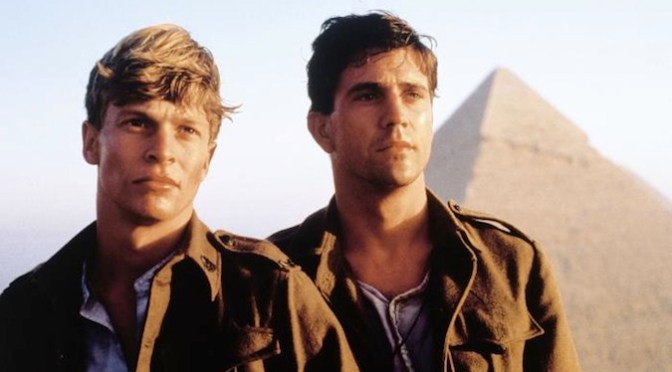
Gallipoli is arguably the feature that catapulted both Mel Gibson and Peter Weir onto the international stage. Though both the actor and the director had found success in the years prior – Weir with The Cars That Ate Paris, Picnic at Hanging Rock and The Last Wave and Gibson with Mad Max – their first collaboration would prove to bring out the best in both of them. Gallipoli spawned plenty of war films and series that would attempt to ride that wave of popularity, but to this day it still remains one of the greatest WWI films out there.

Gibson stars alongside Mark Lee, the latter of whom actually has the larger role despite Gibson’s mug being the only one plastered across the U.S. marketing materials. Lee is Archy Hamilton, hopeful young sprinter from Western Australia who continually hears of the efforts of the Australian Imperial Force on the peninsula of Gallipoli. He first crosses paths with Gibson’s Frank Dunne during a footrace, after which both men travel together to Perth in order to enlist. Their journey is long and full of joy and laughter, but it eventually takes them to the front lines at Gallipoli. Here they confront the reality of war, attempting to hold onto whatever remnants of home they can in the face of such horror.

To be sure, there are no shortage of “loss of innocence” war films. You could even argue that all war films address this in one way or another, even if it’s tangentially through a supporting character or two as in the likes of The Hurt Locker. Not only does Gallipoli get credit for being a precursor to some of the best WWI films of our era, but it’s also worth paying attention to the structuring of the film as a kind of growing, building framework on which we can hang this theme as the credits roll. First off, the focus is very much on Archy and Frank for the entirety of the movie – we only see the battlefield when they see the battlefield, and any notions we have of the war are stemmed from the opinions of the people they meet and the newspapers they read. In this sense, the war is almost a backdrop for a tale about two friends, and Gibson himself expressed as much in an interview (according to the almighty Wikipedia [so it’s gotta be true!]).

Continue reading Gallipoli (1981)

Gone Girl (2014)

Gone Girl had a lot to live up to in the David Fincher oeuvre. I may be alone in saying that nothing in his filmography of the past few years has totally astounded me; The Social Network and Zodiac – well acted and beautifully filmed though they were – just didn’t have enough plot to hold me for the entire runtime, and The Curious Case of Benjamin Button and The Girl With the Dragon Tattoo had more than a few other problems. That said, there’s little doubt that Fincher is still to be considered among the few American masters of filmmaking. Not only does Gone Girl provide more proof of that, but it’s also a film with a much stronger plot than the aforementioned dramas.

Ben Affleck stars as Nick Dunne, husband of Rosamund Pike’s Amy Dunne, who is forced to deal with the events following her sudden disappearance on their fifth anniversary. These events include police interrogations, candlelight vigils and family consolations – but the most jarring presence is the frenzy of media coverage that descends upon Nick’s life. As the first half of Gone Girl progresses, Nick’s behavior seems more and more suspicious, and even though we’ve been following his story since the very moment of his discovery of Amy’s disappearance, Nick still seems more and more guilty.

Continue reading Gone Girl (2014)

Defiance (2008)

Defiance was one of the few Edward Zwick movies I hadn’t seen, so the recent addition to the Netflix catalogue was a welcome one. Zwick – helmer of the undoubtedly great Glory and Blood Diamond and the possibly-great-but-jury’s-maybe-still-out Legends of the Fall and The Last Samurai – is a filmmaker who can balance blockbuster epicness and fragile emotional sentiment like few other directors. Defiance is no exception in this regard, although it suffers in ways that some of Zwick’s previous films do not.

Daniel Craig stars as Tuvia Bielski, Belarusian Jew and oldest brother to three youngers. The Bielski brothers flee and take refuge in the deep forest when Nazi aggression escalates and their parents are murdered. The forest hides them well enough until more and more refugees hear the tale of the Bielski camp and show up for food, shelter, safety, comfort, destabilizing the small hideout with each new hungry child. As the camp grows more rules and hierarchies must be created and maintained and enforced, and it falls to Tuvia to protect his countrymen against the German threat.

Continue reading Defiance (2008)

Three Days of the Condor (1975)

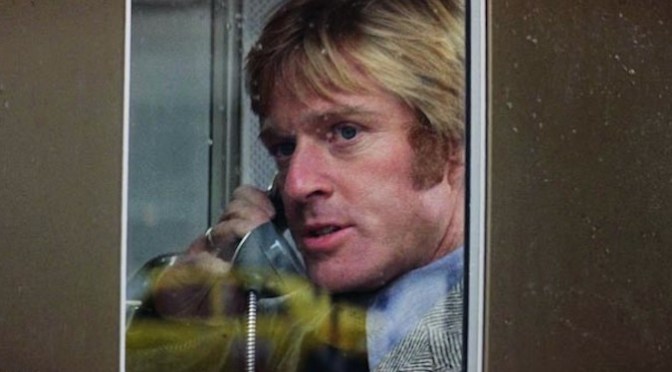
When people say it’s just like a ’70s spy thriller! or if you like ’70s spy thrillers, you’ll love this!, the movie they’re all referring to whether they know it or not is Three Days of the Condor. This is how we measure the influence that the Pollack-Redford political drama has had on our current film industry: in remakes, spinoffs, tributes, allusions, shoutouts and straight-up copies of the original.

Written as the novel Six Days of the Condor by James Grady, the book translated to the screen so well thanks to the the meticulous aplomb of Sydney Pollack and the solid performances of the entire cast. Three Days of the Condor wasn’t written to be an overtly political film, all appearances to the contrary, and according to Pollack and Redford the “thriller” aspect of “political thriller” was the part they tried to emphasize. It worked. Still, the political associations were all but unavoidable in 1975; Watergate was certainly still fresh, but more immediate was the leaking of highly sensitive CIA documents known as the Family Jewels scandal. This occurrence ended up being one of those Hollywood coincidences where a movie gets made about a particular subject and then that particular subject, one day out of the seeming blue, becomes the particular subject of the day’s news. Three Days of the Condor came out too close to the Family Jewels scandal to be able to say anything explicitly about it, but it managed to wrestle with the issue all the same.

Continue reading Three Days of the Condor (1975)

Wolf (1994)

He’s a wolf – and not just in the bedroom! Jack Nicholson’s turn as publisher Will Randall in the Mike Nichols werewolf flick Wolf is, well, a Jack Nicholson performance. He’s sleazy, hairy, and manic as ever here, and so your enjoyment of Wolf might depend entirely upon your enjoyment of Jack Nicholson. There are other things floating around in the movie to distract you, but Jack’s at the heart and soul of everything for better or worse.

Nicholson’s Will encounters a black wolf one night and suffers a bite to his hand. He soon encounters the slinky Laura Alden, played slinkily by Michelle Pfeiffer, and the two begin a romantic relationship. Meanwhile, as Will’s animalistic tendencies simmer to a boil within him, James Spader’s office yuppie Stewart Swinton schemes viciously for Will’s job at the publishing firm. These three characters swirl around each other as the full moon rises, and eventually Joker and Catwoman and Ultron all meet for a fateful reunion.

So is Wolf actually good, or is it B-movie horror trash? Interestingly, really strong arguments can be made for both cases. The first hour of Wolf is pretty razor-sharp: Nichols delights in the blacks and yellows of a bedroom lit by the harvest moon, and the cinematography is damn-near beautiful; writer Jim Harrison (who penned Legends of the Fall) focuses as much on the back-and-forth of workplace politicking as on the back-and-forth between man and wolf, and the parallels he draws are amazing; to boot, a sparkling Ennio Morricone score doesn’t hurt. These guys make Wolf extremely palatable, and Nicholson knocks what they give him out of the park. The metaphorical rise of the wolf is handled with a subtle sophistication by the leading man, apparent only when you consider how hammy and over-the-top the entire thing could have been.

Continue reading Wolf (1994)

Whiplash (2014)

The New York Film Festival opened last week with David Fincher’s Gone Girl and continues until the New York premiere of Birdman to close the festival. In between those films fall a massive spectrum of features, short films, documentaries and retrospective screenings that include entries from some of the biggest names in the entertainment industry.

Whiplash isn’t one of those big huge premieres held up by the strength of name recognition and pre-release buzz. Technically the NYFF screening wasn’t even a premiere at all, as Whiplash first popped up at Sundance last winter. But if any “small” flick can surge through festivals like this and have a strong opening later this month, it’s this one. Less tangentially: Whiplash is one of the leanest and most intense films you’re likely to see this year.

Continue reading Whiplash (2014)