

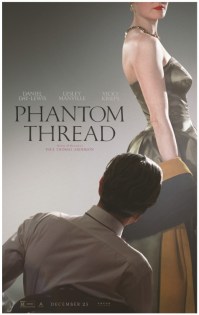
 Early on in Phantom Thread I started thinking about the miniaturized nature of certain segments in the cinema of Paul Thomas Anderson. At the top of this latest film we see Reynolds Woodcock’s morning routine, clearly practiced to the point of automation, nearly mechanical, though the whole scene lasts less than thirty seconds. He shaves, he slicks his hair, he pulls on his big winecolored socks, his pants. And that’s it. The dressmaker is dressed. One might expect a little more extravagance from a film that’s ostensibly about high-end style and tailored beauty, no?
But Anderson has always employed this device throughout his films, these little nugget-sized glimpses that seem like — or sometimes actually are — improvised scraps rather than written scenes. In Inherent Vice this was sort of the entire movie, an assault of crisscrossing people and places and scenarios that rarely evolve into extended sequences. A better example is The Master, probably Anderson’s finest film, throughout which there’s more of a balance in the overall pacing. We meet Freddie Quell lounging on a battleship, then cut to him commiserating with a group of waylaid soldiers, then cut to him masturbating at the edge of the ocean. Later there’s a very quick scene in which he’s chased down after possibly poisoning someone with a stiff drink, and in this span of a minute or so we already know Freddie to be a scrappy rogue fending off all comers on the outskirts of society.
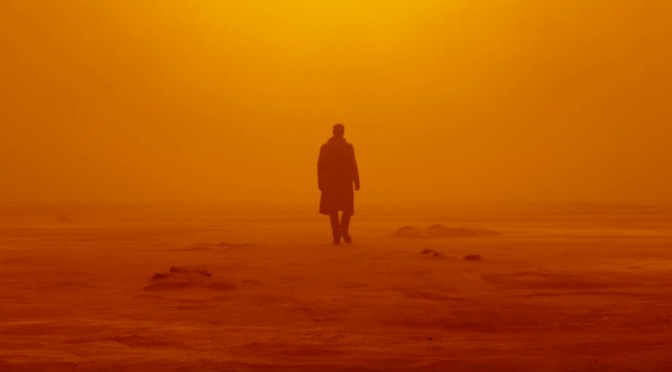
 One of the previews that screened before last night’s Boston premiere of Blade Runner 2049 was for next year’s monsters vs. robots actioner Pacific Rim Uprising, an inevitable if somewhat tardy sequel to Guillermo del Toro’s 2013 original. Based solely on this trailer, it’s evident that Uprising centers on the son of the first film’s protagonist, alludes heavily to that first film, and possibly just revamps the plot with slightly louder explosions. I was reminded, regrettably, of Independence Day: Resurgence, which gave off a similar reek of franchise desperation.
 I recently watched Edgar Wright’s Hot Fuzz for the zillionth time. This was partly to assuage my excitement for Baby Driver, Wright’s latest, and partly because the discovery of a commentary track by Wright and his buddy Quentin Tarantino was too good to pass up. Usually commentary tracks feel slight, strained, straight-up unnecessary; Wright and Tarantino have a casual chat that’s nearly as bonkers as Hot Fuzz itself. The pair share a vast encyclopedic knowledge of film and music, and throughout the course of the commentary they discuss nearly 200 films — basically everything besides Hot Fuzz — and if you’re thinking someone should write out that list, well, yeah: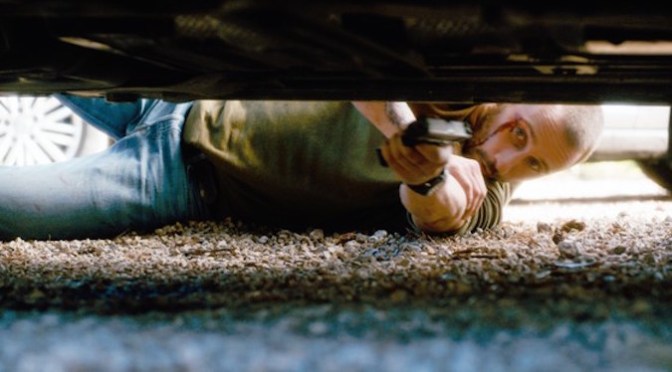



 Motion State Review