Category Archives: Featured

The Man from U.N.C.L.E. (2015)

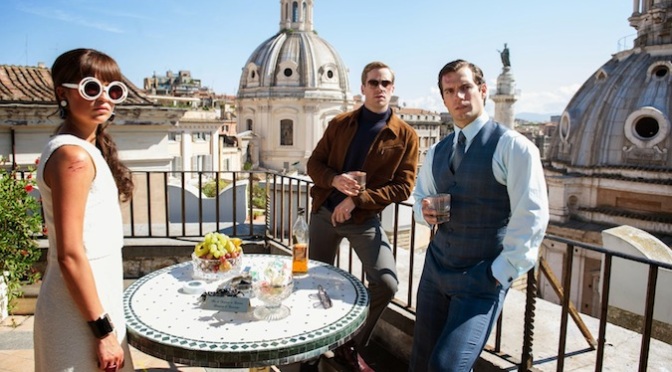
It’s fairly easy to spot a Guy Ritchie flick, and in his most recent movie The Man from U.N.C.L.E. a few of his trademark flourishes find their best use yet. Henry Cavill and Armie Hammer fill the suits first worn by Robert Vaughn and David McCallum in the ’60s television show and globetrot around the Mediterranean attempting to out-spy one another. There are three or four plots going on at once — one’s a crusade to stop a maniacal heiress from obtaining a nuclear weapon, one’s a love story, one’s a hopeful reunification of father and daughter —and so Ritchie’s penchant for hand-holding and retreading ground we’ve already covered is actually quite useful at times.

Mostly, though, the moderately bogged-down plot is just kind of there; the style, the mood, the unending suaveness of the two leads — that’s really what counts in Ritchie’s Man from U.N.C.L.E. There are some slick sequences that don’t make you forget the plot but make you simply not care about it, sequences that lose you, purposefully and gleefully, in the zippy catchiness of it all. There are some slow bits and, again, the retreading of information gets tedious as it does in other habitual instances throughout Ritchie’s filmography. But mostly this movie is all about the flow, and even if the scene-by-scene progression isn’t flawless the pacing within the scenes themselves is fantastic.

Continue reading The Man from U.N.C.L.E. (2015)

Adventureland (2009)

Adventureland represents everything I pray my first months as a college graduate do not include, although worse things than bro-ing out with Ryan Reynolds and having Kristen Stewart fall madly in love me could go down.

Jesse Eisenberg, the unexpected hero of Adventureland (expected hero, really) portrays a less asshole-ish version of his Mark Zuckerberg in The Social Network, pulling out all the nerdy stops, including but not limited to: an immensely awkward and unfailing stammer when speaking to any remotely attractive woman, a less-than-flattering Jew-fro, and a borderline translucent complexion (admittedly much like my own).  Kristen Stewart is…well, Kristen Stewart, bringing the exact same mannerisms and monotone speech that she brings to every other film she’s been in. Last but not least, Ryan Reynolds plays the classic douche.  Did I mention that Adventureland takes place in the ’80s?

Continue reading Adventureland (2009)

Beginners (2010)

Is Ewan McGregor just awesome, or what?  He truly brings his A-game to every role, and he refuses to shy away from anything, whether it seems too “out-there” or taboo or even if it seems like a risky film that could damage his career if it fails.  I love this about him; I respect this about him.  In a recent interview promoting the recent latest blockbuster Focus, Will Smith spoke about his career and said that in previous years, he had been overly concerned with making sure that his movies were hugely popular and that they made a lot of money.  If they weren’t, he felt like he had failed.  Now, he has let go of this obsessive, limiting mindset and has decided that he is more interested in creating.  The beauty of the art of acting, of exploring the human mind by diving into and becoming someone other than yourself is his newfound passion.  I think it is evident that Ewan McGregor shares this passion.  Examining the list of characters he has played, I believe it must be that he delves into the bodies and minds of these vastly different people because he is unsure who he is himself.  I tend to really enjoy watching films with actors who I see this in; Beginners is one of them.

Beginners is really a simple film. The film takes place over three distinct time periods and flips back and forth between them, but this is not confusing, nor meant to be, and there are no grand action sequences or diabolical twists.  This film is simple, it’s about people, it’s about life and everything, every emotion rather, that comes with it.  We see sadness and happiness, of course.  We see sympathy and confusion, we see love.  We see it all.  Yet, this is still a simple film.  There are a hand-full of characters, mostly quite likable, and we get to watch their lives as they are for about a month. Oliver (McGregor) has been through a bit of a rough patch: he lost his mother to cancer; immediately after, his father tells him he is gay; he watches him fall in love with a younger man; and then he watches his father, too, die of cancer.  Oliver does not struggle with coming to terms with the fact that his dad is gay, but with the idea that his childhood was a ruse, a lie, it occurred under false pretenses.  Oliver struggles not with the fact that his dad loves a man, but that his dad loves any person other than his mom.  To make matter worse, he is hurt by seeing his father loving a man his own age and feeling as though his father loves this man more than he loves him.

Continue reading Beginners (2010)

Inception (2010)

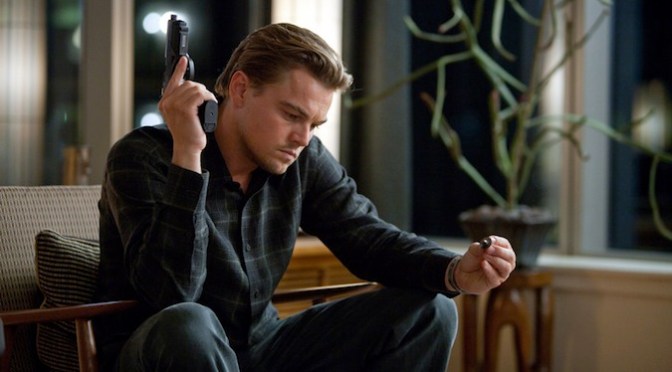
Inception. Five years after seeing the 2010 Nolan mega-hit in theaters, I still asked myself whether or not the top stopped spinning. For a long time, I couldn’t accept the fact that one of the most ingeniously crafted movies of all time would end so ambiguously. There had to be something else there, some other hint to what is really going on at the end.

After some time, however, I grew complacent and rested on logic. Having seen the movie dozens of times, I saw little that pointed towards Cobb (Leonardo DiCaprio) still being in a dream at the end. Moreover, the top is clearly wobbling, and, generally, tops, like dreams, do not regain stability after they start to collapse.

Continue reading Inception (2010)

Focus (2015)

There was a time when I’d never met a movie about con artists that I didn’t like. You name it: the almighty Sting, the classic you-didn’t-even-know-this-was-a-con Usual Suspects, George C. Scott’s The Flim-Flam Man; modern takes like Matchstick Men, Catch Me If You Can, American Hustle; the super-rewatchable original Italian Job and the super-rewatchable remake Ocean’s Eleven. Some of these — like, say, The Spanish Prisoner — technically aren’t that great as far as cinema is concerned. Maybe that’s part of what’s so damn endearing about them: they’re movies, not films, which means they could conceivably appeal to just about anyone because style and fun outweigh technique and competence. I think I was just fine with that for a while, and I might still be.

But I also remember taking issue with Christopher Nolan (you: “who the hell are you to challenge Christopher Nolan?”; me: “I have as many Oscars as he does“) when he made the following comment about heist movies in an LA Times interview while filming Inception:

I originally wrote [Inception] as a heist movie, and heist movies traditionally are very deliberately superficial in emotional terms…they’re frivolous and glamorous, and there’s a sort of gloss and fun to it. I originally tried to write it that way, but when I came back to it I realized that — to me — that didn’t work for a film that relies so heavily on the idea of the interior state, the idea of dream and memory. I realized I needed to raise the emotional stakes.

Continue reading Focus (2015)

Inside Out (2015)

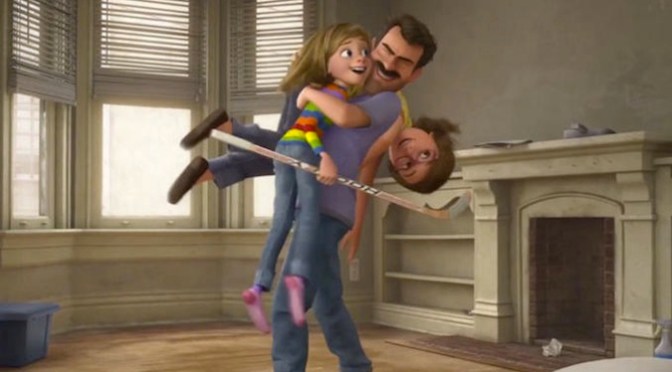
Pixar’s most recent creation, Inside Out, is not a children’s movie as it is advertised to be. The animation and young protagonist, Riley (Kaitlyn Dias), may suggest that the movie is for the ten and under crowd, but it most certainly is a movie that is better suited for an older audience. Now, this is not just a long-winded attempt at justifying the fact that I sat in a theater crowded with six-year olds to see this movie; it is a credit to Pixar for their ability to disguise an emotionally complex and subtly humorous film as a children’s movie. They have wisely used this model several times over, which has led to their vast success. Inside Out, even more so than other Pixar films, is able to not only entertain kids, parents, and everyone in between (or just me in between), but also provide a powerful message about the power and role of emotions.

It is no coincidence that Inside Out is a movie entirely about emotions, mostly centered on Joy (Amy Poehler) and Sadness (Phyllis Smith) because throughout the movie, at least the older portion of the audience goes on a journey of emotion as well, mostly between joy and sadness. As the protagonist Riley tries to adjust to her new life after moving from the comfort of her Minnesota home to San Francisco, we see how she and her emotions (Joy, Sadness, Fear, Anger, and Disgust) handle the transition.

Continue reading Inside Out (2015)

Goodfellas (1990)

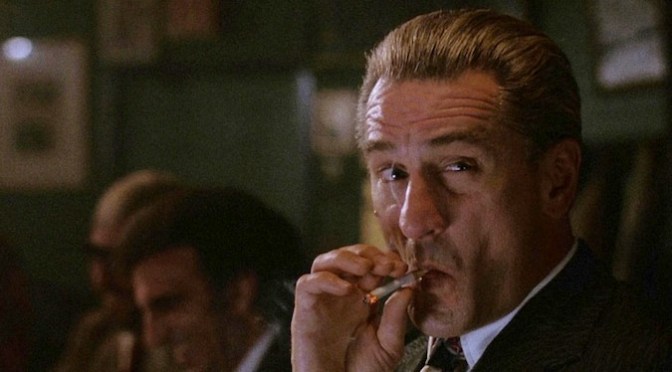
What’s your favorite shot from Goodfellas? I know, I know. It’s like asking which of your children you love the most. The sheer rewatchability of the seminal mafia film is largely due to the intimate composition of each shot, the flow of one into the next, the exhilarating pace of it all. Goodfellas arguably has more flashy camerawork than any other Martin Scorsese film, but it never feels out of place or discordant with the story. It helped that the Director of Photography was the legendary Michael Ballhaus, a cinematographer who worked frequently with Scorsese. In fact, it helped that pretty much everyone on the production was at the top of their game.

So the time has come: the pick of the litter, the crème de la crème, the nonpareil of Goodfellas shots. There’s the slow-mo Tommy Gun shot, the red-lit trunk shot, the explosion as Young Henry dashes into the foreground. There’s The One Where Samuel L. Jackson’s Stacks Gets Shot Out of Nowhere. Guns are pointed directly at the camera twice, and either time could qualify for short odds in this cinematography round robin.

Goodfellas (1990)
Goodfellas (1990)
Goodfellas (1990)
Goodfellas (1990)

There’s the Vertigo shot, one of the more drawn-out examples of Alfred Hitchcock’s famous camera trick:

Continue reading Goodfellas (1990)

Don’t Look Now (1973)

1973 was a hell of a year at the movies. Bruce Lee kicked ass in Enter the Dragon, Roger Moore debuted as Bond in Live and Let Die, and smalltown California got its romantic due in American Graffiti. There was Sydney Pollack‘s The Way We Were, Sam Peckinpah‘s Pat Garrett and Billy the Kid, Robert Altman‘s The Long Goodbye. Martin Scorsese and Terrence Malick announced themselves as filmmakers to be reckoned with upon the respective releases of Mean Streets and Badlands, and Michael Crichton made cinematic history with technological advances in Westworld. Then there’s The Sting, which I’m always willing to defend in a battle to the death as Greatest Film Ever. But these are more than just great movies — these are unique and fresh-seeming efforts, influential to this day because they all pushed the envelope.

And though the horror genre received more than a few landmark films that year — The Exorcist, The Wicker Man, etc. — Nicholas Roeg’s grief-stricken terror Don’t Look Now might be the scariest. It’s certainly the most engrossing. Envelope-pushing apparently wouldn’t cut it for Roeg and Company, as the incredibly intense Venice-set thriller does more to explode the envelope into a zillion tiny bloodstained pieces. The story follows John and Laura Baxter (Donald Sutherland and Julie Christie) in the months following the accidental drowning of their daughter Christine. Paralyzed by anguish, the couple retreat to Venice. Soon, they encounter a pair of women claiming to have a connection to the deceased Christine.

Continue reading Don’t Look Now (1973)

Manglehorn (2014)

Discovered an alternate universe the other day. Stumbled upon it by accident, stayed for a while to check it out. Pretty weird. Their eggs and ham are green and Transformers: Age of Extinction won Best Picture. Hoverboards are the primary mode of travel, everyone’s wearing Air McFlys. Don’t know why, but strong suspicion that George Bailey never existed. Can’t tell which universe is good and which is evil. Met their film director David Gordon Green and discovered him to be a talentless hack who sold out after making a few good movies and now just makes big budget stuff. He did the Oscar-winning Transformers. They’ve him to thank for those Batman/Terminator crossover movies and can look forward to his upcoming Star Wars anthology film R2-D2 Rises. In their universe David Gordon Green also directed Pineapple Express and Your Highness and The Sitter…ah, no, wait, that’s ours.

Thankfully, our David Gordon Green turned away from the big budget stuff in order to make movies like Manglehorn. While Bizarro DGG turned to the dark side and never came back, the chunk of studio comedies characterized by Pineapple ExpressYour Highness and The Sitter just seems like a temporary detour in our world. Even if you liked those flicks, the point stands that Green’s career has followed one of the more unpredictable paths you’re likely to find on any Hollywood résumé. His first several features were intimate character dramas, beginning with the phenomenal coming-of-age tale George Washington. Most were well-received and all were small-scale, independent features. Understandable, then, that when three green things converged — money, weed, and David Gordon — and resulted in Pineapple Express, more than a few eyebrows headed north.

Continue reading Manglehorn (2014)

Blue Ruin (2013)

First of all, I would like to note that I constantly find myself referring to this movie as “Blue Ribbon.” Thanks, college.

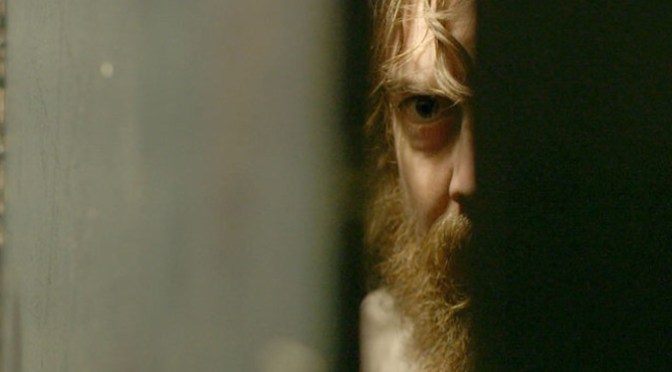
Blue Ruin…HOLY F@#K!! I had heard about this movie maybe a year or so ago, and seeing that it garnered an impressive 96 percent Freshness rating on Rotten Tomatoes, I quickly hopped over to my IMDb app to put it on my Watchlist.  I must regrettably say that I wasted that year or so of my life not watching this movie.

I thought: Ok, so this is a smaller, independent film, I don’t see any actors I really know on the cast list, nor am I familiar with the director, Jeremy Saulnier (who to this day has only helmed three features); it has to be at least decent given the reviews, and the plot looks kinda cool.  I was expecting a slower movie, that built and built to an awesome, explosive climatic conclusion. That seems to be the way most well-received indie action flicks go, right?  Well, maybe. But not Blue Ruin. Not in the slightest.

Continue reading Blue Ruin (2013)