Category Archives: Film Review

Constantine (2005)

Like it or not, the 2016 presidential election is already one for the books. On the Democratic side we have an ex-First Lady and a septuagenarian leading a whiny guy from Baltimore for the nomination; the GOP, meanwhile, having been essentially co-opted by a real estate mogul, is among others asserting a guy who literally read Green Eggs and Ham aloud on the Senate floor. For President. Of the United States.

It’s all Trump all the time, of course, primarily because of the fact that he’s an absolute firecracker and partially because of the fact that we’re all pretty much mortified that he might actually win (having the benefit of time travel, we already know he does). This past weekend The Boston Globe ran a great article about Trump’s forerunners, detailing a collection of figures who for all intents and purposes were Trump before Trump was Trump. Ironically, the point raised here is that Trump’s freshness, his standout vigor, and the anti-establishment rhetoric on which he’s built his entire campaign are in fact already storied installments in the annals of American politics. It’s history repeating itself while the guy at center stage harps about how everything he’s doing has never been done before.

Continue reading Constantine (2005)

Jailbreakers (1994)

You know Frank Miller, right? The comic book guy. No, you’re thinking of Alan Moore. Yeah, that’s right, the 300 guy. He’s done other stuff, though, far better stuff, like Sin City and Ronin and a fantastic run on Daredevil. He did the Daredevil book Born Again and the Batman books The Dark Knight Returns and Year One, all of which might legally be deemed works of genius. For a while he was one of the masters. Then, as so often happens with young artists who garner those labels — “genius” and “master” — Miller produced a string of decidedly less-than-masterful works that included the lukewarm Returns sequel The Dark Knight Strikes Again and another Batman book called All-Star Batman and Robin the Boy Wonder; the latter is largely derided for the portrayal of Batman as a psychotic child-abuser, which is a new one. There are a few more stinkers, but they all get the pass in comparison to Miller’s latest book (ahem, “book”): Holy Terror. This is a story (ahem, “story”) so undercooked that it makes one wonder if Miller forgot to turn the oven on altogether. It’s somehow impossibly offensive and impossibly dull at the same time. Holy Terror is without a doubt Frank Miller’s most abominable creation, and unfortunately that’s saying something.

William Friedkin isn’t exactly the Frank Miller of film, but if he was, Jailbreakers would be his Holy Terror. The fact is that the Frank Miller of film is Frank Miller himself, who helmed his Sin City in 2005 and followed it with the increasingly awful The Spirit and Sin City: A Dame to Kill For. But Friedkin, for a time, had a career in cinema that seemed to be following the hugely disappointing formula that Miller’s laid in comics. For an exhaustive breakdown of the early struggle, the well-earned rise, the questionable fall, the lull, and the eventual redemption of the director known as William Friedkin, I highly recommend this piece by Dissolve‘s Noel Murray. In fact, Dissolve‘s entire Career View column is highly recommended. In fact, Dissolve‘s entire catalog is highly recommended.

Continue reading Jailbreakers (1994)

Underworld: Rise of the Lycans (2009)

When there’s a vampire around, odds are a werewolf isn’t far away. In the last couple decades movies concerned with the bloodsucking creatures of the night — Twilight, Van Helsing, even What We Do in the Shadows — seem inevitably concerned also with slightly hairier, howlier creatures. They’re never equally concerned with werewolves, though, casting them consistently in cameos for pure shock value, and so the conceit of the third Underworld film Rise of the Lycans is a smart one: give the werewolves their due.

The result is by no means a good movie, unless you’re somehow enraptured by the Underworld series. If you’re not, then you might refer to Rise of the Lycans as The One Without Kate Beckinsale, which is a large part of the film’s undoing in the same way the new Independence Day could essentially be subtitled The One Without Will Smith. The bitch of it all is that Michael Sheen, starring as head were-dude Lucian, is a far better actor than Beckinsale will likely ever be. He’s a Shakespearian tragedian, she’s an action hero. Underworld, of course, actually needs the latter, and sadly Michael Sheen just isn’t an action hero. His head’s too big. He’s got the biceps, sure, but everyone has the biceps these days. Have you guys seen Jonathan Lipnicki lately? Sheen is somehow more naturally proportional in his werewolf form than as a regular human. Maybe they should have CGI’d his forehead down.

Continue reading Underworld: Rise of the Lycans (2009)

Batman (1943)

It can be pretty hard to compare one Batman to another Batman. The points of similarity between the super-campy Adam West iteration, the super-rubber Michael Keaton iteration, and the super-dark Christian Bale iteration essentially begin and end with the pointy ears. Val Kilmer and George Clooney are both sleepwalking through their outings, so there’s that. Ben Affleck’s latest incarnation in Batman v. Superman: Dawn of Justice looks to change it up yet again, providing a more world-weary Dark Knight Rises spin on the superhero. Surely the longevity of the character is the major contributing factor to the gradual shifts in tone, as with goofy/serious Bond and goofy/serious Sherlock, and it’s true of the Caped Crusader in the comics as well.

We talked about all of that in our review of Batman Returns, but it’s far more obvious when we go all the way back to the 1943 serial Batman. “Batman and Robin” wasn’t at all a part of the cultural lexicon at this point. The character had only just appeared in 1939, largely as a response to the popularity of counterpart Superman, and so the 1943 theater release of the 3.5-hour marathon serial was for many the very first encounter with Batman. More importantly, 1943 was arguably the height of World War II, meaning that a solid 85% of theatrically-released serials felt compelled to include a strong commentary on nationalistic duty and American pride. Batman was no different. Watch it today and you might find yourself using different descriptors, those being really really racist.

Continue reading Batman (1943)

Anomalisa (2015)

Rather than going out and partying or hanging out with friends as most teenagers do on Friday nights, I instead chose to have an existential nightmare by watching the latest film from writer/director Charlie Kaufman: Anomalisa.

You may recognize Kaufman as the writer of such films as Spike Jonze’s Adaptation. and Being John Malkovich. Kaufman also wrote the much beloved Eternal Sunshine of the Spotless Mind and directed the incredibly complex and possibly genius film Synecdoche, New York. If you’re interested in reading some more thoughts on Kaufman’s works, there’s a wonderful writer series here on Motion State. To say the least, in this very impressive filmography Charlie Kaufman has built for himself, Anomalisa stands out as both incredibly unique and right at home.

Anomalisa is about a man named Michael Stone, played by David Thewlis. Michael is a corporate spokesperson known for writing books on customer service. Many people look up to Michael and the way he is able to look at the world, but beneath that exterior, he is actually struggling deeply with problems in his personal life and what he deems “psychological problems”. When people talk, Michael simply hears the same bland voice over and over. One evening in his hotel room, Michael is practicing delivering a speech he is scheduled to give the next day and attempting to infuse it with the sincerity that he obviously lacks. Just outside, he hears the voice of a beautiful young woman named Lisa, played by Jennifer Jason Leigh. Michael is instantly mesmerized by her and is determined to make Lisa a part of his life.

Continue reading Anomalisa (2015)

The Hateful Eight (2015)

Hey — it’s Christmas! Let’s go to the movies. Slug some hot chocolate, throw on your wool hat, follow the colored lights strung from tree to tree on the citywide commons to the movie theater or the cinema or the multiplex or whatever you call it in your neck of the woods. I’ll get the tickets, you get the popcorn. What do you want to see? It’s Christmas, remember, so we need something that will encourage our merriment and warm up our capacity for joy. That disqualifies The Revenant. What about Star Wars for the fifth time? What do you mean you saw it again this morning? Why didn’t you invite me? Whatever, just go get the popcorn.

Here we go: a new Tarantino movie. One would think that a brand spankin’ new flick from Tarantino would, if nothing else, be entertaining. It’s Tarantino. This is the diabolical purveyor of histrionic, action-packed jaunts that bleed style and ooze cool, of movies that have banging soundtracks and automatically generate an Academy Award for Christoph Waltz. This is the director that champions violence in film as fun, responding to the masses that claim violence in film is a potentially toxic influence on viewers with a beautifully composed shot of red blood spewing out of a newly-severed neck. Take that! The violence-is-bad point always reminds me of part of the testimony of famed censorship bogeyman William Gaines during the 1954 hearings on the validity of the violent comic books he produced: “Do we think our children are so evil, so simpleminded, that it takes a story of murder to set them to murder, a story of robbery to set them to robbery?” I picture Tarantino saying that, only with a lot more gesticulation and overeagerness and a lot of “alright, you know, okay?” and a lot of averted glances.

Continue reading The Hateful Eight (2015)

The Revenant (2015)

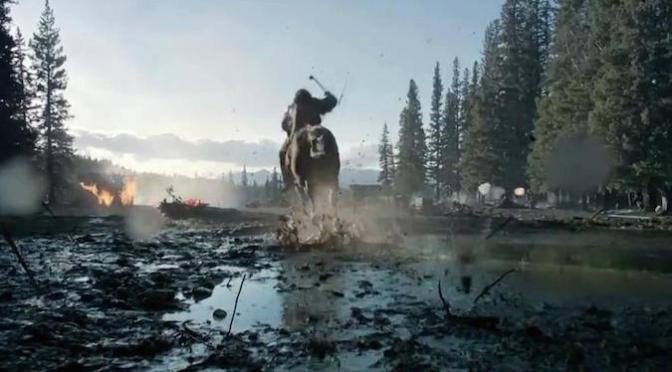
It’s fitting that The Revenant pushes the limits of film, ceasing mercifully only just before breaking, because that’s exactly what happens to Hugh Glass. If you’re one of the people behind the film, crafting it, then you have to push the limit: you’re Alejandro Iñárritu or Emmanuel Lubezki, coming off the exquisite Birdman and arguably at the height of your career, seemingly happy to be shouldered with the weight of expectation or otherwise just left with no choice. If you’re one of the people in front of the film, watching it, you want it to push the limit: if you’re watching The Revenant in the first place, you’re likely quite certain that you’re in for a challenging watch and not a brain-switched-off actioner.

But if you’re one of the people inside the film, acting in it, living it, then being pushed to the limit means actually being pushed to the limit. Throughout 2015 stories of the extremely arduous on-location filming of Revenant trickled down from that remote region of Alberta, from the torrential rains of British Columbia, from the freezing southernmost tip of Argentina. Ten people quit or were fired during production. In July Hollywood Reporter ran an article about the brutal conditions on set, prompting more and more questions about the safety precautions and the direction of the film. Blurbs from Leonardo DiCaprio, Tom Hardy, and the rest of the cast make The Revenant shoot sound more life-threatening than that of Apocalypse Now or Fitzcarraldo; Iñárritu himself has since taken to referring to the cast and crew as “survivors”.

Continue reading The Revenant (2015)

Nostalghia (1983)

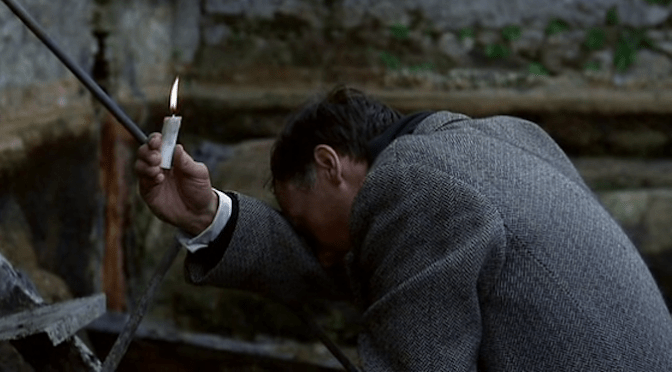
A Russian man named Andrei is in Tuscany. Not the beautiful sunny Tuscany we’re used to seeing, but a foggy and rainy one. He is holding a candle, attempting to carry it from one end of a drained pool to the other. In an astounding nine minute long lateral tracking shot, we see his struggle. He doesn’t get too far in his first attempt, and slowly walks back to the beginning of the pool, going to start again. He starts once more. He makes it a little further, attempting to shield the lit candle from the wind. He fails once again, although he’s made it a bit farther. On this third attempt, Andrei is devoting everything he has to keeping this candle lit. On his face is a look of intense concentration, shielding the candle with his coat and acting as if his life depends on this moment. Finally he makes it. He approaches the other side of the pool, and with every step closer, he struggles more. His legs become weak, sweat is on his brow. He carefully sets this lit candle down onto the side of the pool, and promptly dies. This is the final scene of Andrei Tarkovsky’s Nostalghia. What does this mean? What could it possibly symbolize about our character and his journey? Well, probably nothing if you’re to take the words of the film’s director into account.

Andrei Tarkovsky is widely considered to be one of the greatest filmmakers to ever live. He was hailed by Swedish film maestro Ingmar Bergman as “the most important director of our time.” His movies are rife with incredible imagery and beautiful storytelling. However, one unique characteristic that separates Tarkovsky from most storytellers is his aversion to symbols and symbolism in his films. Tarkovsky disliked the idea and believed it could ruin the composition of a scene and create a distraction for the audience. This is, by all means, a pretty unusual viewpoint. Symbolism has been an incredibly important part of almost all art since words were first put down to tell a story. So why did Tarkovsky think it was so harmful, and how does it relate to his own work and perhaps other films?

Continue reading Nostalghia (1983)

Tangerine (2015)

We’ve all been there before: it’s Christmas Eve and you’ve just been released from jail to discover your pimp has been cheating on you so you flip out and hunt him down. It’s a pretty universal conundrum. That was what Pilgrim’s Progress was about, right? Or doesn’t Plato have some allegorical yarn about emerging from a darkened prison, reaching upward toward the light, finally beginning to perceive the true form of reality, and then bitch-slapping your pimp? The Parable of the Donut Shop, I think. Basic universal plots like Rags to Riches, Voyage and Return, The Quest, and Christmas Eve Pimp Hunting have a certain inherent comfort to them because we’ve all been there before.

Tangerine is fresh, though, even if you somehow don’t have a real-life parallel to the above scenario. I’d love to tell you that the freshest thing about it is the story, and admittedly broad aspects of it are rare in modern multiplexes. The primary cast members are transgender and transsexual individuals, led by Kitana Kiki Rodriguez (as Sin-Dee Rella, the newly-freed pimp-hunter) and Mya Taylor (as Alexandra, the Sundance Kid to Sin-Dee’s Butch Cassidy); the film is rounded out by Karren Karagulian’s Razmik, a cabbie with a penchant for rolling the streets where working girls Sin-Dee and Alexandra “ply their trade”. These aren’t your typical heroes, and that sentiment has little to do with their sexuality or gender. These people are the kinds of people that mothers-in-law everywhere are disgusted by, because the activities they engage in seem supremely self-serving, petty, deviant, etc. Indeed, Razmik’s mother-in-law makes all of this explicit when she shows up and harshly disapproves of what she sees.

Continue reading Tangerine (2015)

Face Off: Flight of the Phoenix (1965) and Flight of the Phoenix (2004)

Motion State Face Offs pit two films, franchises, or television series against each another for no reason other than because we can.

The original Flight of the Phoenix is sort of an unsung classic. Sure, people still watch it a half-century later, catch it on TCM, and it was at least popular enough for somebody to remake it in 2004. But take even just a quick look at the incredible  cast and try to tell me Flight of the Phoenix has the popularity it deserves today. Jimmy Stewart! Richard Attenborough! Ernest Borgnine! Peter Finch! George Kennedy! Ian Bannen, for chrissake! It’s the ensemble equivalent of Age of Ultron except all of the actors are good and are playing characters instead of cardboard cutouts.

Here’s the trouble: in terms of plot, the 2004 remake is one of the most faithful remakes ever remade. It’s nearly beat-for-beat as far as the major story points are concerned, and even some of the lines of dialogue propelling those story points are simply lifted from the original and plopped back down here. Sure, new people are saying those lines and being influenced by those story points — but then again it’s just the actors that are new, not the characters. Those, too, are transplanted in near-entirety. One imagines an archeological expedition to the bowels of the 20th Century Fox studio costume shop under a banner that says Let’s See What We Can See emerging victorious with the costumes and props from the 1965 Flight of the Phoenix still covered in authentic desert sand. “Now all we need is new people!”

Continue reading Face Off: Flight of the Phoenix (1965) and Flight of the Phoenix (2004)