Category Archives: Film Review

Before Sunrise (1995)

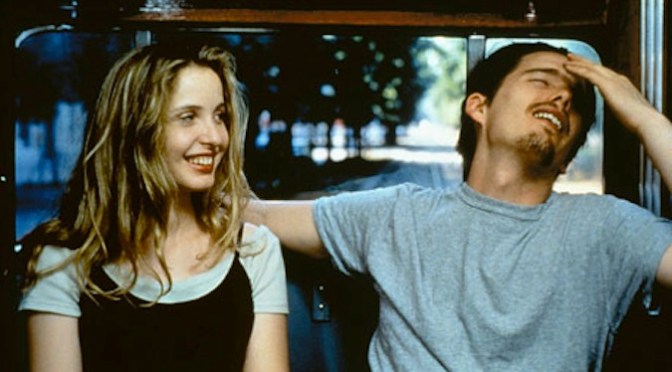
The first installment in Richard Linklater’s acclaimed “Before” trilogy, Before Sunrise is one of the most uniquely structured films in recent memory. Entirely dialogue based, the film discusses important social issues with great depth while examining the nature of a newly formed romantic relationship. Although Before Sunrise is masterfully written, acted and shot, there is no real plot; nothing really happens. Both Ethan Hawke and Julie Delpy turn in exceptional performances that demand close attention, and yet all their characters do throughout the film is walk around Vienna and talk about life. Linklater’s aim here is not to make greatest film ever made, as one might assume is the aim of many directors embarking upon a new project. It is meant to be a simple film, a small film with a small scope. It is short and it is brilliant in its own right.

The only two real characters in the film, Jesse (Hawke) and Celine (Delpy) are total strangers that meet on a train and subsequently fall in love. The film is somewhat inspiring as a result. This detail of the film speaks to the spontaneity of love, the romance of romance, so to speak. Once the two get to talking, the film takes off. Their discussion covers the innate differences between men and women and the good and bad aspects of American and French society and everything in between. The dialogue is serious and provocative at times and humorous at others, and Hawke and Delpy’s performances are smooth and keep it realistic, despite the remarkable intelligence and obvious care put into the writing. A fantastic, stand-out moment comes in Jesse and Celine’s pretend phone calls to their friends back home, in which they reveal their thoughts about and feelings toward each other. Another comes when Jesse asks Celine to get off the train with him. This moment almost becomes a cheesy, cliche rom-com-esque scene, but Jesse’s actually quite intelligent reasoning for why Celine should oblige him makes it truly enjoyable to watch.

Continue reading Before Sunrise (1995)

Boyhood (2014)

This is Boyhood. This is right now. This is no ancient Greek tragedy; there is no intricate or precise or necessarily coherent plot structure. What this film is all about is in the title: Boyhood is the narrative of a young man growing up in a difficult and harsh world. This film will make you laugh hysterically, and it will make you cry. Watch this film alone for the first time. That way, you can let yourself truly feel it. That’s important, because this is more than a movie. This is a therapeutic exercise.

It is possible that I am partial to Richard Linklater’s film because: one, I am a boy; two, I share some of the same experiences that Mason (Ellar Coltrane) has had. I know what it is like to have divorced parents, and I know what it is like to see my mom cry. I know what it is like to be bullied and I, too, have often wondered why the world has to suck so much. Many of us have. Many more will. That is why this film is so truthfully beautiful. It captures such incredible, emotional aspects of human life and brings you back in time to the moments in your own life that are relatable to what is going on in the film. I cannot even begin to think of another film that has brought me so close to tears so many times. Boyhood is able to give its audience that inexplicable Dead Poets Society vibe. Just that feeling that makes the film relevant to life in such an actual and immediate way. This is the type of film that leaves you unsure what there is to do next. When you decide to sit down and watch this film, you effectively decide to spend the next three hours completely and totally immersed in and consumed by the universe of Boyhood.

Continue reading Boyhood (2014)

Hero’s Island (1962)

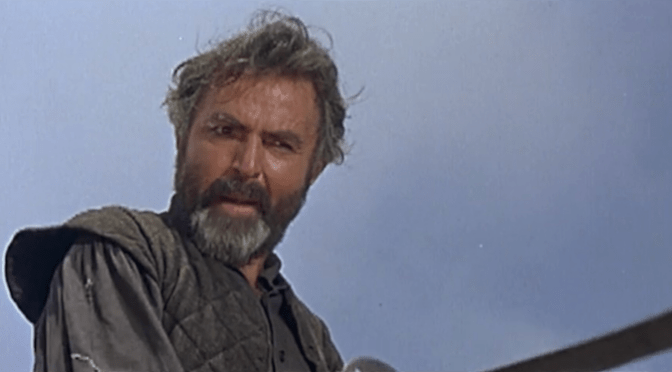
Long before James Mason was cast in the role of Stodgy Old Man in every movie ever, he once played Young Hunk in Hero’s Island. This somehow has nothing to do with his age – Mason was 53 when he played the island-bound Jacob Weber, which is far older than today’s Young Hunk standards – and instead has everything to do with Mason being one hell of an actor. In fact, he appeared as Humbert Humbert in Kubrick’s Lolita in the same year, a role which definitely leans more toward Stodgy Old Man than toward Young Hunk. One can imagine a remake of Hero’s Island casting Chris Hemsworth or Chris Evans or Chris Pratt – basically any of the Marvel Superhero Chrises – in the role of the brawny Jacob, sandy hair and strategically tattered shirt and all. This would be an entirely different kind of film (Superhero’s Island) because Mason’s Jacob is hunky, sure – but is he a hero?

Set on Bull Island in 1719, we meet the Mainwaring Family as they arrive on their new waterlocked home. The deed in Father Mainwaring’s hand entitles him to ownership of Bull Island, but standing on the dirt for the first time he states with a sense of wonder that “it doesn’t feel that I own this”. Ownership, of course, is entirely a matter of opinion – and in the opinion of the fisherman who’ve lounged around the island for years, the “right” of the Mainwaring Family’s presence is no right at all. They’re essentially Crusoe’s savages in the context of Hero’s Island, though their depiction in the opening scenes hews closer to this comparison than their actual function once the film is fully fleshed out. One of the first things the Mainwaring Family sees to is the construction of a large cross, which they kneel and pray in front of once it stands tall. The “savage” fisherman watch from afar, and before we hear them say anything more than a few words we see them bless themselves with the sign of the cross upon seeing the Christian symbol rising from their dirt.

Continue reading Hero’s Island (1962)

The Dark Valley (2014)

Aside from the title, the majority of Andreas Prochaska’s The Dark Valley is refreshingly original in the way it tackles a familiar story. Perhaps Das finstere Tal, the Austrian title, makes more sense in native tongue and context – but if you don’t care to brush up on your Austrian beforehand The Dark Valley is still to be enjoyed. Prochaska’s resume shows he’s been fairly prolific over the past few years, but most of his projects are horror flicks or TV shows. The Dark Valley looks to be his most mature feature effort thus far.

Sam Riley stars as the lone drifter Greider, largely the strong and silent type, recently arrived at a remote snowbound village high in the Alps. The aforementioned “familiar story” is really just that: mysterious stranger arrives in otherwise comfortable close-knit town, people become uncomfortable; secrets exist for the townsfolk and for the drifter, said secrets are exposed; drifter and young woman flirt with obligatory fling; things seem okay for a while until suddenly, one day, shit hits the fan. These by-the-numbers plot points are most at home in a Western, which is a genre that The Dark Valley is now a part of in spite of the snowy mountain setting (though, agreed, not technically a Western in the American sense – so, an Eastern?), but that familiarity is never crippling. As much as The Dark Valley resembles Once Upon a Time in the West on paper, it’s a starkly different kind of movie.

Continue reading The Dark Valley (2014)

Batman Begins (2005)

Most of the comic book influences on Batman Begins are fairly evident. Everyone points to Frank Miller’s Year One, the redefining four-part series that put the “Dark” back in Dark Knight, and they’re right to hold that book up as the major influence. Begins relies heavily on Year One for a number of things, not least among them the exploration of the Bruce Wayne/Jim Gordon relationship, the exploration of the Bruce Wayne/Alfred relationship, the Gotham Monorail, the mention of the Joker at the end, the entire character of Flass, the entire sequence where Batman calls a squadron of bats to his aid (a bat-talion, am I right? Guys?) and, of course, the entire bat-flies-through-window genesis of the hero himself.

So Year One is the obvious one. Nolan and David Goyer pilfered little things from other famous Bat-books as well, often just an image or a line of dialogue. Here’s the Scarecrow in Loeb and Sale’s The Long Halloween, another popular arc:

Long Halloween
The Long Halloween (1996/97)

Goyer brought this to Nolan and said “I think Katie Holmes and the little kid who will eventually grow up to be Joffrey from Game of Thrones would look really good if we added them in front of the horse here” (paraphrased) and Nolan said “true dat, brah” (not paraphrased) and ran with it:

Batman Begins (2005)

The red eyes and flames are an admittedly nice touch.

Continue reading Batman Begins (2005)

Indiana Jones and the Kingdom of the Crystal Skull (2008)

Indiana Jones and the Kingdom of the Crystal Skull has no shortage of detractors. Whenever a beloved film or film series receives a new treatment or installment, most people – myself included – are bound to vocalize their qualms. We said why can’t they leave well enough alone? We said why does everything have to be CGI? With the fourth Indy flick, we said a whole bunch of stuff that shouldn’t be reprinted. So yeah: Crystal Skull is the weakest Indiana Jones for a few reasons. But let’s find something nice to say about it for a change, shall we?

Harrison Ford returns to one of his most famous characters after a quarter-century hiatus (he appeared in one or two movies in the meantime) and most of the old crew returns with him: Steven Spielberg directs from a story by George Lucas, composer John Williams scores the film, and Karen Allen revives the role of Marion Ravenwood. Cate Blanchett plays (ahem, overplays) the primary antagonist Dr. Irina Spalko, and the best things about her are her hair and her name. Among the other new additions to the Indy legend is the consistent use of CGI, which was used sparingly in the first three adventure films in favor of practical effects. It feels at times as if somebody wanted to cram as many CG shots into this thing as possible, and many of those instances are very unfortunately unconvincing. Also: aliens.

Continue reading Indiana Jones and the Kingdom of the Crystal Skull (2008)

The Spanish Prisoner (1997)

Most everybody loves a good con movie. While the thrill of the illegality of it all – the curiosities, the impossibilities, the big reveal – is ostensibly what makes heist flicks appealing, the fact that everything about the crime subgenre seems so damn stylish is probably more of a reason to keep making films about con artists (and more of a reason to keep watching them). The Sting remains the ultimate con movie, super stylish from start to finish, and everything that followed owes a great deal to that film. But even recent takes like Inception and American Hustle breathe new life into the idea by inhabiting a distinct aesthetic niche.

This is taking the long way around the barn to say that David Mamet’s The Spanish Prisoner, through it is very much a part of the aforementioned genre, is a surprisingly and suspiciously unstylish little film. It’s extremely well-written, as is almost everything Mamet touches, but it’s noticeably devoid of any of the visual trickery or larger-than-life characters that we might expect. This isn’t necessarily a bad thing, but it does mean that The Spanish Prisoner promises a lot in the first act and doesn’t quite deliver on that promise when all is said and done.

Continue reading The Spanish Prisoner (1997)

Legends of the Fall (1994)

A defense of Legends of the Fall? Really? Is this really what the world needs? Shouldn’t this space be used for something more worthwhile, like an examination of Renée Zellweger’s face? Is a treatise on Battlefield Earth up next? Lest there be any doubt: Legends of the Fall is a deeply, deeply flawed movie full of stiff writing, stiff acting, and a healthy dose of that cringeworthy unexplainable badness reserved for a particular class of film (though, no, not as bad as Battlefield Earth). It’s unbearably soapy, it’s long, and we’re expected to take ridiculously sappy scenes like this with utter seriousness:

Ah, man hugs. Can we ignore stuff like this? Should we? Maybe not. But still, somehow, inexplicably, in spite of stiff writing, stiff acting, unbearable soapiness, absurd sequences like the one above – in spite of all that, Legends of the Fall is one of the most epic standalone sagas ever filmed.

Continue reading Legends of the Fall (1994)

Transformers: Age of Extinction (2014)

Transformers: Age of Extinction is simply awful. There is no use in saying it any other way. There’s hardly any use in reviewing the thing at all, really. By some sick twist of fate a recent transpacific flight held only a handful of movies in store, all of which I had seen with the exception of Age of Extinction. I read the safety instruction card first, and you know what? I’d rather review the f*cking safety instruction card.

As far as safety instruction cards go, I found this one (for a Boeing 777) to be colorful and well-mapped out. The characters fasten their seatbelts, make sure their seats recline and their tray tables go up and down, switch off their iPods. They take note as to whether they are seated in an exit row. Disaster strikes. They enter a variety of brace positions and assist small children with their oxygen masks before adjusting their own. What is this disaster? The safety instruction card leaves this ambiguous. This is the world we live in: anything could strike at any moment. We must be prepared.

Continue reading Transformers: Age of Extinction (2014)

Interstellar (2014)

With brand-new releases the tendency is usually to shy away from spoilers in reviews, and those potential spoilers can be especially sensitive with a long-anticipated film like Interstellar (“I waited two years for this and find out the night before that [censored] is really [censored] the whole time??”). I respect reviewers who are able to provide an accurate representation of a film without divulging any/many of its secrets, but I’ve never been one of them. I can tread lightly, sure, but to really talk about a movie like Interstellar there are important plot points that need to be laid out in the open. Just the fact that we have a three-hour movie with a two-minute trailer means that the film holds vast sequences, settings, and even actors that you couldn’t possibly expect, and it’s partly those revelatory realms that we’ll be dealing with here. Consider yourself warned.

Now: let’s talk about ghosts.

Continue reading Interstellar (2014)