The Third Man (1949)

Graham Greene only wrote The Third Man as a novella in order to better understand the tone and characterizations before committing the story to screenplay, so in a way Carol Reed’s film adaptation can’t really be considered an adaptation at all. It was Greene himself who penned the screenplay, although Reed and Orson Welles are said to have had strong influence on the resulting film, and the novella version of The Third Man was never intended to be published. Eventually it was published, paired with the even shorter novella The Fallen Idol, and so today we have further insight into the development of the story.

Reed, who helmed a few other Greene adaptations including The Fallen Idol and Our Man in Havana, understood the novels of the author in a way that few other directors can claim. The atmosphere of The Third Man is masterful, with the long shadows of hidden still-hunters creeping along Viennese landmarks and midnight cafés. The famous sewer scene still echoes today, just as the voices of the police echoed throughout the subterranean columned halls as they hunted the elusive Harry Lime. As a whole the film and the novella share the strongest aspects of atmosphere and characterization, which is why film clubs still pore over Reed’s film while a few doors down the hallway a literature course picks apart Greene’s book.

Continue reading The Third Man (1949)

Film & TV News: June 7

News

  • The limited revival of The X-Files begins shooting this coming week. A strange casting announcement came in the form of Joel McHale, who will apparently be playing a popular news anchor in a guest role. I’m a fan of X-Files and I’m a fan of McHale, but I’m finding it hard to imagine how they’d taste in the same recipe.
  • Stephen King’s The Stand is set for an eight-part miniseries at Showtime followed by a feature film, which at this point is really only dredging up the heretofore-repressed memory of the abysmal 1994 Molly Ringwald version. Thanks, Showtime!
  • The second season of Daredevil is allegedly courting Jason Statham for the role of the assassin Bullseye, which is one of the most perfect comic book casting rumors I’ve heard in a while.
  • Speaking of comic book films, James Wan has been officially announced as the director for DC’s Aquaman.

Continue reading Film & TV News: June 7

Jack Ryan: Shadow Recruit (2014)

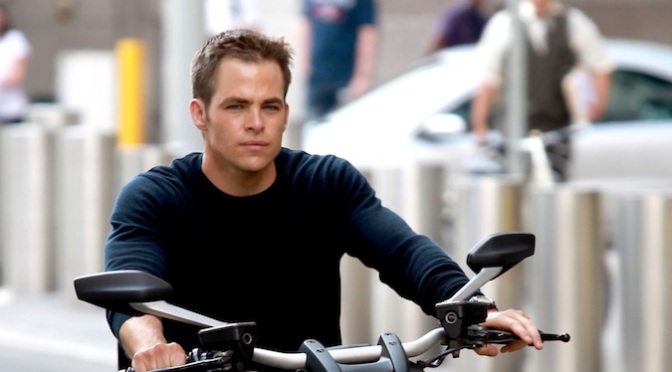
Jack Ryan has the distinct honor among cinematic spies of being…not that great. He’s been in more films than Jason Bourne and as many as Ethan Hunt (once Mission: Impossible – Rogue Nation hits theaters next month), but after being shuffled from actor to actor over the course of the franchise the character has lost a ton of steam. Part of this is due to the caliber of actor (from Alec Baldwin to Harrison Ford [x2] to Ben Affleck to Chris Pine) and part of this is due to the fact that Ryan’s less “spy” and more “data analyst”. That’s not a cop-out, though: Jack Ryan is really just an analyst. It’s the increasing need to shove Ryan into spy territory that begs the comparison to other spies (‘magine dat), so by the time Shadow Recruit came out Jack Ryan wasn’t a mild-mannered systems professional but a sexy gun-wielding wannabe.

And hey: if you want us to make that comparison, Mr. Powers That Be, then with the ghost of Tom Clancy as our witness we’ll do so gleefully. Or not so gleefully, as it were, because no one’s having any fun at all with Shadow Recruit. Why should we? We established in our recent review of the fantastic Quiller Memorandum that a great spy movie doesn’t even need to have a spy as the main character, so forcing Ryan to be more badass than bookworm doesn’t do much for credibility in that arena. Spoon-feeding every plot point doesn’t help either, and again with Quiller the brilliance was in the sense that any John Doe walking across the screen could be a villain; the poster tagline for Shadow Recruit is a flaccidly unoriginal TRUST NO ONE…but then we get nineteen shots of the hotel maid looking suspicious, so it turns out we’re informed exactly who we should and should not trust.

Continue reading Jack Ryan: Shadow Recruit (2014)

Jurassic Park (1993)

One week from today is the wide release of Jurassic World, the highly-anticipated fourth installment in the dinosaur franchise that began with Steven Spielberg’s Jurassic Park. Early reviews indicate that Colin Trevorrow, World‘s director, has delivered a more worthy successor to the original film than Spielberg’s sequel The Lost World or Joe Johnston’s follow-up Jurassic Park III. If that isn’t enough in and of itself, we might root for World to actually be as good as Park rather than just “better than the crappy ones”.

Short of having actually seen Jurassic World yet (I’d be so biased if I had!), the premise is already more akin to the original tale than to the rehashed visits of the second and third films. We won’t speculate too hard about World, and it will certainly need more than a cool premise to survive sequelitis; still, it’s already obvious that the storytelling mentality is focused on a particular point in time that falls between creation and destruction, and the importance of that theme in the Jurassic franchise shouldn’t be brushed aside. In fact, it’s an significant storytelling element of many of Spielberg’s films, and many of Michael Crichton’s works as well.

Continue reading Jurassic Park (1993)

Nightingale (2015)

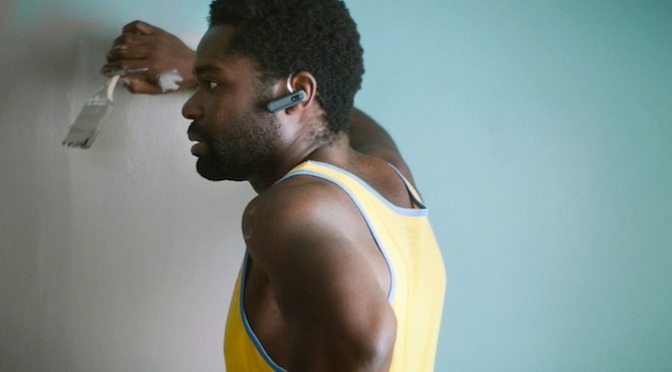
I wanted to love Nightingale unconditionally. We’ve written about one-man-show films here before, from Locke to Buried to Redford‘s All Is Lost to Altman‘s Secret Honor, and Nightingale certainly stands with those true one-man-shows rather than with, say, Cast Away or Gravity or 127 Hours or any other single-character flick that actually has a small supporting cast. Nightingale has no supporting cast, no strange premise wherein the hero is trapped underground or trapped on the high seas or trapped in space. Nightingale‘s Peter Snowden is trapped in his mind, and that’s scarier than any of the aforementioned scenarios.

David Oyelowo is the single actor in question here, and to say he delivers a great performance would be a pathetic understatement. Oyelowo is an absolute force of nature from the first frame of Nightingale to the last. The storyline is unsettling, sure, and we’ll get to that in a minute, but shorn of that Oyelowo’s performance is unsettling in and of itself for the sheer velocity of it all. Not only are Peter’s highs and lows very very high and very very low, but they’re backed up into each other and jumbled up in such a way that Peter switches like a lightbulb from on to off, from calm to manic, from contemplative to downright inconsolable. It’s impressive, but before that it’s incredibly disturbing.

Continue reading Nightingale (2015)

True Detective 1.7 – “After You’ve Gone”

This review appeared shortly after the initial premiere of True Detective in early 2014 — slight edits have been made since the original posting.

Matthew McConaughey took home a well-deserved Oscar last night for his work in Dallas Buyers Club, beating out stiff competition in the likes of Christian Bale and Leonardo DiCaprio. While his acceptance speech was, as you would expect, very positive and un-Rustin Cohle, the usual drawling fatalism we’ve come to expect from Sunday Night McConaughey was going down on another channel. True Detective followed the slow-paced “Haunted Houses” with an even slower penultimate episode, and yet it still provided enough story progression that waiting a week to find out what the finale has up its sleeve will be torturous. Spoilers follow for the seventh episode “After You’ve Gone”.

At the end of “Haunted Houses” Cohle and Hart met in 2012 for the first time, having not seen each other for a decade and both looking a little worse for wear. Speculations as to what their ultimate meeting would entail were fueled by the shot of Hart checking his loaded gun, guesses ranging from standoff to a revelation that Cohle or Hart or both or whoever is indeed The Yellow King.

Continue reading True Detective 1.7 – “After You’ve Gone”

Swingers (1996)

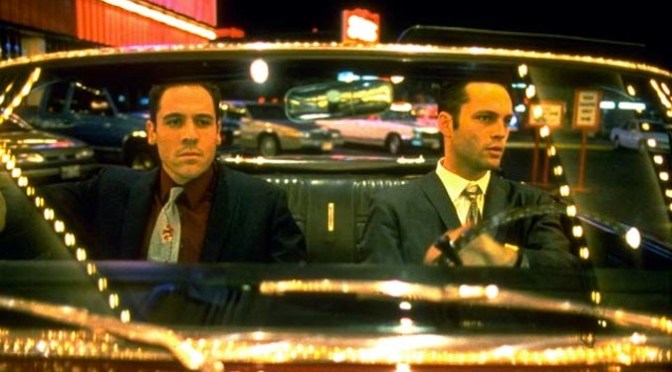
Jon Favreau and Vince Vaughn’s most recent writing/acting collaboration, Couples Retreat, had a budget of around $60 million. Their first collaboration of this sort, Swingers, had a lowly budget of $200,000. However, despite Couples Retreat having 300 times more money to work with, it is my honest belief that Swingers is at least 300 times better than Couples Retreat.

Swingers is the quintessential low-budget, indie, cult-classic film. Mostly the movie focuses on aspiring actors and best friends Trent (Vaughn) and Mike (Favreau), who meet up with other friends, such as Rob (Ron Livingston), Sue (Patrick Van Horn), and Charles (Alex Desert) in L.A. As with most other films of this similar prototype, the plot is not necessarily the most important aspect. Nothing super exciting happens per se, but it is still such a fun watch because it feels actually real.

Continue reading Swingers (1996)

Film & TV News: June 1

News

  • Rumor has it that the casting for the new Spider-Man will be announced this week, as the character is scheduled to appear in the already-filming Captain America: Civil War. Also on the Marvel superhero front, the Ryan Reynolds jaunt Deadpool has wrapped filming this past week.
  • The Trevor Noah Daily Show handoff will occur on September 28th, less than two months after the late Jon Stewart passed aw…wait, he’s not dead? He left on purpose? Why, Jon, why?
  • Kung Fury is pretty hilarious, provided you’re in the right frame of mind (or, I suppose, the wrong frame of mind). The beginning is dumb, but the ending is more or less bliss:

Continue reading Film & TV News: June 1

Bobby Deerfield (1977)

At least as far as the majority of the American public is concerned, Erich Maria Remarque is one of those authors who only wrote one book. It’s not true, of course, but his seminal All Quiet on the Western Front eclipsed his other work in the same way that Joseph Heller’s Catch-22 and Ken Kesey’s One Flew Over the Cuckoo’s Nest eclipsed everything else they wrote. In some cases this all-encompassing book isn’t even the best work by the given author, and there’s certainly a case to be made for that notion as far as Remarque is concerned. Heaven Has No Favorites, his 1961 novel, was serialized before publication but joined the rest of his works in achieving only minor notoriety. But it’s a hell of a book, heartbreaking and beautifully written even with the knowledge that it’s been translated from German.

And it would be nice to say that Bobby Deerfield yanked Heaven out of obscurity, but it really didn’t. Alvin Sargent (who would eventually win an Oscar for his screenplay for Ordinary People) penned the adaptation of Remarque’s novel, and the treatment soon piqued the interest of Sydney Pollack. By this point Pollack was well-established in Hollywood, having the Robert Redford-starrers Jeremiah Johnson and Three Days of the Condor under his belt, and so the next stop in the life of the script was in front of the on-fire Al Pacino. Pacino was drawn to the role of American F1 driver Bobby Deerfield, saying he identified with his journey more than any role he’d taken to date.

Continue reading Bobby Deerfield (1977)

Tomorrowland (2015)

“There are two wolves,” says Casey of Tomorrowland. “One represents darkness and despair, the other light and hope. Which one survives?” To be sure, the philosophizing throughout Brad Bird’s latest film is never any more subtle than this (or less). Casey, optimist to such a ridiculous degree that we learn that about her before we even learn her name, disregards any need for subtext and instead just states the thing itself: “I’m an optimist”. She answers the wolves question in a similarly matter-of-fact manner. Which one survives? “The one you feed.”

Happily, we put this very quote to work in our review of an episode of The Red Road called “The Wolf and the Dog“. It’s much less of a stretch here in Tomorrowland, and again, you don’t really have to stretch at all. It’s plainly clear that the vast majority of today’s storytelling is geared towards the grim, towards the harrowing action-filled future, towards the Cormac McCarthy-style doom and gloom. This is true of almost every medium and almost every target audience, but since Tomorrowland is so much in line with the present Young Adult craze (and because Casey is a teenager) we’ll deal in that genre. The examples should leap readily to mind: Hunger Games, The Maze Runner, The Giver, Divergent, The Mortal Instruments and Ender’s Game are all youthful dystopias with damn similar plots and damn similar everything else. Even Harry Potter, while not dystopian in any way, was a kid’s story turned dark and brooding on screen (see: everything after Daniel Radcliffe grew up).

Continue reading Tomorrowland (2015)