Charlie Wilson’s War (2007)

If this is Charlie Wilson’s War, then we’re the ones losing it. That’s part of the message at the conclusion of Aaron Sorkin’s script for Charlie Wilson’s War, based on the book of the same name by George Crile. “The ball keeps on bouncing,” Charlie says to the government suits that deny him what he needs to properly put his crusade to rest, and he repeats himself purposefully — “the ball keeps on bouncing.” This line is at the heart of this particular act of War, and as with many of Sorkin’s works the seemingly-muddled message is really just an unusually demanding one, designed for interpretation by those on either side of a given political line.

The movie starts and ends with the same scene: Charlie, the Reagan-era Texan House Representative inhabited here by Tom Hanks, stands onstage waiting to be introduced. There’s a banner hanging across the back of the hall that’s somewhat difficult to read, but it clearly says CHARLIE in BIG LETTERS. The moderator says a few words about this man, this wonderful man, and Charlie approaches the rostrum to a standing ovation. His chest is slightly puffed out — just slightly — and Charlie smiles the Tom Hanks smile. The message in this scene is clear: he did it.

Continue reading Charlie Wilson’s War (2007)

The Quiller Memorandum (1966)

It’s been almost fifty years since The Quiller Memorandum, and spy movies have changed quite a bit in the ensuing half-century. It’s unfair to say they’re better or worse nowadays, especially considering the qualification of “spy movie” can mean anything from Skyfall to Syriana to Agent Cody Banks (though, if we’re talking about the latter, then yes: they’re worse). Even the superhero genre is dabbling in spy-ish flicks, with the espionage thriller Captain America: The Winter Soldier drawing favorable comparisons to Three Days of the Condor; Condor, of course, is a spy movie with a main character who is not in fact a spy, nor is he a suave step-ahead killer fighting for what’s right, nor does he even know what’s going on — this all by way of saying that a great “spy” movie doesn’t even need a spy.

But Peter Quiller is a spy, and a damn good one to boot. He’s good by today’s standards, he’s good by the standards of 1966, and he’s good by the standards of his fellow spies in Memorandum. The film opens with a stark, memorable sequence of a man plodding cautiously down a dark, quiet street. He looks around constantly, fearing that the hidden blade might finally come from the shadows. Cautious, quiet. He enters a phone booth and reaches for the receiver when bam! — he’s shot in the back. Dead.

Continue reading The Quiller Memorandum (1966)

True Detective 1.6 – “Haunted Houses”

This review appeared shortly after the initial premiere of True Detective in early 2014 — slight edits have been made since the original posting.

The status quo changes yet again three-fourths of the way through the first season of True Detective, with the sixth episode providing a relatively muted but still provoking turnaround from last week’s guns-blazing action (“The Secret Fate of All Life“). This is the episode that fills in some gaps and gets us from Point A to Point B — so far, Point A has been a hell of a ride, and the final two episodes of the season will hopefully clear the bar that’s been set so very high. Spoilers follow for the sixth episode “Haunted Houses”.

The rift between Hart and Cohle is explored in full, and we delve into the 2002 events that would serve to alienate the two for the next decade. Michelle Monaghan finally gets some time to shine as Maggie when Hart’s ex-wife (in 2012) is brought in for questioning before Detectives Gilbough and Papania, and much of the episode stems from her recollections. Aside from her mere presence in the interrogation room, “Haunted Houses” offers up a fairly predictable feast of leftovers from earlier in the show — Hart reacts violently to everything and somehow gets laid by an attractive woman without even trying while Cohle does police work by himself, drinks by himself, and gets laid by an attractive woman without even trying (okay, that was new). The revelations were predictable mostly in the sense that they were inevitable, and any fears that True Detective is slipping into rote procedural territory can be swept aside — “Haunted Houses” was straightforward, yes, but it managed to clear the stage for the final two episodes.

Continue reading True Detective 1.6 – “Haunted Houses”

Film & TV News: May 25

News

  • The jury at the 2015 Cannes Film Festival (which included the Coen Brothers, Jake Gyllenhaal, Sienna Miller, Guillermo del Toro, Xavier Dolan and a few more) selected champions yesterday as the festival comes to a close. The Palme d’Or went to Dheepan, the Grand Prize went to the Holocaust drama Son of Saul, acting awards went to Rooney Mara and the fantastic Vincent Lindon, and the best screenplay award went to Michel Franco for Chronic. Whew!
  • Ex Machina‘s Alicia Vikander is rumored to be in talks for both Assassin’s Creed and the next installment of the Bourne franchise. If she doesn’t get either role, we’ll be more than content to just watch Ex Machina again.
  • Empire has released the first pictures from Ridley Scott’s The Martian, starring Matt Damon and everyone else who’s in every movie these days. From the looks of the photo above, The Martian may touch on the theme of man’s singular place in the vast and unknowable universe. Shocking.

Continue reading Film & TV News: May 25

Batman: Mask of the Phantasm (1993)

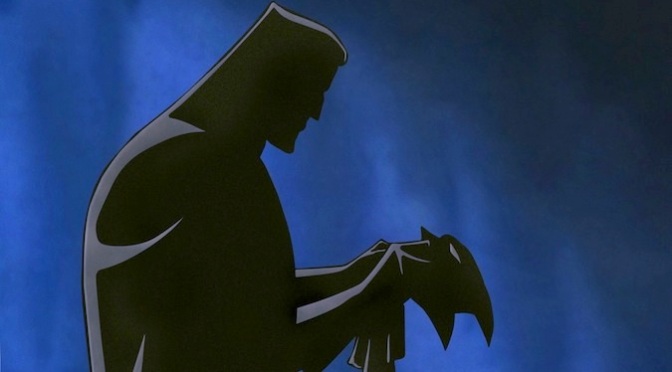
I have a few favorite Batman moments, but the one that trumps them all occurs in the first Batman animated movie Mask of the Phantasm. The comic books are full of contenders, of course — the iconic “legends can never die!” panel in Jim Aparo’s “Man Behind the Mask”, the more-iconic moment in “Hearts in Darkness” when Batman rises from the grave, or the most-iconic “fiend from hell” moment from “The Demon Lives Again!” (which we talked about in our rundown on Batman Begins). The feature films have some epic moments as well, like the introductory call-to-arms of Batman Returns or the final ascension from the pit in The Dark Knight Rises. But Mask of the Phantasm captures what many of these moments capture — the determination of Bruce Wayne, the -ness of the Bat — in a unique way.

Phantasm, of course, is more than just the best animated Batman movie — it might be the best Batman movie, period. It certainly stands with the live-action iterations of Tim Burton and Christopher Nolan, and getting over the fact that Phantasm happens to be animated (as if that’s a point against it) is just a necessary assumption akin to classing The Incredibles at the top of the list of Best Superhero Films. It’s easy to forget about The Incredibles amid the present torrent of live-action Marvel hero flicks, just as it’s easy to forget that Mask of the Phantasm is without a doubt a better Batman film than at least 6/10 live-action Batfilms. I’ll let you figure out which ones I mean.

Continue reading Batman: Mask of the Phantasm (1993)

Backdraft (1991)

I’m thinking of a movie. It came out in 1991. In this movie, a young hotshot investigator is faced with a particularly gruesome series of crimes. Stumped, the investigator seeks the help of a criminal already incarcerated for similar but unrelated crimes. The criminal is clearly a devious maniac, and his help is contingent on a cat-and-mouse game of psychological cabaret. He helps solve things in a roundabout way, but only after the investigator gives up personal feelings about the crimes. This movie features Scott Glenn in a fairly major role.

If you hadn’t seen Backdraft as the header for this review, you might have said The Silence of the Lambs. Either way, you’d be right — all of the above criteria fits with both films, strange as it seems. There’s no shortage of suspiciously-timed blockbusters that have a great deal in common — see Illusionist/Prestige, Tombstone/Wyatt Earp, Truman Show/EdTV, Antz/Bug’s Life, etc. — or just operate on a similar premise or gimmick, like the one-man-in-one-location flicks Buried and 127 Hours. But while Backdraft and Silence of the Lambs operate in fairly different territory, the similarities are far more numerous than those of the kindred spirits listed above. This can only mean one thing: an unfathomable conspiracy, deadly and ancient, marshaled and brought to bear for the purpose of ending civilization as we know it.

Continue reading Backdraft (1991)

Kiss of Death (1995)

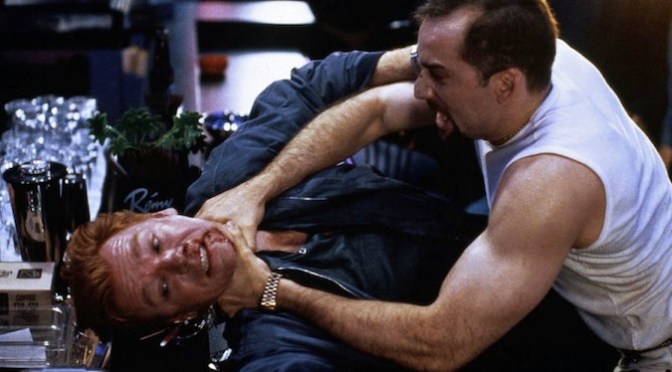
Maybe the lasting symbols of the 1990s are different for everyone, but as far as movies go there’s an uncomplicated formula: we either remember a movie because it’s great or we remember a movie because it absolutely sucks. The vast majority fall in the middle, films that might have been passable at the time but are ultimately forgettable because, hey, look, Dunkaroos. Did you see that movie? No, I was too busy trading six Warheads for a gel pen and beating the hell out of my siblings with Sock’em Boppers with a sweatshirt tied around my waist. But what a time the mid-’90s was for movies that were just straight-up fun — like Space Jam, Home Alone, Men in Black, Independence Day, Jurassic Park, Mrs. Doubtfire, Jumanji, Flubber, every other Robin Williams movie. And what a time it was for movies that were just straight-up awful — like Kiss of Death.

Admittedly, this is not a movie I remember from childhood as being spectacularly bad. It came and went and I never watched it or even heard of it until recently, engrossed at the time in Goosebumps books and Outkast (Say Cheese and Die! was my jam, Outkast still is). But the first ten minutes of Kiss of Death brought ’90s nostalgia rushing back — the good kind, not the O.J. Simpson kind — in such a way that it felt like this just might be one of those terrible, laughably overacted ’90s action flicks that, were I a few years older, I might have remembered as one of those terrible, laughably overacted ’90s action flicks. In lieu of entering the abyss of nitpicking that would result from a look at the entire movie, let’s just take those first ten minutes.

Continue reading Kiss of Death (1995)

True Detective 1.5 – “The Secret Fate of All Life”

This review appeared shortly after the initial premiere of True Detective in early 2014 — slight edits have been made since the original posting.

Anyone who has been watching HBO’s True Detective knows that there’s something not quite right about Detective Rust Cohle. Matthew McConaughey has one of the roles of his life here, and he conveys the darkness inside Rust with brilliant ambiguity — is he a deceitful lawman or a meticulous killer? The fourth episode of the series “Who Goes There” marked the first indication of real evidence of something sinister within Cohle, although viewers have suspected as much since the pilot episode. Sunday night’s episode began, finally, to blow the question wide open — full spoilers follow for the fifth episode “The Secret Fate of All Life”.

“Who Goes There” finished with a tracking shot that quickly took the internet by storm over the past week, and the following episode picked up more or less where that shot left off. Hart and Cohle use the latter’s Iron Crusaders connection to hunt down Reggie Ledoux, meth chemist and prime suspect in the Dora Lange murder, and we finally reach the swamp-set shootout that both men allude to frequently in their case testimonials in 2012. Detectives Gilbough and Papania ask Hart and Cohle to recount this event for what must be the thousandth time since it happened 17 years ago, and Hart confirms that every time he’s told the story he’s told it the same, because “it only went down the one way.”

Continue reading True Detective 1.5 – “The Secret Fate of All Life”

Film & TV News: May 18

News

  • The Cannes Film Festival is well under way, and buzz is strong on a lot of the films screened thus far. Yorgos Lanthimos presented The Lobster (Colin Farrell, Rachel Weisz), Woody Allen presented Irrational Man (Joaquin Phoenix, Emma Stone) and Stéphane Brizé presented La loi du marché (with Vincent Lindon of La mustache), all of which played favorably. On the other end of the spectrum is Gus Van Sant’s Sea of Trees (Matthew McConaughey, Ken Watanabe), which was met with a sea of boos.
  • Jude Law has joined the tentatively-titled The Young Pope, a speculative HBO series about an American pope. That premise would be only vaguely interesting were it not for the presence of director Paolo Sorrentino, helmer of 2013’s The Great Beauty, as Pope‘s showrunner.
  • David Lynch does another 180° and says the Twin Peaks revival is happening after all. At this point we’ll believe it when we see it, and even then we might not care.

Continue reading Film & TV News: May 18

Restrepo (2010)

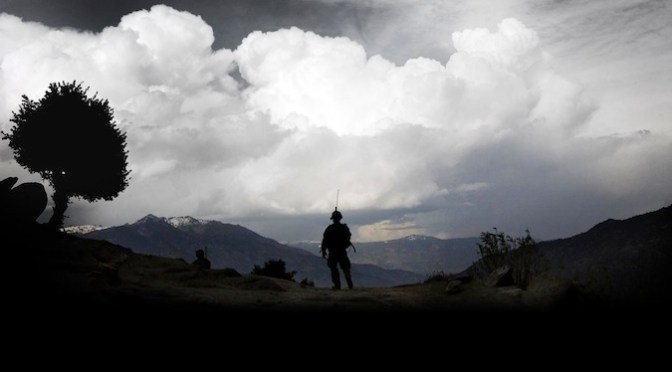
I had the good fortune of meeting Sebastian Junger a few years ago in Boston as he did the press junket for his book War. From mid-2007 to mid-2008 Junger was embedded with a U.S. unit in the Korengal Valley in Afghanistan with his friend and photographer Tim Hetherington, and War was one of the many pieces of journalism that resulted from that year. Another was a series of Vanity Fair dispatches collected as “Into the Valley of Death“, which is an excellent companion to War and an excellent account of that year in the Korengal. But the most affecting portrait from Junger’s tour as a war journalist might be Restrepo, the documentary he and Hetherington directed from the thousands of hours of footage they took during the year and ensuing interviews with the soldiers immediately upon their return home.

The Korengal Valley (sometimes spelled Korangal) was at the time dubbed the deadliest place in the world, an overblown-sounding moniker that is nonetheless entirely lacking exaggeration. U.S. troops in the Korengal took fire from Taliban insurgencies every single day, often engaging in five or six firefights between dawn and dusk. For soldiers on a fifteen-month deployment, that’s an unheard-of amount of action. By the time the U.S. pulled out of the Korengal in April 2010, nearly fifty American soldiers had been K.I.A. there. Seventy percent of ordinance dropped throughout Afghanistan during the course of the war was dropped here. In an interview with CNN, Junger describes the Korengal as “the Afghanistan of Afghanistan, too remote to conquer, too poor to intimidate, too autonomous to buy off.”

Continue reading Restrepo (2010)