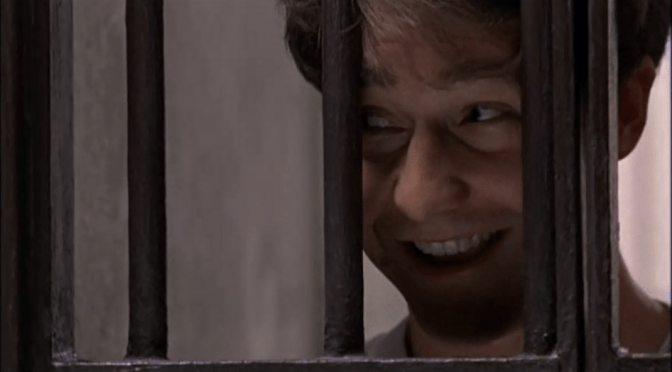
The Red Road 1.5 – “The Great Snake Battle”

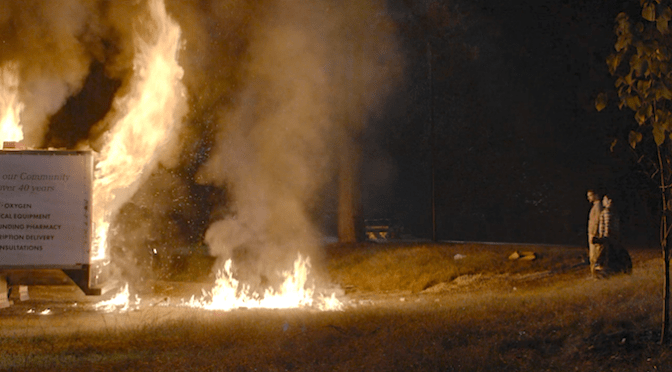
The opening scene of the first season Red Road episode “The Great Snake Battle” reminded me of a scene from James Gray’s directorial feature Little Odessa. Both use a skinny hallway of a rundown New York City tenement as their setting, both depict a passionate confrontation between father and son, and both show how quickly a power dynamic can change from one man to the next. The comparison is strengthened somewhat by the fact that Gray directed Road‘s pilot episode “Arise My Love, Shake Off This Dream“; this fifth episode, focusing almost exclusively on main characters Phillip Kopus and Harold Jensen, is also the best since Gray’s opening hour.

We’ve seen how smart and manipulative Jason Momoa’s Kopus can be in pretty much every episode so far. He always seems to have the upper hand, even when he’s pissed off or cornered or spoken to like a child by his manic father Jack. It’s Jack and Phillip who come head-to-head in that dim hallway, the former ripping the door open with a gun in his hand and demanding his payment, the latter hardly saying a word at all. It’s not the fact that Phillip is quiet that makes this scene different — we’ve talked at length about the silent observations of Kopus, watching from afar and gathering ammunition to use against anyone and everyone. But he’s more than just quiet in this hallway scene. As his father rips into him, Kopus seems truly sad. Sad Kopus is without a doubt a new Kopus.

Continue reading The Red Road 1.5 – “The Great Snake Battle”

The Insider (1999)

A smash cut can be a beautiful thing. It can also be a broadly-defined thing, somewhat unfortunately, which means I have to reel you into a conversation about Michael Mann’s The Insider by providing a narrowed definition of smash cut. Excited yet? The added problem, of course, is that one of you damn dear readers will no doubt have the time to point out precisely where I’m mistaken in my definition, holding my hand and stating that, no, that’s not a smash cut, that’s a match cut, and that one over there is a jump cut, and over there is…my, oh my! Is that a Dutch angle shot in its natural habitat?

Anyway, the thing I’m thinking of might not even qualify as a smash cut, but for now that descriptor will have to suffice. Mann loves an extreme close-up, especially in his earlier works like Heat (I’m thinking of that early bouncing shot of Val Kilmer), and in his follow-up The Insider we probably get closer to the facial pores of Russell Crowe and Al Pacino than we’ve ever been before. But there are a few close-ups not of faces but of objects, inserted for a second or a half-second right smack in the middle of a scene, and those cuts are what I’m talking about. They smash to the forefront when you’d least expect them, these otherwise uninteresting objects. Why does Mann shove these in so boldly, and how does he get it to work so damn well?

Continue reading The Insider (1999)

The Red Road 1.4 – “The Bad Weapons”

We discussed the significance of the episode titles of the first season of The Red Road in our review of the second episode “The Wolf and the Dog“, one of a handful of Native American legends employed as allusion and metaphor for the events of the series. “The Bad Weapons” is no different, but the episode goes one further in attempting to apply the belief systems of the given tribe (in this case the Blackfoot Nation) to the moral quandaries of Philip Kopus, Harold Jensen, and the other residents of Walpole, NJ.

There’s a Red Road subplot revolving around the years-ago death of Jean’s twin brother that rears its head again in “Bad Weapons”. It’s certainly an important history for the show (or at least the opening season), mainly because of the subtle intimation that Kopus might have been involved in that untimely demise. But as Jean and Harold’s daughter Rachel discovers tape recordings of the twin’s stream of consciousness, that particular storyline slips away from importance and approaches convenience instead.

Continue reading The Red Road 1.4 – “The Bad Weapons”

Top Five (2014)

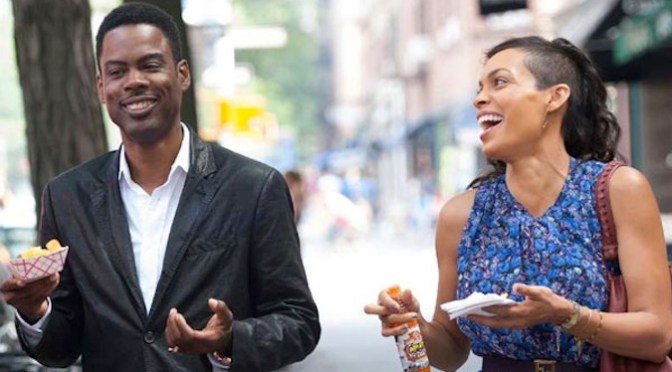
You have to marvel at Top Five, the third and best feature directed by Chris Rock, because it occupies what good ol’ Dave Matthews might call The Space Between (right now you’re saying this motherf*cker just referenced Dave Matthews in a review of a Chris Rock movie — you’re damn right). There’s the in-betweenness of the genre itself, which like main character Andre Allen keeps toggling from comedy to drama and back again. Even within the more likely genre of the two — comedy, for those of you who’ve never heard of this “Chris Rock” fellow — there’s the sense that the movie is stuck in the middle between the comedy we expected and the comedy we didn’t. Rock, after all, made his directorial debut with Head of State, and it’s pretty clear that with Top Five he’s partly digging stuff like that instead of just doing it all over again.

Mostly, though, the tightrope walking in Top Five occurs in the dialogue. Andre’s a has-been comedian, known to the masses for playing Hammy the Bear in three Hammy movies, and as of now he’s trying to break into more serious roles (like the leader of the Haitian Revolution in his new movie Uprize). He’s also trying to stave off his alcoholism, and Top Five provides a nice link between Andre’s sobriety and his ability to be funny. So the dialogue reflects this in the obvious way, in the events of the script and the plot points and such, but it also reflects this in the way it seems by turns well thought-out and yet totally spontaneous.

Continue reading Top Five (2014)

Film & TV News: March 23

News

  • David Lynch stated that season 3 of Twin Peaks may still be “up in the air” despite some series regulars already signing on. We wait with bated breath.
  • Meanwhile, The X-Files‘ limited season seems to be getting closer to a green light at Fox. Don’t expect any more than ten episodes, though, since David Duchovny claims everyone is “too old.” I think Gillian Anderson would beg to differ!
  • Bridge of Spies will be the first of 27 Steven Spielberg films not to feature a John Williams score. This time the honor goes to Thomas Newman, though Williams will return for The BFG.
  • Annapurna Pictures, champion of compelling artistic cinema, has filled out Ana Lily Armipour’s mysterious The Bad Batch with some fascinating names: Keanu Reeves, Jim Carrey, Jason Momoa, and Diego Luna.

Continue reading Film & TV News: March 23

Film & TV News: March 16

News

  • The first Star Wars spinoff, from director Gareth Edwards and writer Chris Weitz, now has a title and a star: Star Wars: Rogue One with Felicity Jones.
  • Star Wars: Episode VIII, written and directed by Rian Johnson, has been scheduled for May 26, 2017, exactly forty years and one day after the release of A New Hope.
  • Disney surprised absolutely no one by announcing Frozen 2. “Just let it go, Disney” jokes abounded.
  • Eddie Murphy could make a triumphant return to drama in Lee Daniels’ Richard Pryor biopic, playing the comedian’s father. Let’s just hope he doesn’t get too invested in an Oscar this time…

Continue reading Film & TV News: March 16

American Movie (1999)

Stories about filmmakers in their early days have become a part of Hollywood legend. Sam Raimi and his friends got lost in the woods on their first day of shooting The Evil Dead. Kevin Smith sold his comic books and maxed out ten credit cards to finance Clerks. Paul Thomas Anderson dropped out of NYU after only two days and used his college fund to film Cigarettes & Coffee. These stories are charming, funny, and encouraging for aspiring filmmakers. But for every apocryphal story about a celebrity’s climb to the top, there are hundreds of stories about those who didn’t make it. American Movie is one of those stories. Sort of.

In 1996, Mark Borchardt began production on his short film Coven in the working class town of Menomonee Falls, Wisconsin. The plan was to use Coven to inspire investors to fund Borchardt’s feature film, Northwestern. Documentarian Chris Smith, fresh out of film school, chronicled Mark’s year-long struggle to finish his short against all odds. With only friends, family, and townies to help him finish his film, Mark faced a stoned crew, a stubborn uncle, and stiff cabinetry in this hilarious, yet oddly inspirational documentary. Continue reading American Movie (1999)

The Red Road 1.3 – “The Woman Who Fell from the Sky”

The Red Road, great as it is, is like any other show in the history of television: it has weak spots. “The Woman Who Fell from the Sky”, the third episode of the opening season, is likely the first time the chinks in the armor are visible. The writing up until this point has been largely commendable, succumbing to the occasional been-there-done-that moment, but mostly avoiding them, hinting at new roads (red ones) instead of relishing the old ones. “Woman” is a bit shakier, but thankfully Jason Momoa’s Philip Kopus, far and away the best character on the show, does what he can to save this particular episode from sliding wholly into those moments of cliché.

These days, “antihero” is like a curse word. We’re living in a post-Breaking Bad world, so the last word on the TV antihero thing has kind of been said. Does that mean antiheroes should be avoided altogether? Of course not. But is that what Kopus is? Hard to say. He has some qualities of an antihero in that he’s definitely a bad guy, robbing medical wholesalers and dealing in guns and drugs and manipulating kids, but he’s simultaneously someone you root for. It’s fun as hell to watch him do his thing, even if that thing isn’t strictly legal.

Continue reading The Red Road 1.3 – “The Woman Who Fell from the Sky”

Netflix Picks #2

Kevin:  Gregg Araki’s mesmerizing White Bird in a Blizzard has all the initial trappings of a typical coming-of-age drama. Kat Connors (Shailene Woodley) longs to leave her idyllic hometown life, while her mother, Eva (Eva Green), feels overburdened by her role as a doting housewife. When Eva mysteriously disappears, Kat is haunted by persistent dreams of her, and reassesses their tumultuous relationship through therapy and an affair with a cop assigned to her missing person’s case. The premise is familiar, but the film draws upon the melodramas of Douglas Sirk to convey how Eva feels shackled by the hardships of marriage and motherhood. Aided by cinematographer Sandra Valde-Hansen and composer Robin Guthrie, Araki abstains from the histrionic tendencies of his earlier work, opting for an understated color scheme and score that firmly establishes the themes of alienation in 1980s suburban life. Following her widely praised turn in The Spectacular Now, Woodley demonstrates assertiveness in the lead role, but it’s Eva Green who leaves the greatest impression. Green’s steely flourishes invite comparisons to Joan Crawford, but feel closer to Barbara Stanwyck in their unrelenting swagger. Other notable performances include those of Gabourey Sidibe and Mark Indelicato, whose lively exchanges with Woodley provide a needed respite from the drama, and Shiloh Fernandez, who complements his character’s fetching looks with a charming half-witted persona as Kat’s boyfriend Phil. In a standout sequence that takes place in a local underground club, Kat and Phil seductively dance to Depeche Mode’s 1987 classic “Behind The Wheel”. Through a breathlessly shot and edited montage, Araki injects this scene with infectious spontaneity and groove. White Bird in a Blizzard is Gregg Araki’s most restrained directorial effort since Mysterious Skin, but is punctuated with many spirited moments that reaffirm his reputation as a genre-defying, risk-taking filmmaker.

Continue reading Netflix Picks #2

Primal Fear (1996)

Edward Norton wowed audiences this past year with his supporting role in Birdman, one that earned him an Oscar nomination for Best Supporting Actor and, at times in the movie, stole the show, even from lead actor nominee Michael Keaton. It was an impressive, but not necessarily unexpected, performance from Norton. He has established himself over the past two decades as a great actor. But how did he get to this point? Where did he start? Two words: Primal Fear.

Truth be told, Norton’s start and end points in his journey have had identical impacts on audiences. On both ends of his career—in his first movie and his most recent one—he has absolutely captivated audiences with his performance. It is his first performance that seems more impressive, though, for the sheer fact that no one saw it coming. Continue reading Primal Fear (1996)

Never judge a book by its movie