

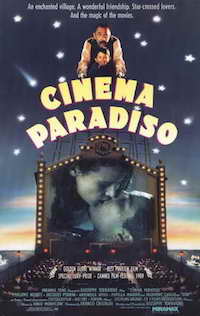
 I’m not a big crier, but an exception can usually be made for Cinema Paradiso. I wasn’t too much older than young Toto when I first saw the film, and I held it together until the very end when a middle-aged Toto sits in reverent silence to watch the film left behind by his departed friend Alfredo. The film is a patchwork of clips deemed too pornographic by the village priest, kisses and sexual advances and tender embraces from dozens of different movies, cut and discarded for the sake of public decency. It is a mosaic of passion, free of dialogue, cobbled together by a blind man as a reminder of the place where Toto’s own passions were born. It brings him backwards in time. And if you’re Toto or a big baby like me, it’s a real tearjerker.
Returning to Paradiso today, I was at first struck by the wit and daring of the dialogue in the script. The repetitions throughout the village are a good example of this, reinforcing the idea that Toto’s escape from his hometown is really an escape into a larger, more varied, more passionate world. There’s a beggar who constantly asserts the the town square is “his”, doing so even forty years later as an old man. Another patron of the cinema can’t help but fall asleep in his seat, hollering at the kids who shock him awake “I’ll make mincemeat out of you!” He repeats it so often that the entire theater eventually joins him in chorus.
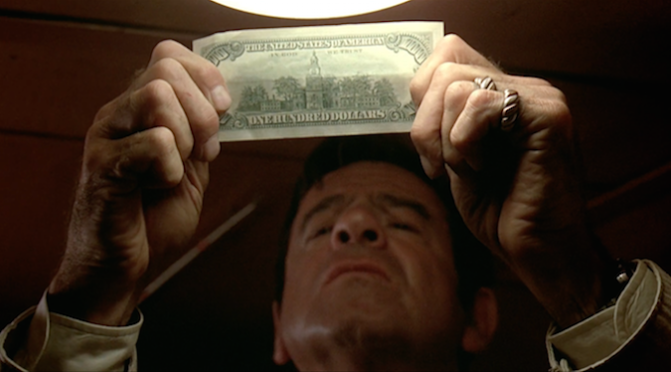
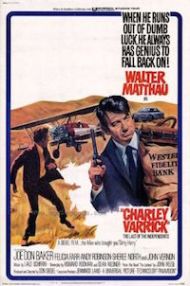 Charley Varrick is one lucky guy. Odd, maybe, to associate “luck” with a man who botches a robbery and gets his wife killed, and odder still once he discovers that the money he does get away with belongs to the ruthless Mafia. Over the course of Charley Varrick poor Charley buries his wife, runs from the police, runs from the Mafia, loses his partner, loses his house, loses his plane, and spends a heck of a lot of time contending with the incompetence of others. Traditionally we call the person in this string of situations “unlucky.”
 Today, the Fifth of November, is the perfect day for V for Vendetta. To be sure, Guy Fawkes Day finds a reference or two in a story about an anarchist in a Guy Fawkes mask. Go figure. He even intones as much: Remember, remember, the Fifth of November. But it’s this particular 11/5, the one here in 2017, that’s a perfect day for V. Because we’re now coming up on a year (!) since the presidential election of 2016, an entire year of what this masked anarchist, vested with a vast and verbose vocabulary, would call vitriol, venom, vilification, violence.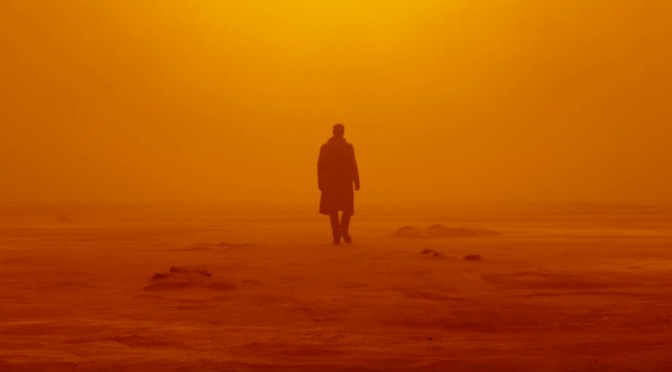
 One of the previews that screened before last night’s Boston premiere of Blade Runner 2049 was for next year’s monsters vs. robots actioner Pacific Rim Uprising, an inevitable if somewhat tardy sequel to Guillermo del Toro’s 2013 original. Based solely on this trailer, it’s evident that Uprising centers on the son of the first film’s protagonist, alludes heavily to that first film, and possibly just revamps the plot with slightly louder explosions. I was reminded, regrettably, of Independence Day: Resurgence, which gave off a similar reek of franchise desperation.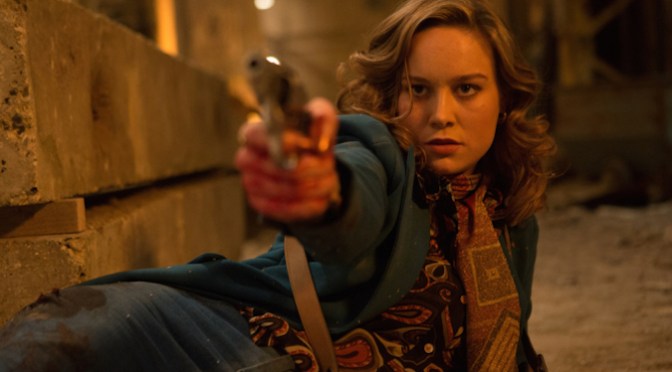
 Prolific director Ben Wheatley followed up 2015’s
 I recently watched Edgar Wright’s Hot Fuzz for the zillionth time. This was partly to assuage my excitement for Baby Driver, Wright’s latest, and partly because the discovery of a commentary track by Wright and his buddy Quentin Tarantino was too good to pass up. Usually commentary tracks feel slight, strained, straight-up unnecessary; Wright and Tarantino have a casual chat that’s nearly as bonkers as Hot Fuzz itself. The pair share a vast encyclopedic knowledge of film and music, and throughout the course of the commentary they discuss nearly 200 films — basically everything besides Hot Fuzz — and if you’re thinking someone should write out that list, well, yeah: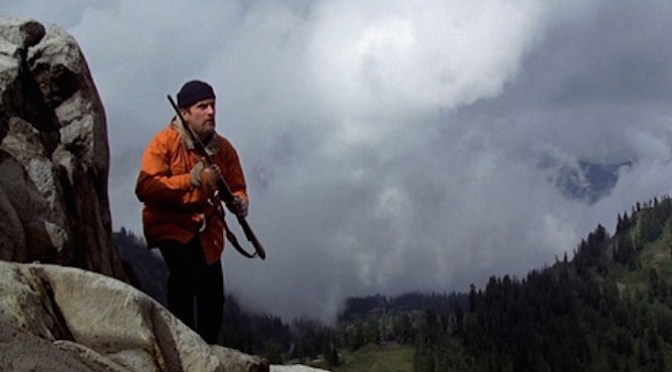

 Motion State Review