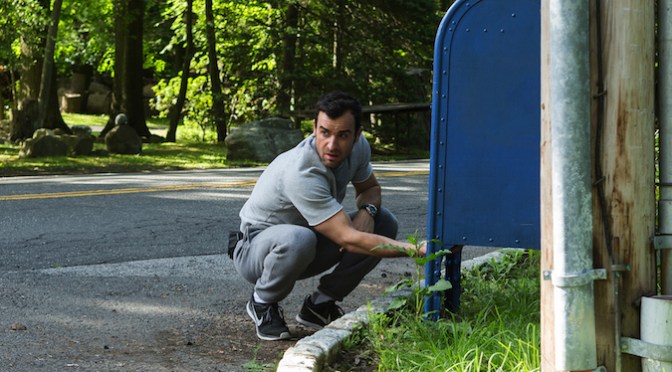
Steve Jobs (2015)

97% of Steve Jobs is nearly perfect. Much like the products borne of the man’s unparalleled creative vision, everything in his latest biographical film is optimized, streamlined, rounded when the edge should be rounded, sharp when the edge should be sharp, forward-thinking, life-changing, and pitched to be perfect. The performances are subtle and explosive, depending on which character you’re dealing with. The drama is heavy-duty; the comedy is excitingly witty. The pacing of the whole film is breathless. And the writing — whew, the writing — Aaron Sorkin has probably never been this good or done this much with a film script. This is ostensibly The Social Network 2.0, a story about a genius/jerk who defined the times for the rest of us, except Steve Jobs has a richer character in the driver’s seat.

And in comparing the two, that leftover 3% only becomes all the more glaring. The structure of the film is unique, built over three days in history: the launch of the Macintosh in 1984, the launch of the NeXT computer in 1988, and the launch of the iMac in 1998. The aforementioned breathlessness of the film is derived from setting each episode immediately before these launches, as that’s probably the most stressful and nerve-wracking collection of hours in any product launcher’s life. No different in Steve Jobs. Jobs needs everything to be perfect, every address to start exactly on time, every personal grievance from his staff and family (of which there are many, and between which the words staff and family mean less and less) to be voiced and dealt with. “It seems like five minutes before every launch, people go to a bar and get drunk and decide to air their grievances,” says Jobs.
Continue reading Steve Jobs (2015)

Film & TV News: October 13

News

  • Both the New York Film Festival and the New York Comic Con concluded this weekend. From the former, I’d like to give a sarcastic shout-out to the idiot who talks through the Closing Night premiere and is inevitably seated right next to me; from the latter, I’d like to give an actual shout-out to the girl dressed as Harley Quinn that I saw zipping through Grand Central. Nice mallet.
  • Quentin Tarantino is cutting two versions of The Hateful Eight (rather than, you know, eight versions), one for 70mm and one for the rest of the peons to check out in digital. I really cannot for the life of me think of a good reason for this, other than because he’s Tarantino.
  • Jeff Goldblum, Bryan Cranston, Bob Balaban and Edward Norton will be voicing a pack of dogs for Wes Anderson’s next stop-motion animation film. Even if you’re not a huge Wes fan, that’s a pretty top-tier voice cast.

Continue reading Film & TV News: October 13

The Leftovers 2.1 – “Axis Mundi”

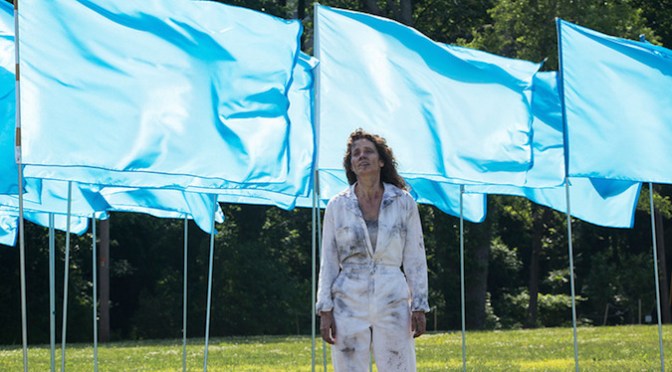
If 2% of the world’s population — call it roughly 140 million people — suddenly vanished one day, the world would change, right? Everything would be different, right? Religion would be shaken for some, as we saw last season on The Leftovers in the third episode “Two Boats and a Helicopter“. Grief, as a concept, would take on a new complexity as in “Guest“. Heck, even the ATF would necessarily expand to become the Bureau of Alcohol, Tobacco, Firearms, Explosives and Cults (obviously). Three years after the Sudden Departure, Carrie Coon’s Nora Durst lives her life (again, in “Guest”) in what appears to be a normal way: she goes to the grocery store and takes the trash out. But Leftovers unveils something underneath those trips to the grocery store and to the trash barrel, betrays a world changed but changed only beneath the business-as-usual facade.

I expect as much to be the case with Jarden, Texas, a town that miraculously was unaffected by the Departure. All 9,261 citizens of the town were “spared”, turning Jarden into a mecca for those believing it to be the only safe haven on the planet. It’s now billed as Miracle National Park, and tourists flock by the thousands to breathe the air of the place that God saved. The change of location from Mapleton, NY, works on several levels, providing more than fresh faces and fresh challenges. The sparing of Jarden is no more explicable than the Departure everywhere else, and thus we get a fresh take on the world of The Leftovers as well, one where the whole business of “not knowing” is framed as a positive thing instead of a tragic thing. In Mapleton everyone asked what happened, and we talked about how Leftovers will never actually answer that question. Here, in Jarden, whoever asks what happened is met with a chorus of justifications from God saved us to stop asking and just be thankful.

Continue reading The Leftovers 2.1 – “Axis Mundi”

Miles Ahead (2015)

The 53rd New York Film Festival came to a close Saturday night with the world premiere of Miles Ahead, Don Cheadle’s longtime passion project about the late great Miles Davis. An actor of Cheadle’s caliber attached so fully to a single film might be a rarity, and in this case it’s the lead role, the directing, and the writing that all fall in the man’s wheelhouse…and he co-produced and wrote original music for the film. And he was in Avengers: Age of Ultron just a few months back.

Interestingly, the similarities between the vigilante War Machine and the musician Miles Davis make it evident what Cheadle saw in both charac…just kidding. Miles Ahead is the best thing Cheadle’s done since Hotel Rwanda, or at the very least the most substantial role since then, and thus an overdue reminder that Cheadle is a fantastically likable leading man. He’s likable even when he’s playing Davis at his lowest point, a five-year creative drought fueled by cocaine and loneliness that makes up the majority of Miles Ahead, and through all the stubbornness and figurative horn-tooting (sorry) Cheadle still conveys the fact that Davis was overflowing with passion for his art. It’s fitting that the actor, who took eight years to craft Miles, matches the musician in passion for his own art.

Continue reading Miles Ahead (2015)

The Measure of a Man (2015)

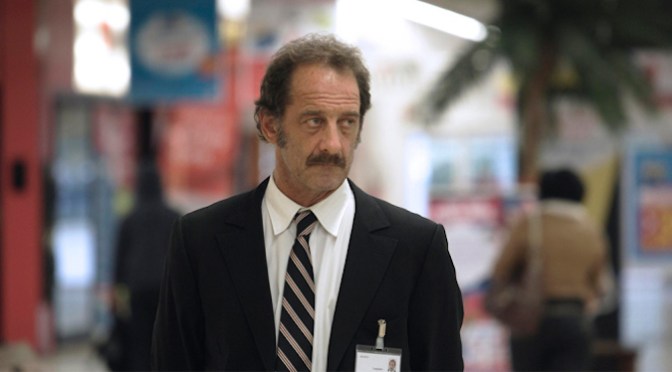
A film like The Measure of a Man needs the right actor in the leading role, and Vincent Lindon is the right actor. He’s not commanding, but he’s dignified; he’s not emotive, but he’s emotional; he’s not a force of nature, but if he is then he’s a fault line waiting to quake. He’s always just about to boil, “simmering”, maybe, but then again there’s even less violence in his demeanor than there is in a pot of increasingly hot water. Lindon is simply comfortable, at ease and natural in a tie or a T-shirt, genuine as if he’s blissfully unaware of the camera in his face (and in Measure it’s really in his face).

On the other hand Lindon’s character, unemployed factory worker Thierry Taugourdeau, is decidedly uncomfortable. There are very few opportunities for Thierry to just loosely enjoy life in his own body in the manner of the actor portraying him; Thierry can’t afford that. He’s confronted with his financial realities during every waking moment, sometimes explicitly and sometimes during a scene of him dancing with his wife, and Measure presents Thierry during a time in his life when his employment is everything. He’s like a saggy old Augie March in a rotation of labor by necessity instead of by election; instead of working in jobs dictated by his pride, he takes what he can get and usually has to suppress that pride.

Continue reading The Measure of a Man (2015)

The Martian (2015)

Hands down, the best movie theater experience I’ve ever had.

Sci-fi royalty Ridley Scott’s’ latest space voyage did not disappoint.  The Martian — starring Matt Damon, Jessica Chastain, Kristen Wiig, Jeff Daniels, Michael Peña, Sean Bean, Kate Mara, Chiwetel Ejiofor, and Donald Glover (holy shit) — epitomizes the term “modern classic.”  It gets its two major themes of unrelenting determination and human bravery across gracefully and without any integrity-damaging clichés, an accomplishment that continuously eludes many filmmakers who embark upon such a journey. That’s the difference between this film and Independence Day, for me (that’s not to say that the latter doesn’t hold a special place in my heart).

I left the theater with the stupidest grin on my face. The film’s humor was the beautiful element that made it exceptional, not only in the simple sense of making the film more enjoyable, but also in the sense that it unquestionably aided Damon’s performance — otherwise, I doubt his sheer optimism would have been nearly as believable.  The humor lightened the mood for us and kept us believing that Mark Watney was going to do the impossible.  Far from falling into the category of comedic-relief-humor, The Martian might actually get nominated for Best Comedy or Musical at the Golden Globes next year.  When Watney practically blows himself up and goes I flying across the hab, I cried with laughter.  When Watney intentionally goes to town with expletives in an inter-planet online chat that is being streamed worldwide, I cried with laughter.

Continue reading The Martian (2015)

Sicario (2015)

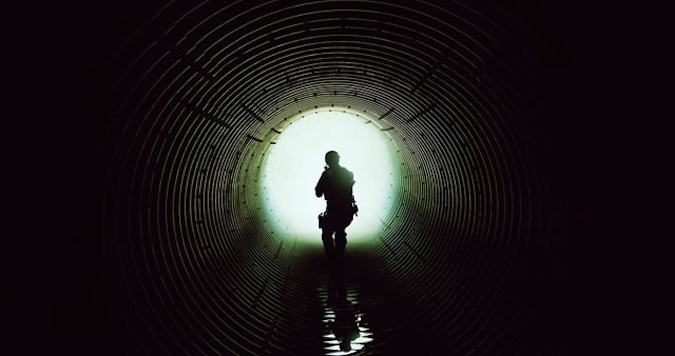
I admit: I was sold early on Sicario. Were you? There’s no shortage of seduction. Emily Blunt leads a stellar cast that includes Josh Brolin and Benicio Del Toro in some of the finest roles of their respective careers; Roger Deakins (blame him for this) is behind the camera, which is hardly ever wrong; and Denis Villeneuve is in the director’s chair, following up on Enemy and Prisoners with another intense thriller. Not completely onboard yet? How about a poster that recalls The Third Man?

The Third Man (1949)
Sicario (2015)
Sicario (2015)

Ah, works every time. Happily, as we sit down in the darkened theater and Sicario (a film which by the way has little to do with The Third Man) begins, it turns out the theme of seduction was at the heart of the film all along.

Continue reading Sicario (2015)

The Leftovers 1.10 – “The Prodigal Son Returns”

Sometimes drama is hard. Part of the reason why people are throwing around phrases like The Golden Age of Television is because great drama often implies a certain longevity, a depth not only of feeling but of space and time as well. Rust Cohle’s True Detective arc spans more than a decade, and we’re allowed insight into that arc for eight hours rather than for the limited runtime of a film. Walter White’s (d)evolution is likewise more effective for the time it takes building itself. In the coldest sense television allows what comic book chronology allows, simply more, and thus more of a compounding effect in the later hours or later seasons. True Detective and Breaking Bad are intense in their final sequences mostly due to brilliant writing, brilliant directing, brilliant acting — nothing replaces storytelling (preach!) — but partially due to what came before.

And yes: sometimes drama is easy. Fabricated drama isn’t hard to find. Heck, take Best Picture winner Argo, which climaxes with a harrowing scene at the airport where the heroes are really just standing in a room sweating as to whether they’re about to be let out of the country or not. Quick cuts are made to the drama, vehicles holding the bad guys hurtling along the tarmac. It’s all spiced up, and usually when you have to spice up your scene with cuts to action that simply happen faster and faster as the music plays faster and faster — well, maybe there’s another way to extract drama, a less easy way, an infinitely more effective way. Argo is hardly the worst example. The cringeworthiest one that leaps to mind is all the extraneous shit going down at the end of The Amazing Spider-Man 2, because Spidey battling his enemy isn’t enough. And Spidey battling two enemies isn’t enough. And Spidey battling two enemies while a hospital full of people is in danger and a plane full of people is about to crash isn’t even enough, so throw Gwen Stacey in there. There we go: amazing.

Continue reading The Leftovers 1.10 – “The Prodigal Son Returns”

Calvary (2014)

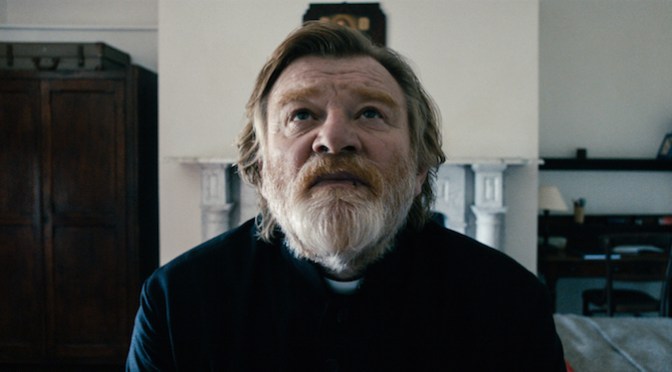
Seeing as I am spending this academic year studying abroad in Ireland, I suppose it would be appropriate to review some good Irish cinema. In the starring role of Father James, the brilliant and wildly underestimated Brendan Gleeson turns in one of his most impressive acting efforts in Calvary, channeling the frustration of a man who’s spent a lifetime actually giving a shit. Sporting a thick reddish-brown mane and sounding his still-thicker brogue, Gleeson covers a great range of emotions, as convincing in his attempts to mold the children of Sligo into proper men and women as he is in sardonically issuing back-handed compliments and even some more blatant insults.

Calvary’s dialogue is probably its strongest suit.  While the film is a clever black comedy with a plethora of lines that are as obscene as they are hilarious, there is also a cloud of seriousness and deep-meaning that hangs over the few players in this small-budgeted indie flick. Every jest is followed closely with an exasperated sigh, telling of the emotionally crippling environment in which these people live.  Where questionable jokes about child molestation are made frequently, there is a great deal of it happening. Where people often contemplate taking their own lives, jokes about such things are tossed around haplessly. So, while the film’s overtones are rather comedic, its undertones are actually quite upsetting. I suppose this is fairly insightful, as people do seem to make light of the real problems they face in order to cope.

Continue reading Calvary (2014)

The Leftovers 1.9 – “The Garveys at Their Best”

“The Garveys at Their Best” is probably the most illuminating episode of the first season of The Leftovers, and had it been placed at the beginning where it belongs chronologically it might have heightened the impact of a lot of the symbolism that came in the first eight hours. Pure benefit of the doubt dictates that The Leftovers is playing the long game, see, and so this is still the beginning. Fair enough, and the rewatchability factor is not to be discounted either. But those who claim the series is often purposefully obscure or figurative for the sake of being figurative can probably point to “Garveys” as evidence of that, and despite the realizations that come about during the episode there are just as many new questions.

Set in the few days leading up to the Departure, “Garveys” is the first look at “normal” life in The Leftovers aside from the season-opening scene in the grocery store parking lot and a brief swath of “Two Boats and a Helicopter” depicting Matt Jamison’s horrific personal experience on October 14th. Having an entire episode follow the main characters of the show in their day-to-day lives provides a huge amount of context for the often-questionable ways in which the same characters conduct themselves in the Brave New post-Departue world, and it also betrays the fact that pre-Departure life was possibly not as “normal” as everyone might like to believe.

Continue reading The Leftovers 1.9 – “The Garveys at Their Best”