
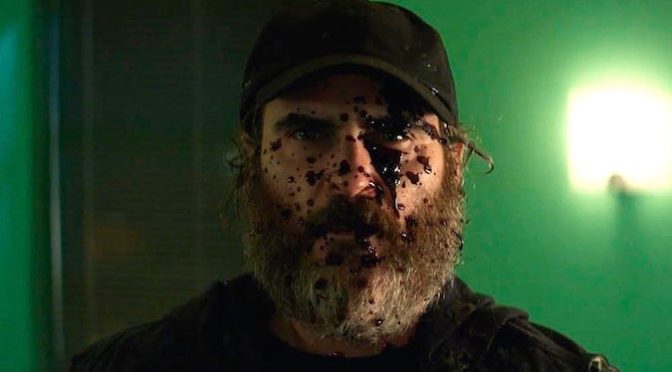
 There were a number of factors that prevented me from rushing out to see You Were Never Really Here on opening night. First was the weather, which is not really an excuse at all if you’re a New Englander like me. The second factor was the review snippet plastered on the poster that referred to the film as “Taxi Driver for a new century.” Do I enjoy Taxi Driver? I do. Do I enjoy “modern updates” to ’70s classics like Westworld, for example? Occasionally, yes, I do. But this kind of explicit tailcoat-riding is either lazy marketing or inadequate criticism or, likely, both. I don’t think I saw Interstellar because people said “it’s 2001 for a new generation!” and I didn’t see Annihilation because people said “it’s 2001 for a new generation!“, but I do know that I enjoyed those movies primarily for how not-2001 they both were.
But this, too, is a weak excuse. Two big preventatives: firstly, in a move most unforgivable and piteously ironic for someone who purports to point out “inadequate criticism” in the first paragraph of this very review, I had never before seen anything directed by Lynne Ramsay. People had gently suggested this oversight as something I should reconcile tout suite. “Start with Ratcatcher,” they said, recommending Ramsay’s feature debut. “Start with We Need to Talk About Kevin,” they said, recommending her 2011 effort. I’m a bit of a completist in this regard, watching one movie by the Coen Brothers and then suddenly finding myself rewatching them all. Maybe my appreciation of You Were Never Really Here would be heightened if I first paid my dues to Ramsay’s previous films, no?
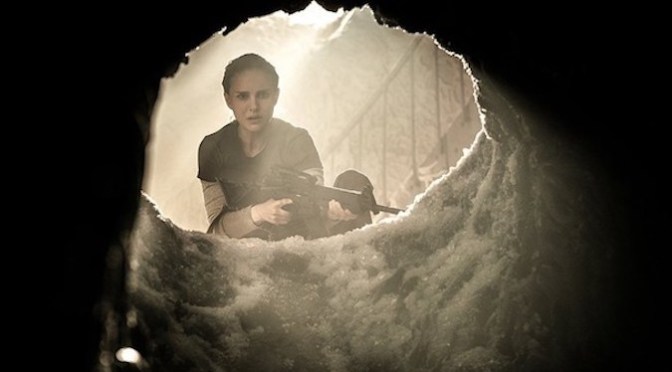
 In the climactic finale of Annihilation, there is a moment in which a shape-shifting alien bioclone with burning arms lovingly embraces a charred corpse in a lighthouse that has been struck by a meteor and overtaken by a mutated blight that threatens all life as we know it. Go ahead and read that sentence again if you have to. I dare you to try to come up with something so outlandish, so unsettling, so straight-up weird, much less deploy it at a crucial moment in a multimillion-dollar motion picture production. We live in a time where pretty much every sci-fi film with a budget this size (about $40 million) ends one way: explosions. The scripts all contain the same line: Big CGI Thing bursts into CGI flame. Heck, explosions probably typify the finale of most Hollywood films, sci-fi or otherwise, and the scripts for their inevitable sequels all contain the same line: Bigger CGI Thing bursts into bigger CGI flame.
 For better or worse, the most apparent quality of the first season of Jessica Jones was how out-of-place it felt amongst the rest of the Marvel Cinematic Universe continuity. If you’re accustomed to (or numbed by) Marvel’s
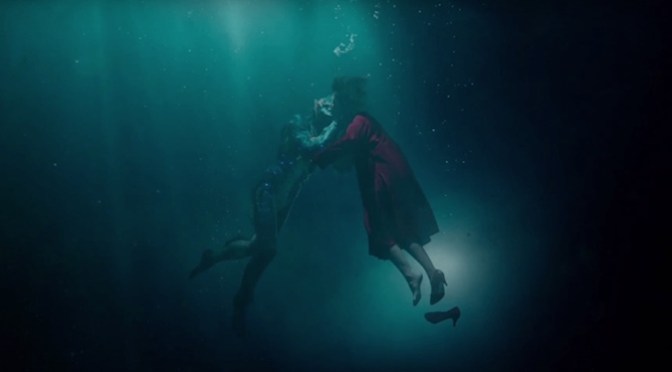
 I arrived late to the party for The Shape of Water, having finally caught the movie a few weeks ago after months and months of dodging reviews online. Guess I’d better add my voice to the fray, huh? Maybe a piece on how writer/director Guillermo del Toro’s creativity allowed him to get away with a smaller budget…but, no,
 There’s nothing quite like a good movie villain. If we’re talking about the Marvel Cinematic Universe, maybe you read this statement another way: there’s nothing quite like a good movie villain, anywhere. With the exception of Loki and a few other superbaddies, the MCU’s well-documented track record for weak villains has been the franchise’s persistent shortcoming. In much the same way as the villains of the Bond franchise became less and less interesting with each progressive installment, by this point you basically know what you’re getting in the Antagonist Department. At worst, the MCU gives us a paper-thin doppelgänger for the hero, a bland apocalypse-seeker with vague motivation, or whatever the heck Christopher Eccleston was supposed to be in Thor: The Dark World. At best, the MCU just gives us Loki for like the fifth time.
 Of the nine Best Picture nominees at this year’s Academy Awards, four of them — that’s a healthy 44% — address predatory love. Okay, maybe only three if you don’t include The Shape of Water, though, technically, yes, the protagonist is in love with a literal predator. Down to 33%, which is still a higher percentage than you’d expect from American awards season. Though I suppose Three Billboards Outside Ebbing, Missouri is never really about rape, only using that (as it used a number of other social issues) as a springboard for dramatic explorations of entirely different social issues. So, okay, fine: 22%.
 Early on in Phantom Thread I started thinking about the miniaturized nature of certain segments in the cinema of Paul Thomas Anderson. At the top of this latest film we see Reynolds Woodcock’s morning routine, clearly practiced to the point of automation, nearly mechanical, though the whole scene lasts less than thirty seconds. He shaves, he slicks his hair, he pulls on his big winecolored socks, his pants. And that’s it. The dressmaker is dressed. One might expect a little more extravagance from a film that’s ostensibly about high-end style and tailored beauty, no?
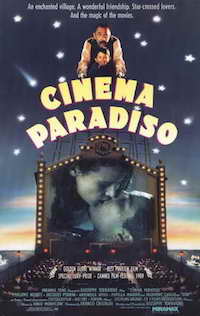 I’m not a big crier, but an exception can usually be made for Cinema Paradiso. I wasn’t too much older than young Toto when I first saw the film, and I held it together until the very end when a middle-aged Toto sits in reverent silence to watch the film left behind by his departed friend Alfredo. The film is a patchwork of clips deemed too pornographic by the village priest, kisses and sexual advances and tender embraces from dozens of different movies, cut and discarded for the sake of public decency. It is a mosaic of passion, free of dialogue, cobbled together by a blind man as a reminder of the place where Toto’s own passions were born. It brings him backwards in time. And if you’re Toto or a big baby like me, it’s a real tearjerker.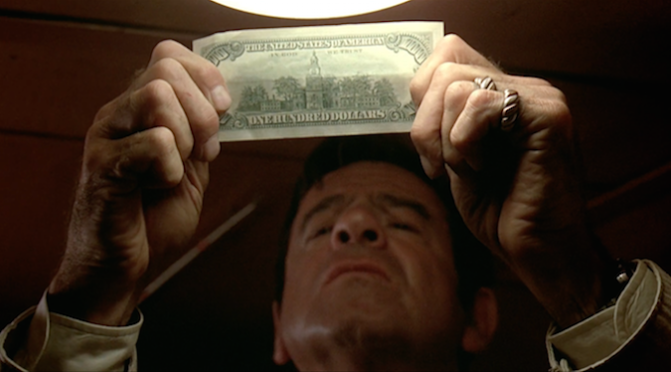
 Charley Varrick is one lucky guy. Odd, maybe, to associate “luck” with a man who botches a robbery and gets his wife killed, and odder still once he discovers that the money he does get away with belongs to the ruthless Mafia. Over the course of Charley Varrick poor Charley buries his wife, runs from the police, runs from the Mafia, loses his partner, loses his house, loses his plane, and spends a heck of a lot of time contending with the incompetence of others. Traditionally we call the person in this string of situations “unlucky.”
 Motion State Review