All posts by hangmantitan

Out of Africa (1985)

The “Out of Africa” theory of evolution posits that Homo sapien originated on the African continent and migrated to replace other hominid species, which is in direct contrast to the multiregional theory of human evolution (the “Multiregional Continuity Model”) positing the phenomenon of Homo sapien to be just that: a phenomenon, simultaneous across varied regions and indicative of some level of gene flow between geographically separated populations. Significantly, this gene flow would have prevented speciation after the dispersal, a somewhat unbelievable but not altogether impossible occurrence that nevertheless would seem to nudge all credibility in the direction of the Out of Africa model. Among the critical tenets of this hypothesis is the assumption that after Homo erectus migrated out of Africa the different populations became reproductively isolated, evolving independently and, in some cases — as with the Neanderthals — into separate species entirely.

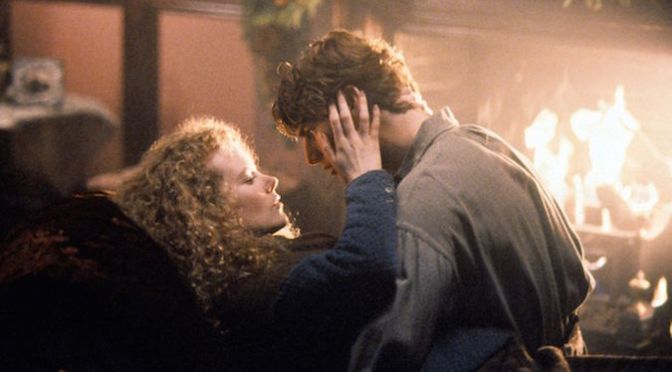
Thankfully, Sydney Pollack’s Out of Africa has nothing to do with any of that boring science stuff. Two nights ago the 88th Academy Awards granted Spotlight two major trophies, one for Best Original Screenplay and one for Best Picture, and so as usual a return to the past Picture winners seemed in order to see where we stand as a cinema-appreciating public. Is Spotlight better/worse than winners past? Did you see Spotlight? Did you enjoy it? Did you enjoy it at unprecedented best-film-of-the-entire-year levels? Did The Revenant or The Big Short deserve the trophy instead? Ah, of all sad words of tongue or pen!

Continue reading Out of Africa (1985)

Better Call Saul 2.3 – “Amarillo”

“Amarillo” incorporated a ton of thematic material from the first season of Better Call Saul, and in doing so became a pivotal chapter in the hilarious, sad tale of Jimmy McGill. There are callbacks to nearly every episode. Jimmy casts a spell on his phone as he did throughout the first season, starting in “Uno“. We have the return of the dimwitted film students from “Hero” and the Alpine Shepherd Boy from “Alpine Shepherd Boy“. Mike chomps on the same sandwich from “Pimento” and sits outside his daughter-in-law’s house as in “Five-O“. At one point Jimmy even whispers bingo as if to say, hey, we had an episode called “Bingo“.

Details like this are nothing new for Saul, and they don’t even take into account the hundreds of little callbacks/foreshadowing to companion series Breaking Bad (like Kaylee’s little pink elephant). At best, the high degree of subtlety with which these are employed makes for what Jimmy would call a rich tapestry, a comprehensive and highly believable narrative that can afford to veer into ridiculousness in plot due to the strong foundation of details and character quirks. At one point in “Amarillo” Jimmy approaches Clifford Main’s office and pauses outside the door. We hear faint guitar chords and then Jimmy walks away. The inclusion of those chords — which we know are from Clifford himself after his explanation in “Cobbler” — isn’t necessary by any means, but it reinforces the history behind the scene enough that we feel the history as Jimmy does.

Continue reading Better Call Saul 2.3 – “Amarillo”

Better Call Saul 2.2 – “Cobbler”

There’s nothing quite like a good ol’-fashioned Hoboken Squat Cobbler, amirite? You know what I’m talking about. A Full Moon Moon Pie. Seriously! Would I make this up?

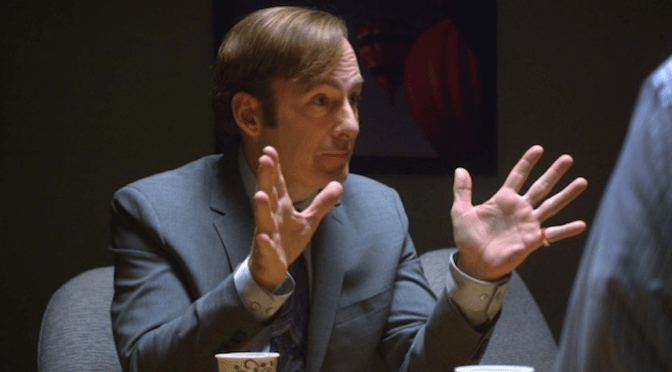
If Bob Odenkirk isn’t TV’s Best Funnyman then he’s certainly #2, right behind the unstoppably hysterical Louis C.K. or the endlessly quippy Stephen Colbert. Odenkirk’s advantage is that few comedians are a part of something as brilliant as Better Call Saul, and “Cobbler” might be a microcosm of the entire series in terms of tone and humor/drama balance. The season opener “Switch” was great, pulling back for some breathing room after the comparatively cataclysmic events of “Pimento” and “Marco” and allowing Jimmy some Me Time to reflect on his epic sibling rivalry with Chuck. We didn’t see Chuck or Mike (aside from the in-episode recap of the ending of “Marco”) and it was a refreshing change of pace.

Happily, bringing those characters back in full didn’t shake up the feeling of changing pace, nor did it feel as if those characters are anything but vital to Better Call Saul. Saul is definitely a true blood brother to Breaking Bad in the sense that a minor-seeming character like Pryce or Gale Boetticher can become a crucial piece of the whole puzzle, but the heart and soul reside in the core cast. “Cobbler” felt more like a return to greatness than “Switch” because that core was out in full force.

Continue reading Better Call Saul 2.2 – “Cobbler”

Man of Steel (2013)

Okay: let’s get linear.

The critical conversation surrounding Man of Steel has always been only moderately interesting at best, founded largely on qualms with Superman’s less-than-super demeanor and with the Metropolis-leveling final act of the film. There are no shortage of detractors who do their detracting based solely on Zack Snyder’s position in the director’s chair, which, okay, fine. I saw Sucker Punch in theaters. I hear you.

But that’s neither here nor there. Of all the labels to slap on Man of Steel — laudations and/or criticisms — the one we’re concerned with today is that of Most Non-Linear Time-Jumpy Superman Movie Ever Made. Yes, a high achievement, to be sure.

Continue reading Man of Steel (2013)

Better Call Saul 2.1 – “Switch”

Jimmy McGill is at any given time more than Jimmy McGill. He’s Slippin’ Jimmy, the scam artist specializing in falling on black ice and selling fake Rolexes. He’s “Charlie Hustle”, according to Howard Hamlin, the scrappy upstart lawyer with an unparalleled relentlessness. Eventually he’s Saul Goodman, the best possible lawyer to have provided you’re guilty. And eventually, in a post-Breaking Bad world, he’s Gene, the manager of the Cinnabon in that mall in Omaha. All of these personalities share what would appear to be major character traits, primarily a highly-charged relationship to the local criminal underworld and a serious gift of gab.

It’s what they don’t share, the traits that Jimmy sheds like dead skin as he moves from label to label, that find purchase in “Switch”. The first season of Better Call Saul surprised pretty much everyone by having a real emotional core to support the wicked humor, something that brought it fully into the deserving company of Breaking Bad. “Switch” strengthened that connective tissue in an important way, in a sort of add-by-subtracting way, drew nearer to it by moving further away. It’s vital that Saul measure up to Bad, but it’s far more vital that Saul stand as a strong series unto itself.

Continue reading Better Call Saul 2.1 – “Switch”

Batman: The Animated Series 1.32 – “Beware the Gray Ghost”

As an animator with an undeniably strong sense of visual storytelling, it’s perhaps not too much of a stretch to assume that Bruce Timm played with toys. Kids are kids, sure, and even the ones who don’t grow into animators with undeniably strong senses of visual storytelling still tend to love toys. But we might assume this love to be especially strong in the visual artists of the future, an unconscious recognition of the memorable facets of personality reflected in a color scheme or a suit or a pair of pointy black ears. Bruce, if you’re reading, feel free to comment with confirmation or denial of youthful toy-loving.

Whatever the case, the Timmverse is populated by designs from a toymaker’s dream. Classic characters — especially those most well-known rogues appearing in Batman: The Animated Series — get fresh, clear-eyed revivals, unmistakably cartoonish concepts that somehow mesh perfectly with the “Dark Deco” cityscapes of Gotham City. If you’re crafting miniature Batmans and Jokers and Riddlers and Catwomen for the kiddies to play with, both you and the kiddies are going to be happiest with the toys that look like Bruce Timm drawings. They’re simple, memorable, cohesive, and there’s nary a muddled line on any of the character designs. See for yourself.

Continue reading Batman: The Animated Series 1.32 – “Beware the Gray Ghost”

The Human Stain (2003)

The Human Stain tackles a great many things, with racism and African-American struggles being only the largest of the many themes at play. The dehumanizing power of racism is an undeniable part of America’s past, but it was every bit as important a discussion in the early years of the new millennium when the film came out. It’s every bit as important now at the time of writing and will be every bit as important there, where you are, in the future, at time of reading. As with anything so powerful, so socially destructive, the cultural perception ebbs and flows with time and with provocation. Do we remember that dark past? Do we really? Do we hold a part of it in secret? These questions pry at Coleman Silk, our “hero”. Before we delve into Coleman it must be noted that The Human Stain (the novel) should be a mainstay of every contemporary African-American literature curriculum, and it was written by an Old White Jewish Guy.

That guy is Philip Roth, an author so prolific that it’s surprising so few of his works have been adapted to the screen. The long-gestating adaption of American Pastoral, arguably Roth’s most famous work, is now looking set for the year ahead with Ewan McGregor taking on directing and starring duties. And the adaptation of Indignation just played at Sundance a few days ago to positive reviews, too, so maybe we’re in for a bit of a Roth resurgence in the same way No Country for Old Men prompted a scramble to adapt the best stuff by Cormac McCarthy. Here in The Land of Hypothetical Roth Adaptations we’d cast Johnny Depp as the possibly-demented Mickey Sabbath in Sabbath’s Theater, so when that happens in real life just know that you heard it here first.

Continue reading The Human Stain (2003)

Far and Away (1992)

At some indiscriminate point in the ’90s movie producers everywhere decided to simply stop caring about trying to get actors to do passable Irish accents. Can’t we try, begged writers and moviegoers and people from Ireland, at least try to make this sound accurate? We know it’s more appealing to have a major American beefcake rather than, say, an actual Irish guy playing the role of “actual Irish guy”, but can’t we spend the extra time/money to ensure this film won’t become a laughingstock in ten years, or five, or instantaneously? Please? Please?

Far and Away (1992)

We’ve charted a course backwards through movie time and discovered Far and Away to be one of the earliest and most egregious offenders. If not patient zero per se, Far and Away is effectively worse than the index case for presenting itself on the largest possible stage and thus spreading the Awful Irish Accent disease much more quickly. Prior to Far and Away a shitty accent was a shitty accent. After Far and Away, a shitty accent became a perfectly acceptable feature of a major blockbuster because Ron Howard and Tom Cruise and Nicole Kidman couldn’t be bothered to do better. Why should anyone else?

Continue reading Far and Away (1992)

Groundhog Day (1993)

Isn’t there some rule against repetition in storytelling? Most tales that purposely retread the same ground all over again do so lazily, a conceit allowed either because a concept begs the question (a la time travel tales) or simply because we, the audience, are feared to be too dimwitted to get it. Thus do Guy Ritchie movies and movies like The Illusionist regularly spend the entire climax copy-and-pasting stuff from the first half of the movie, albeit with a little added flair. Yes, we get it, it’s like poetry, they rhyme. Surely Orwell or Strunk and White have some preventative edict concerned with this brand of laziness, no? Surely repetition is the friend of the lazy writer, no?

Anyway, Happy Groundhog Day! Looks like little Phil didn’t see his shadow. Think we’ll be stuck in a time loop, forced to relive today over and over again? I gotta say: it’s 8:28 AM here and I can’t say I’m exactly thrilled with today’s results this far. Still have a ways to go, I know. Maybe starting over would actually be a good thing, though. I’ll be careful what I wish for. I’ll also be careful to remind everyone that this hysterical song is the theme for Groundhog Day:

Continue reading Groundhog Day (1993)

Spotlight (2015)

One appreciates how difficult it is to make a successful film like Spotlight. Yes, you have an A-list cast at your disposal, and yes, it’s Oscar season. They’re going for it. You have a true story that is quite literally already recorded for the public eye, plain as day, and besides the revelatory Spotlight newspaper clippings you have a vast backlog of coverage on the coverage, stories about the story. Yes, most of the real people who took part in that story are still alive and willing to participate in making a film about their achievements. And yes, the crucial win is already firmly in place: this is a highly relevant story, stranger than fiction but all the more urgent for being the truth.

Granted, there’s one massive pressure point in the expectations set by the aftermath of the sex abuse scandal in the Catholic Church. Director Tom McCarthy (“you” from the first paragraph) must have felt what Adam McKay felt in directing The Big Short, what David O. Russell felt in directing Joy, what Danny Boyle felt with Steve Jobs, what Don Cheadle felt with Miles Ahead. Any director dealing with the poster tagline Based On a True Story must ask “am I getting this right?”

Continue reading Spotlight (2015)