Category Archives: TV Review

Better Call Saul 2.8 – “Fifi”

It’s endlessly entertaining watching the montage — an old-fashioned, familiar, nearly-cliched storytelling device — and the cold open — a sort of newfangled, disorienting, “edgy” storytelling device — used to such loving and sincere effect throughout Better Call Saul. Both were hallmarks of Breaking Bad, too, from the “Crystal Blue Persuasion” cooking montage to the pesky little housefly of that third season episode. But here in Saul they’re more frequent and often more ambitious, and in “Fifi” there were multiple examples to this point.

Before we dive into those devices it’s worth noting that this is the home stretch of Saul‘s second season, and the arc has become superbly focused and compelling in ways that the earliest episodes of Season 2 (“Switch” and “Cobbler” in particular) hinted at ever-so-subtly. For a show about a guy who wears orange suits and wails on the bagpipes at the office, for a show built on flashy devices like the montage and the cold open, for a show peopled by characters as bombastic and iconic as any of the Salamancas…if the writing were equally outlandish we’d have an entirely different show. Instead, the character arcs intersect with intricacy and propel forward in subtle ways, lending no small degree of unease to the thematic undercurrent.
Continue reading Better Call Saul 2.8 – “Fifi”

Better Call Saul 2.7 – “Inflatable”

I knew while reviewing “Bali Ha’i“, last week’s episode of Better Call Saul, that I’d be eating my words not long after the following episode hit the airwaves. “Bali Ha’i” wasn’t at all a bad episode; on the contrary, it was full of tension and character development and that special Saul mix of humor and meaningful symbolism. But for the first time the Jimmy McGill storyline felt like second fiddle to the Mike Ehrmantraut storyline, mostly because the latter was about a highly personal slow-boil turf war and the former was about a file audit at a law office. Doesn’t take much to discern which one of those will be more gripping.

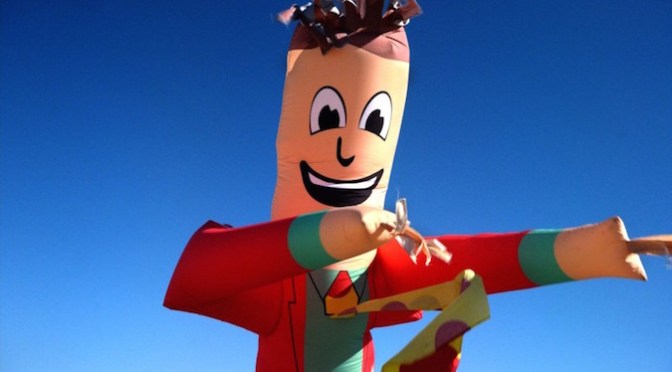
“Inflatable” did much more than put the focus back on Jimmy. After a cool flashback cold open showing some of the elements of the youthful genesis of Slippin’ Jimmy, “Inflatable” finally seemed to push Jimmy over the invisible threshold at the heart of the series itself. The conceit was always this: we watch Jimmy become Saul. In the same way that Walter White’s Mr. Chips becomes Scarface, Jimmy’s sensibilities are leading him toward a particular version of himself. One could argue that “Inflatable” is the episode where Jimmy finally becomes Saul.

Continue reading Better Call Saul 2.7 – “Inflatable”

Better Call Saul 2.6 – “Bali Ha’i”

For a minute there I forgot that Better Call Saul‘s main character was not in fact Mike Ehrmantraut, nor any of the other characters dominating the landscape of “Bali Ha’i”. Jimmy McGill is here, yes, and he’s probably got more time on screen than in the phenomenal preceding episode “Rebecca“. He has a nifty little cold open highlighting the fact that he’s the kind of guy who’s more comfortable in his shitty little office than he is in his cushy new digs. He pulls another barroom short con with Kim, as in “Switch“, and the two have a meaningful make-up session after weeks on the rocks. The end of the episode belongs to Jimmy, too, as he attacks his stupid little cupholder with a tire iron in order to finally make room for his travel mug.

But for what might be the first time since the beginning of the series, the A Storyline felt like the B Storyline and vice versa. Shifting from Mike to Jimmy, frankly, felt like downshifting. Partially this is because of where we are in the second season of Saul, coming off a solid mid-season episode and entering that spate of hours tasked with setting up the final few. Last season we had “Five-O” in this slot, which in fact had a grand total of one scene with the esteemed soon-to-be Mr. Goodman. The rest of that episode was about Mike.

Continue reading Better Call Saul 2.6 – “Bali Ha’i”

Better Call Saul 2.5 – “Rebecca”

Better Call Saul talks to itself. In this YouTube video about the various callbacks to Breaking Bad throughout the companion series Saul, showrunner Peter Gould refers to the “encyclopedia” of the world — the people, places, items, songs, sayings and histories of Bad and Saul — and there’s no doubt it’s an interesting way to craft a serial. We talked about the “slavish devotion to itself” present in both series in our review of this season’s opener “Switch“, but that phrase somehow makes it seem like a negative thing. So: Better Call Saul talks to itself. It talks to Bad, bringing back characters and diners and trinkets galore, but midway through the second season it’s able to turn heel and talk to itself as well. In “Rebecca” Jimmy returns to the courthouse where he spent his public defender days — seen largely in “Uno” and “Mijo” — and his return highlights both the ways in which he’s changed and the ways in which he hasn’t.

But Saul talks to us, too, and that can be a mark of a great show. Without being condescending or hand-holdy in the least, Saul pivots outward every now and then and asserts something that’s not exactly a callback or an easter egg per se; more of a cue, visual or otherwise, that acknowledges something that only the viewers would be able to appreciate. The people in the show may realize that there’s a connective thread running from the Salamancas to Mike Ehrmantraut to Saul Goodman and beyond, but there are other things that only the people outside the show would appreciate.

Continue reading Better Call Saul 2.5 – “Rebecca”

Better Call Saul 2.4 – “Gloves Off”

IGN said it best: Better Call Saul has high stakes, and yet somehow they’re mostly personal stakes. Yes, Mike’s storyline finds him embroiled in a dangerous and deceptive feud between Nacho and Tuco, wherein the stakes are most certainly life-and-death. Obviously Mike’s personal experiences and outlook play into his actions (more on that later), but when juxtaposed against Jimmy’s it’s clear that Mike deals with a lot of external factors in the form of predictable people. Tuco will kill Nacho someday, so Nacho takes the initiative to kill him first. Tuco will take the bait Mike lays out for him, and the police will arrive at around the time Mike intends them to arrive. Mike says to Nacho “Your Tuco Salamanca problem goes away,” with such certainty that before the plan is put into effect we’re already pleased with the result.

Jimmy’s side of the series is a little different, not because the people he’s surrounded by are any less predictable but because each of them is most concerned with their own personal reputation. If Mike fails there’s a distinct possibility it will end his life; if Jimmy fails it will end his career. Actually, “failing” to Jimmy now seems synonymous with “following all of the rules”, which would in fact result in him keeping his job, which everyone but Jimmy would likely deem “succeeding”. Saul asks us to see his side of things while positing that he’s the one who’s backwards, and never was that more clear than in “Gloves Off”.

Continue reading Better Call Saul 2.4 – “Gloves Off”

Better Call Saul 2.3 – “Amarillo”

“Amarillo” incorporated a ton of thematic material from the first season of Better Call Saul, and in doing so became a pivotal chapter in the hilarious, sad tale of Jimmy McGill. There are callbacks to nearly every episode. Jimmy casts a spell on his phone as he did throughout the first season, starting in “Uno“. We have the return of the dimwitted film students from “Hero” and the Alpine Shepherd Boy from “Alpine Shepherd Boy“. Mike chomps on the same sandwich from “Pimento” and sits outside his daughter-in-law’s house as in “Five-O“. At one point Jimmy even whispers bingo as if to say, hey, we had an episode called “Bingo“.

Details like this are nothing new for Saul, and they don’t even take into account the hundreds of little callbacks/foreshadowing to companion series Breaking Bad (like Kaylee’s little pink elephant). At best, the high degree of subtlety with which these are employed makes for what Jimmy would call a rich tapestry, a comprehensive and highly believable narrative that can afford to veer into ridiculousness in plot due to the strong foundation of details and character quirks. At one point in “Amarillo” Jimmy approaches Clifford Main’s office and pauses outside the door. We hear faint guitar chords and then Jimmy walks away. The inclusion of those chords — which we know are from Clifford himself after his explanation in “Cobbler” — isn’t necessary by any means, but it reinforces the history behind the scene enough that we feel the history as Jimmy does.

Continue reading Better Call Saul 2.3 – “Amarillo”

Better Call Saul 2.2 – “Cobbler”

There’s nothing quite like a good ol’-fashioned Hoboken Squat Cobbler, amirite? You know what I’m talking about. A Full Moon Moon Pie. Seriously! Would I make this up?

If Bob Odenkirk isn’t TV’s Best Funnyman then he’s certainly #2, right behind the unstoppably hysterical Louis C.K. or the endlessly quippy Stephen Colbert. Odenkirk’s advantage is that few comedians are a part of something as brilliant as Better Call Saul, and “Cobbler” might be a microcosm of the entire series in terms of tone and humor/drama balance. The season opener “Switch” was great, pulling back for some breathing room after the comparatively cataclysmic events of “Pimento” and “Marco” and allowing Jimmy some Me Time to reflect on his epic sibling rivalry with Chuck. We didn’t see Chuck or Mike (aside from the in-episode recap of the ending of “Marco”) and it was a refreshing change of pace.

Happily, bringing those characters back in full didn’t shake up the feeling of changing pace, nor did it feel as if those characters are anything but vital to Better Call Saul. Saul is definitely a true blood brother to Breaking Bad in the sense that a minor-seeming character like Pryce or Gale Boetticher can become a crucial piece of the whole puzzle, but the heart and soul reside in the core cast. “Cobbler” felt more like a return to greatness than “Switch” because that core was out in full force.

Continue reading Better Call Saul 2.2 – “Cobbler”

Better Call Saul 2.1 – “Switch”

Jimmy McGill is at any given time more than Jimmy McGill. He’s Slippin’ Jimmy, the scam artist specializing in falling on black ice and selling fake Rolexes. He’s “Charlie Hustle”, according to Howard Hamlin, the scrappy upstart lawyer with an unparalleled relentlessness. Eventually he’s Saul Goodman, the best possible lawyer to have provided you’re guilty. And eventually, in a post-Breaking Bad world, he’s Gene, the manager of the Cinnabon in that mall in Omaha. All of these personalities share what would appear to be major character traits, primarily a highly-charged relationship to the local criminal underworld and a serious gift of gab.

It’s what they don’t share, the traits that Jimmy sheds like dead skin as he moves from label to label, that find purchase in “Switch”. The first season of Better Call Saul surprised pretty much everyone by having a real emotional core to support the wicked humor, something that brought it fully into the deserving company of Breaking Bad. “Switch” strengthened that connective tissue in an important way, in a sort of add-by-subtracting way, drew nearer to it by moving further away. It’s vital that Saul measure up to Bad, but it’s far more vital that Saul stand as a strong series unto itself.

Continue reading Better Call Saul 2.1 – “Switch”

Batman: The Animated Series 1.32 – “Beware the Gray Ghost”

As an animator with an undeniably strong sense of visual storytelling, it’s perhaps not too much of a stretch to assume that Bruce Timm played with toys. Kids are kids, sure, and even the ones who don’t grow into animators with undeniably strong senses of visual storytelling still tend to love toys. But we might assume this love to be especially strong in the visual artists of the future, an unconscious recognition of the memorable facets of personality reflected in a color scheme or a suit or a pair of pointy black ears. Bruce, if you’re reading, feel free to comment with confirmation or denial of youthful toy-loving.

Whatever the case, the Timmverse is populated by designs from a toymaker’s dream. Classic characters — especially those most well-known rogues appearing in Batman: The Animated Series — get fresh, clear-eyed revivals, unmistakably cartoonish concepts that somehow mesh perfectly with the “Dark Deco” cityscapes of Gotham City. If you’re crafting miniature Batmans and Jokers and Riddlers and Catwomen for the kiddies to play with, both you and the kiddies are going to be happiest with the toys that look like Bruce Timm drawings. They’re simple, memorable, cohesive, and there’s nary a muddled line on any of the character designs. See for yourself.

Continue reading Batman: The Animated Series 1.32 – “Beware the Gray Ghost”

The Man in the High Castle 1.2 – “Sunrise”

The Man in the High Castle operates on one of the greatest what if? concepts in history: what if the Allies lost WWII? It’s somewhat of a miracle that this particular hypothetical alternate universe hasn’t already been made into fiction, considering the possibilities brought to mind by the premise alone. It was odder still that Philip K. Dick’s story only really came to light when it was optioned for a television show, considering how fantastic the book is. And the show’s pilot, which aired as a part of Amazon’s Pilot Season back in January, didn’t disappoint. We’re whisked across a mid-’60s America that might have been, an Orwellian totalitarian state consisting of an unsettling blend of the familiar and the strange. We’re in New York — but this isn’t New York. We’re in San Francisco — but something’s out of place here. And it’s not just that the buildings are plastered with propaganda (although they are); something darker has taken root and changed society, changed the people.

“Sunrise”, the second hour, throttled back a bit on all of that (everything’s still plastered in propaganda). Joe and Juliana, the NYC- and San Fran-dwelling protagonists of the pilot, have now met up in the Neutral Zone that makes up the middle third of the Once-United States. They’ve fled the Greater Nazi Reich and the Japanese Pacific States, respectively, for reasons that aren’t altogether dissimilar. Copies of the mysterious film known in hushed whispers as the work of the equally mysterious “Man in the High Castle” have been smuggled by each protagonist, which on the surface seems a well-wrought story structure. Here are the show’s two most interesting characters, bringing the show’s most interesting item to a central location, bringing the story inward from each coast.

Continue reading The Man in the High Castle 1.2 – “Sunrise”