Apocalypse Now (1979)

Oftentimes our “reviews” here at Motion State aren’t reviews at all, really, but just tangentially-related trivia-night factoids stretched into meandering essays posing as criticism (see here, here, here, here, here, herehere, and here, among others). Think sitting down for dinner and accidentally filling up on appetizers — every now and then it just happens. This is that, essentially, except today we’re filling up on dessert.

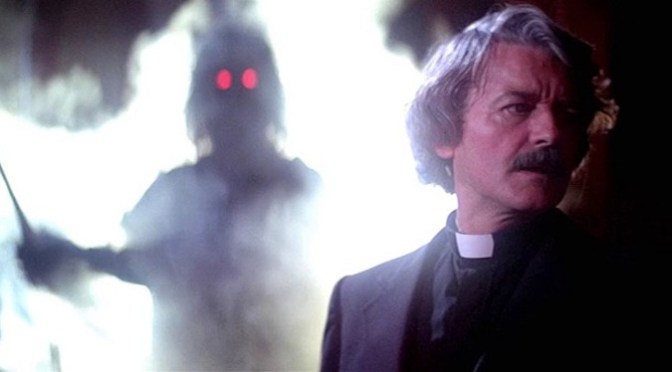
During the grueling production of Francis Ford Coppola’s seminal Apocalypse Now, his wife Eleanor took copious notes and video footage with an eventual resolve to distill it all into a documentary about the making of the film. She never found the proper “angle” for a documentary feature, but Notes on the Making of Apocalypse Now was eventually published in 1995. And the unedited, uncensored writings are probably a better peek into Apocalypse Now than a film would have been, because here there is no “angle” — there’s only the experience of being there as the film came together.

Continue reading Apocalypse Now (1979)

Sense8 – Season 1

Sense8 seems like the kind of show that began with the title, then developed an edgy concept to match/justify the title, then built a plot around the concept, then sort of accumulated characters to fill the whole thing out. That’s conjecture, of course, and of course there’s no “right” way to build a lasting story in the medium of television or otherwise. Lana and Andy Wachowski have been around the block, too, with the Matrix series, V for Vendetta, Cloud Atlas and their most recent film Jupiter Ascending among the numerous entries on their joint résumé. Their sci-fi movies are big, loud, and undeniably ambitious, and while the jury’s mostly still out on whether those movies are any good or not it’s certainly true that their concepts are highly original.

The concept of Sense8 is simultaneously the best thing about the series and the most frustrating. Eight people, spread across the world from San Francisco to Chicago to Mexico City to London to Berlin to Nairobi to Mumbai to Seoul, make a fascinating discovery about themselves: they are able to sense each other. Thoughts, feelings, secrets, emotions — regardless of the distance between them, these “Sensates” (get it?) share a bond that no one else can understand. They themselves don’t understand it for some time, and by the end of the first season there’s still a lot left to explore about the connection these eight people share.

Continue reading Sense8 – Season 1

Watchmen (2009)

Come senators, congressmen, please heed the call/ Don’t stand in the doorway, don’t block up the hall/ For he that gets hurt will be he who has stalled/ There’s a battle outside ragin’/ It’ll soon shake your windows and rattle your walls/ For the times they are a-changin’

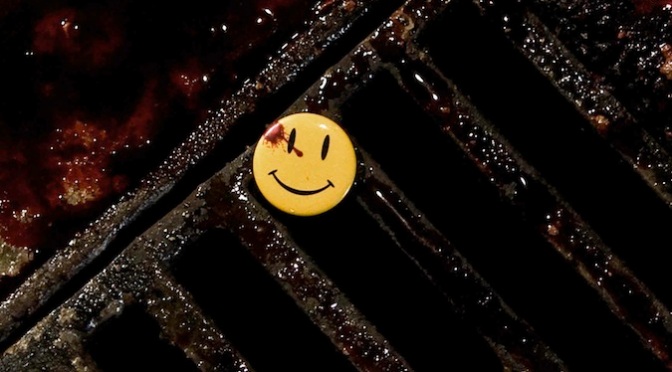
Those famous Bob Dylan lyrics set the scene for the changing times the viewer finds in Zack Snyder’s Watchmen. The year is 1985, but not your parents’ 1985. Richard Nixon is still president after triumphing in Vietnam thanks to Dr. Manhattan (Billy Crudup). However, it’s not all good news — the Cold War has escalated and the world is on the verge of nuclear Armageddon.

In this alternate universe, the superhero group the Watchmen have been forced into retirement. However, after one of their own Eddie Blake (Jeffrey Dean Morgan), the Comedian, is murdered, vigilante Rorschach (Jackie Earle Haley) concludes that someone must be trying to kill off the Watchmen.

Continue reading Watchmen (2009)

Film & TV News: June 15

News

  • The great Christopher Lee passed away earlier this week at 93. He’ll be remembered for countless roles, for Dracula, for Saruman in Lord of the Rings, for Count Dooku in Star Wars, and for his symphonic metal concept albums (yes).
  • Quentin Tarantino’s The Hateful Eight will be screened in 70mm, meaning theaters near you will either have to outfit their booths with new projectors or decide against screening a Tarantino flick. It’s a great power move by Tarantino, because once major theater chains have that capability alongside their digital projectors it opens the door for more films on actual film.
  • Videosyncrazy, David Fincher’s HBO series about the music video industry in the 1980s, has mysteriously halted production. No word on what the primary issue is, but as Fincher’s the perfect guy for a series like this we really hope the pieces get reassembled soon.
  • Pixar’s The Good Dinosaur, having already completed all of the voice work, has now turned around and completely recast nearly every voice actor. Production on this one has always been rocky, but Pixar’s no stranger to that. As long as it’s not called Cars, we’re safe.

Continue reading Film & TV News: June 15

Jurassic World (2015)

Right before Jurassic World started my seatmate turned to me and inquired after my favorite dinosaur. I didn’t have the heart to tell her that I hadn’t thought about what my favorite dinosaur was for a solid few years, that despite my boyish charms I actually wasn’t in third grade. I shrugged and said Tyrannosaurus. Good ol’ T. Rex is what would pop into my head if you approached me and said “dinosaur”, so maybe that kind of bias does qualify the stub-armed carnivore as a darling dino of mine. Seatmate agreed.

The more I weighed this pressing question the more I believed answering it to be a requisite for instant peace of mind. I was, I remembered, quick to raise an eyebrow when that Spinosaurus took down a T. Rex in Jurassic Park III — can they do that? This is T. Rex, Ancient King of the World, and he gets taken out by Dinosauria threequelae? And in the sequel The Lost World, which features a Tyrannosaurus loose on the mainland in the climax, we should really be honest about who we’re rooting for in that scenario. Though it traded the color and wonder of the first film for a considerably darker tone and palette, The Lost World succeeded in taking the bull of the first film and finding a more expensive china shop.

Continue reading Jurassic World (2015)

Netflix Picks #4

Matt: Remember the Titans director Boaz Yakin got his start with Fresh, a 1994 film about a 12-year-old drug dealer caught in a bad cycle with bad people. Young Fresh is a quiet kid living in a loud world. The housing project where his family lives is packed with people, and out on the street it seems sex and violence won’t leave him alone either. There’s a realness to Fresh that you don’t often see in coming-of-age tales, an earnestness that makes the movie seem less like the idealistic Titans and more like a David Gordon Green film. Fresh’s escape from the prostitutes, dealers and gangster-wannabes comes in the form of his estranged father (Samuel L. Jackson), who plays chess with Fresh every week. Sean Nelson, the 13-year-old kid who plays Fresh, turns in some amazing scenes with the veteran Jackson; their relationship is the core of the film, though the rest of that noise keeps encroaching on their meditative matches. As a whole, the blend of real-world urgency and sincere emotion makes Fresh compelling, distinctive and — sorry — refreshing.

Continue reading Netflix Picks #4

The Fog (1980)

Hollywood has a thing for remaking anything with John Carpenter’s name on it, even the snoozier stuff like The Fog. It almost never ends well. Whether or not you enjoy early Carpenter fare like Assault on Precinct 13 or Halloween, there’s little doubt that the remakes amount to nothing but unorganized grabastic pieces of amphibian shit. They remade The Thing recently, too, which approaches sacrilege, and they even had the gall to structure the thing (ha!) as a prequel of sorts without bothering to dream up a different title (like Dawn of the Planet of the Thing: Origins). We weren’t fooled: it’s a remake. Just last week a proposed remake of Big Trouble in Little China hit the internet because why the hell not? It’s there, isn’t it? What else are we supposed to do with it? Sit on the couch with Dwayne Johnson right there and everything and just watch it?

The Fog, Carpenter’s first studio feature after the unexpected success of Halloween, might have been one that could have been improved by a remake. The original contains a great deal of evidence as to why Carpenter’s films seem so remakeable, regardless of whatever the reason is that no one can seem to pull it off. 2007’s Halloween completely missed massive aspects of the original that made it good in the first place, as have most other Carpenter re-dos, but with The Fog there wasn’t much to worry about in that arena. The premise is straightforward and the execution in the original leaves much to be desired, based on a few things we’ll touch on here. But lo and behold: they quite literally hired the dude who directed Blank Check to helm the Fog remake, and the update managed to be so many zillion times worse than the already-not-that-great original. Go figure.

Continue reading The Fog (1980)

The Pawnbroker (1964)

I read The Pawnbroker at the wrong time. Jewish American author Edward Lewis Wallant published the thin novel, his second after The Human Season, a year before his untimely death in 1962. I wouldn’t be hitting the scene for another few decades, and by the time I did The Pawnbroker existed only in relative obscurity. I read it in college, where I sort of zipped through the little volume in between zipping through others.

In doing so, I read Sol Nazerman’s tale largely as a tale of urban woe. Those of suburban woe — by Updike, Cheever, O’Hara, and  even a few guys who weren’t named John — were in great supply back then, from Rabbit, Run to Bullet Park to Appointment in Samarra. These books had protagonists that were either downright miserable or just miserable without knowing it, perhaps indifferent to the constant comings and goings or the constant stillness of life around them, and in that feeble criteria they were all grouped together. Bernard Malamud’s The Assistant, about a Jewish shopkeeper in postwar New York, seemed a worthy companion to The Pawnbroker  because the protagonists seemed so similar. Assistant‘s Morris worked out of Brooklyn while Sol Nazerman’s pawnshop was in Harlem, but both were simply exhausted by life.

Continue reading The Pawnbroker (1964)

True Detective 1.8 – “Form and Void”

This review appeared shortly after the initial premiere of True Detective in early 2014 — slight edits have been made since the original posting.

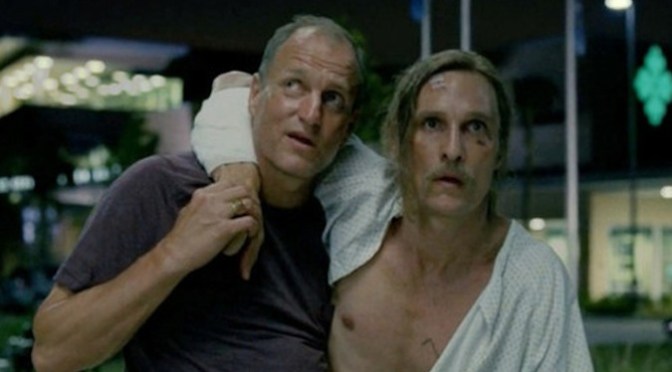
Everything leading up to last night’s conclusion to True Detective’s first season has been pretty stellar, setting the bar higher for the show as a whole than any other first season you care to name. The finale was so sought-after, in fact, that the HBO GO server overloaded and crashed due to such high demand, sending millions into despair over whether Rust and Marty would finally get their man. Last week’s episode “After You’ve Gone” served up a nice volley for the finale to knock down — and the eighth and final installment did just that. Needless to say, spoilers follow for the season one finale “Form and Void”.

Writer and showrunner Nic Pizzolatto dug himself into a hole in several ways with True Detective, foremostly by turning out a phenomenal, pitch-perfect pilot and a five-episode arc that brought with it the most intriguing hour “The Secret Fate of All Life”. I didn’t hear any major complaints after the first three episodes, and only when the fourth episode “Who Goes There” indulged in an action sequence did reviewers post fears about the show becoming “just another procedural”. Now, it seems, we have something of the reverse: “Form and Void” was inarguably, inescapably, and at times frustratingly revelation-free, instead providing a straightforward “resolution” where most fans pined for a major twist involving the unveiling of the Yellow King.

Continue reading True Detective 1.8 – “Form and Void”

The Third Man (1949)

Graham Greene only wrote The Third Man as a novella in order to better understand the tone and characterizations before committing the story to screenplay, so in a way Carol Reed’s film adaptation can’t really be considered an adaptation at all. It was Greene himself who penned the screenplay, although Reed and Orson Welles are said to have had strong influence on the resulting film, and the novella version of The Third Man was never intended to be published. Eventually it was published, paired with the even shorter novella The Fallen Idol, and so today we have further insight into the development of the story.

Reed, who helmed a few other Greene adaptations including The Fallen Idol and Our Man in Havana, understood the novels of the author in a way that few other directors can claim. The atmosphere of The Third Man is masterful, with the long shadows of hidden still-hunters creeping along Viennese landmarks and midnight cafés. The famous sewer scene still echoes today, just as the voices of the police echoed throughout the subterranean columned halls as they hunted the elusive Harry Lime. As a whole the film and the novella share the strongest aspects of atmosphere and characterization, which is why film clubs still pore over Reed’s film while a few doors down the hallway a literature course picks apart Greene’s book.

Continue reading The Third Man (1949)