All posts by hangmantitan

Manglehorn (2014)

Discovered an alternate universe the other day. Stumbled upon it by accident, stayed for a while to check it out. Pretty weird. Their eggs and ham are green and Transformers: Age of Extinction won Best Picture. Hoverboards are the primary mode of travel, everyone’s wearing Air McFlys. Don’t know why, but strong suspicion that George Bailey never existed. Can’t tell which universe is good and which is evil. Met their film director David Gordon Green and discovered him to be a talentless hack who sold out after making a few good movies and now just makes big budget stuff. He did the Oscar-winning Transformers. They’ve him to thank for those Batman/Terminator crossover movies and can look forward to his upcoming Star Wars anthology film R2-D2 Rises. In their universe David Gordon Green also directed Pineapple Express and Your Highness and The Sitter…ah, no, wait, that’s ours.

Thankfully, our David Gordon Green turned away from the big budget stuff in order to make movies like Manglehorn. While Bizarro DGG turned to the dark side and never came back, the chunk of studio comedies characterized by Pineapple ExpressYour Highness and The Sitter just seems like a temporary detour in our world. Even if you liked those flicks, the point stands that Green’s career has followed one of the more unpredictable paths you’re likely to find on any Hollywood résumé. His first several features were intimate character dramas, beginning with the phenomenal coming-of-age tale George Washington. Most were well-received and all were small-scale, independent features. Understandable, then, that when three green things converged — money, weed, and David Gordon — and resulted in Pineapple Express, more than a few eyebrows headed north.
Continue reading Manglehorn (2014)

The Electric Horseman (1979)

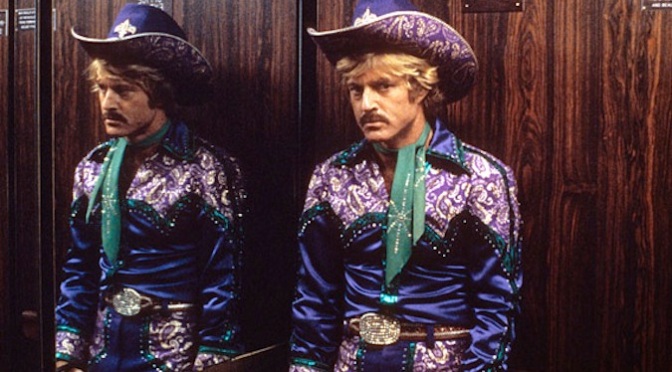
As the Annals of Film History come to resemble the Annals of Film Remakes more and more every day, one might suppose it’s only a matter of time before someone digs up The Electric Horseman and updates it with a modern twist. If we’re going by plot alone, Horseman has in fact already been remade a thousand times; there’s nothing earth-shatteringly original about the concept, or the characters, or the message, or the way the whole thing comes together. It’s very nearly your everyday run-of-the-mill romantic comedy, sharing a great many characteristics with all of those other romantic comedies, except for the fact that the romance outplays the humor at every turn. Horseman‘s a lot more enjoyable if you can manage to ignore genre classifications, or ignore the fact that you loathe country music. I’m happy to be your guide on both.

Mainly The Electric Horseman has something a lot of romantic comedies don’t: Robert Redford. Over the course of seven collaborations, Redford and Sydney Pollack essentially only made two films that weren’t structured around the romance of Redford’s character with a woman smitten by his jawline and just-visible chest hair. Both Jeremiah Johnson and Three Days of the Condor overshadow the likes of Horseman, but the other four romantic films — This Property is Condemned, The Way We Were, Out of Africa and Havana — probably do too. That’s without considering the zillion other films that Redford made in the ’70s, the busiest time in his career.

Continue reading The Electric Horseman (1979)

A Deadly Adoption (2015)

You have to put a lot of effort in if you want to get a perfect score in anything worthwhile, and the reverse is also true: if you want to score a pure 0%, you still have to work pretty damn hard. After forgetting to put your name at the top of the quiz, you basically need to know the right answers to all of the questions in order to then select the wrong answers, which, of course, begs the question as to why you didn’t just shoot for the A+ instead. This would be nearly paradoxical if it wasn’t just a plainly obvious certainty.

A Deadly Adoption is a bit like that, except that the people intentionally flunking the exam are getting paid handsomely to do it and their classmates are zipping around the playground after the period’s over spreading the word about how cool they are. Will Ferrell and Kristen Wiig have been getting pretty good grades so far, but now that the popular table has…aw, f*ck it. Extended metaphors are for the more involved. Besides, we’re talking about passing/failing something worthwhile, which is a thing A Deadly Adoption is absolutely not.

Continue reading A Deadly Adoption (2015)

True Detective 2.1 – “The Western Book of the Dead”

Most everyone is comparing last night’s premiere of True Detective‘s second season with all of the highs of the first, which is both an inevitability (it’s True Detective, after all) and an exercise in futility. For the purposes of our Season 2 reviews we’ll be largely ignoring Matthew McConaughey’s Rust Cohle and Woody Harrelson’s Marty Hart (trying, anyway) although some comparisons do hold favorably with the current cast of characters. Our recent piece “A Man Without a Family” touched on the various family circles throughout the first season, and it’s clear in characters like Colin Farrell’s Ray Velcoro and Rachel McAdams’s Ani Bezzerides that some themes are inherent to the show regardless of which season we’re in.

“The Western Book of the Dead” was jam-packed with stuff, juggling a handful of protagonists and delving into flashbacks and allusions to mysterious pasts. Ray, a California cop in the Vinci Police Department, is introduced to us as the father of a young boy. The kid’s afraid of his classmates picking on him, but Ray seems tender and loving in his encouragements. “Be proud,” he says. When we discover that Velcoro’s kid is likely  product of the years-ago violent rape of his wife, our picture of Ray the Loving Father starts to disintegrate. By the end of the episode he’s ripped into his son, driven to the home of the kid that’s been bullying him, and beaten the father of that kid to hell while making the kid watch. The beauty in the fact of watching this scene on Father’s Day is not lost on me.

Continue reading True Detective 2.1 – “The Western Book of the Dead”

Slow West (2015)

These days, Westerns seem to either be smaller art-house fare or destined box-office flops. Michael Agresta’s phenomenal article “How the Western Was Lost (and Why It Matters)” touches on a few reasons why — see The Lone Ranger, Cowboys & Aliens, Jonah Hex, or don’t see them — and a few reasons the erosion of the genre marks a sad day for American Cinema. Agresta is mainly writing about the public perception of the Western and not necessarily about whether Jonah Hex is any good or not (it’s not), and so the commentary on the smaller art-house stuff is limited. He’d agree, though, I think, that the more limited platform of independent and small-studio filmmaking is where the majority of “good” Westerns are being produced these days.

And Slow West is somewhat of an interesting film to consider in the larger context of The American Western, a long-standing genre with a hugely important but slightly malleable history as outlined by Agresta. Starring Kodi Smit-McPhee as the young dreamer Jay and Michael Fassbender as the mysterious drifter Silas, Slow West is an undeniably style-heavy piece that takes full advantage of the fact that it’s not a big-budget tentpole. In doing so, the film retains a self-awareness that manages to be less wink-wink than you might expect.

Continue reading Slow West (2015)

True Detective (2014): A Man Without a Family

Our Take Two column offers second opinions and alternative angles on films and TV series reviewed elsewhere on Motion State. See below for our original reviews of True Detective.

“Past a certain age,” advises Marty Hart, “a man without a family can be a bad thing.” This is 2012 Hart, slightly overweight Hart, reelin’-in-the-years Hart. This is the Hart that’s about to recount the majority of the events of True Detective‘s first season, the 1995 Dora Lange case that the retired detective has long since considered closed. This is also the version of Martin Hart that no longer has a family — he’s cheated on his wife repeatedly, notably in 1995 and again in 2002, and so she and the kids have long since left. After seventeen years he’s still the same person, though, as it’s very Hart-like that he should describe himself with such accuracy without even meaning to do so.

Family is a major theme at the center of True Detective‘s rookie year, and Hart’s judgement begins to reveal why. He approaches his family with more or less the same mentality he applies to his job as State Police Detective: it’s duty. His is the American nuclear family, traditional in the way that would make social conservatives nod in approval, with working father, aproned mother, two daughters, a front lawn, a white picket fence. To Marty this is very much a patriarchal nuclear family, which casts him as father in the primary role of moral authority, social privilege, property control, etc. Though our perception of this slowly erodes over the course of the eight-episode season, Marty, years later in 2012, refuses to believe anything else to be the case.

Continue reading True Detective (2014): A Man Without a Family

Apocalypse Now (1979)

Oftentimes our “reviews” here at Motion State aren’t reviews at all, really, but just tangentially-related trivia-night factoids stretched into meandering essays posing as criticism (see here, here, here, here, here, herehere, and here, among others). Think sitting down for dinner and accidentally filling up on appetizers — every now and then it just happens. This is that, essentially, except today we’re filling up on dessert.

During the grueling production of Francis Ford Coppola’s seminal Apocalypse Now, his wife Eleanor took copious notes and video footage with an eventual resolve to distill it all into a documentary about the making of the film. She never found the proper “angle” for a documentary feature, but Notes on the Making of Apocalypse Now was eventually published in 1995. And the unedited, uncensored writings are probably a better peek into Apocalypse Now than a film would have been, because here there is no “angle” — there’s only the experience of being there as the film came together.

Continue reading Apocalypse Now (1979)

Sense8 – Season 1

Sense8 seems like the kind of show that began with the title, then developed an edgy concept to match/justify the title, then built a plot around the concept, then sort of accumulated characters to fill the whole thing out. That’s conjecture, of course, and of course there’s no “right” way to build a lasting story in the medium of television or otherwise. Lana and Andy Wachowski have been around the block, too, with the Matrix series, V for Vendetta, Cloud Atlas and their most recent film Jupiter Ascending among the numerous entries on their joint résumé. Their sci-fi movies are big, loud, and undeniably ambitious, and while the jury’s mostly still out on whether those movies are any good or not it’s certainly true that their concepts are highly original.

The concept of Sense8 is simultaneously the best thing about the series and the most frustrating. Eight people, spread across the world from San Francisco to Chicago to Mexico City to London to Berlin to Nairobi to Mumbai to Seoul, make a fascinating discovery about themselves: they are able to sense each other. Thoughts, feelings, secrets, emotions — regardless of the distance between them, these “Sensates” (get it?) share a bond that no one else can understand. They themselves don’t understand it for some time, and by the end of the first season there’s still a lot left to explore about the connection these eight people share.

Continue reading Sense8 – Season 1

Jurassic World (2015)

Right before Jurassic World started my seatmate turned to me and inquired after my favorite dinosaur. I didn’t have the heart to tell her that I hadn’t thought about what my favorite dinosaur was for a solid few years, that despite my boyish charms I actually wasn’t in third grade. I shrugged and said Tyrannosaurus. Good ol’ T. Rex is what would pop into my head if you approached me and said “dinosaur”, so maybe that kind of bias does qualify the stub-armed carnivore as a darling dino of mine. Seatmate agreed.

The more I weighed this pressing question the more I believed answering it to be a requisite for instant peace of mind. I was, I remembered, quick to raise an eyebrow when that Spinosaurus took down a T. Rex in Jurassic Park III — can they do that? This is T. Rex, Ancient King of the World, and he gets taken out by Dinosauria threequelae? And in the sequel The Lost World, which features a Tyrannosaurus loose on the mainland in the climax, we should really be honest about who we’re rooting for in that scenario. Though it traded the color and wonder of the first film for a considerably darker tone and palette, The Lost World succeeded in taking the bull of the first film and finding a more expensive china shop.

Continue reading Jurassic World (2015)

The Fog (1980)

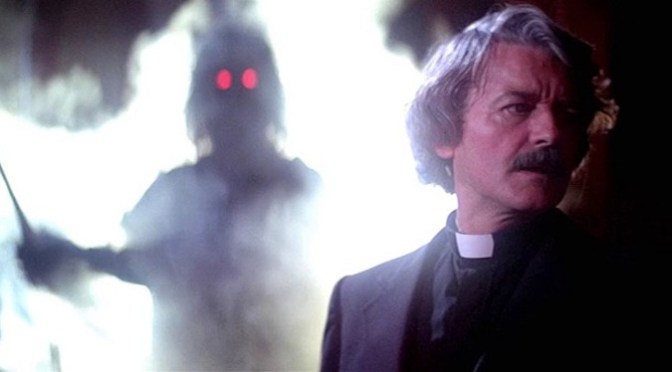
Hollywood has a thing for remaking anything with John Carpenter’s name on it, even the snoozier stuff like The Fog. It almost never ends well. Whether or not you enjoy early Carpenter fare like Assault on Precinct 13 or Halloween, there’s little doubt that the remakes amount to nothing but unorganized grabastic pieces of amphibian shit. They remade The Thing recently, too, which approaches sacrilege, and they even had the gall to structure the thing (ha!) as a prequel of sorts without bothering to dream up a different title (like Dawn of the Planet of the Thing: Origins). We weren’t fooled: it’s a remake. Just last week a proposed remake of Big Trouble in Little China hit the internet because why the hell not? It’s there, isn’t it? What else are we supposed to do with it? Sit on the couch with Dwayne Johnson right there and everything and just watch it?

The Fog, Carpenter’s first studio feature after the unexpected success of Halloween, might have been one that could have been improved by a remake. The original contains a great deal of evidence as to why Carpenter’s films seem so remakeable, regardless of whatever the reason is that no one can seem to pull it off. 2007’s Halloween completely missed massive aspects of the original that made it good in the first place, as have most other Carpenter re-dos, but with The Fog there wasn’t much to worry about in that arena. The premise is straightforward and the execution in the original leaves much to be desired, based on a few things we’ll touch on here. But lo and behold: they quite literally hired the dude who directed Blank Check to helm the Fog remake, and the update managed to be so many zillion times worse than the already-not-that-great original. Go figure.

Continue reading The Fog (1980)