
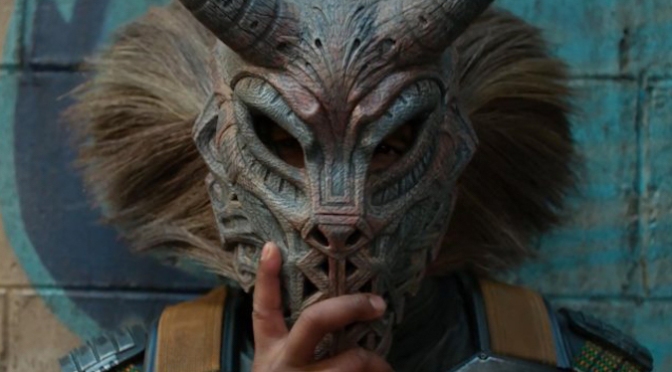
 There’s nothing quite like a good movie villain. If we’re talking about the Marvel Cinematic Universe, maybe you read this statement another way: there’s nothing quite like a good movie villain, anywhere. With the exception of Loki and a few other superbaddies, the MCU’s well-documented track record for weak villains has been the franchise’s persistent shortcoming. In much the same way as the villains of the Bond franchise became less and less interesting with each progressive installment, by this point you basically know what you’re getting in the Antagonist Department. At worst, the MCU gives us a paper-thin doppelgänger for the hero, a bland apocalypse-seeker with vague motivation, or whatever the heck Christopher Eccleston was supposed to be in Thor: The Dark World. At best, the MCU just gives us Loki for like the fifth time.
And then Black Panther came along.

 Of the nine Best Picture nominees at this year’s Academy Awards, four of them — that’s a healthy 44% — address predatory love. Okay, maybe only three if you don’t include The Shape of Water, though, technically, yes, the protagonist is in love with a literal predator. Down to 33%, which is still a higher percentage than you’d expect from American awards season. Though I suppose Three Billboards Outside Ebbing, Missouri is never really about rape, only using that (as it used a number of other social issues) as a springboard for dramatic explorations of entirely different social issues. So, okay, fine: 22%.
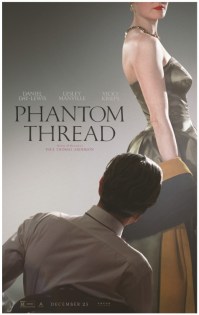 Early on in Phantom Thread I started thinking about the miniaturized nature of certain segments in the cinema of Paul Thomas Anderson. At the top of this latest film we see Reynolds Woodcock’s morning routine, clearly practiced to the point of automation, nearly mechanical, though the whole scene lasts less than thirty seconds. He shaves, he slicks his hair, he pulls on his big winecolored socks, his pants. And that’s it. The dressmaker is dressed. One might expect a little more extravagance from a film that’s ostensibly about high-end style and tailored beauty, no?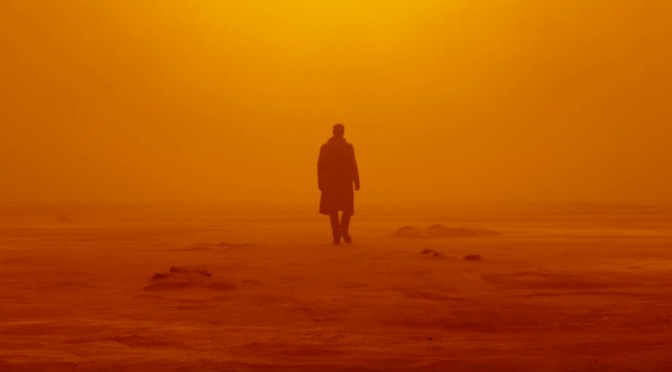
 One of the previews that screened before last night’s Boston premiere of Blade Runner 2049 was for next year’s monsters vs. robots actioner Pacific Rim Uprising, an inevitable if somewhat tardy sequel to Guillermo del Toro’s 2013 original. Based solely on this trailer, it’s evident that Uprising centers on the son of the first film’s protagonist, alludes heavily to that first film, and possibly just revamps the plot with slightly louder explosions. I was reminded, regrettably, of Independence Day: Resurgence, which gave off a similar reek of franchise desperation.
 I recently watched Edgar Wright’s Hot Fuzz for the zillionth time. This was partly to assuage my excitement for Baby Driver, Wright’s latest, and partly because the discovery of a commentary track by Wright and his buddy Quentin Tarantino was too good to pass up. Usually commentary tracks feel slight, strained, straight-up unnecessary; Wright and Tarantino have a casual chat that’s nearly as bonkers as Hot Fuzz itself. The pair share a vast encyclopedic knowledge of film and music, and throughout the course of the commentary they discuss nearly 200 films — basically everything besides Hot Fuzz — and if you’re thinking someone should write out that list, well, yeah:


 Motion State Review