Category Archives: TV Review

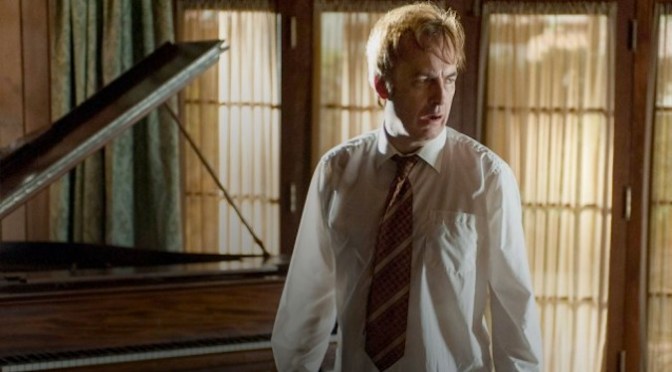
Better Call Saul 1.5 – “Alpine Shepherd Boy”

We’ve talked a lot over the course of the last few reviews about how Better Call Saul fares in relation to predecessor Breaking Bad. We’ve talked about Jimmy’s character, his moral standing and his concern over the presentation of his image. We’ve talked about the supporting cast and about the beautifully Bad-like cinematography, we’ve talked about the brilliant set pieces in episodes like last week’s “Hero“, and we’ve talked about how all of this adds up to something that ties into the original show but also stands alone.

We’ve also mentioned in passing that Saul has a good sense of humor, but the latest episode “Alpine Shepherd Boy” demands a somewhat more straightforward dispatch: Saul is funny. Really funny. Jimmy has the dark wit and sheer quotability we know makes Saul Goodman such a fun character (“Don’t drink and drive — but if you do, call me!”) and in Saul he obviously gets a lot more time to shine. In Bad he was kind of the comic relief (although that phrase kind of plays down his importance, doesn’t it?) and much-needed muscle relaxant amongst the insanity of Walter White’s crusade. Bad focused on the drama — Saul, while still a fledgeling series, has already found a way to play with that focus.

Continue reading Better Call Saul 1.5 – “Alpine Shepherd Boy”

Better Call Saul 1.4 – “Hero”

S’all good, man. Our lovable lawyer Jimmy McGill states categorically that he’s “no hero” during the third episode “Nacho“, and a large part of the fourth episode “Hero” seeks to play with that assertion. It also seeks to play with our expectations (much as I despise the phrase “play with our expectations”) about Jimmy’s transformation into Saul, revealing more about his past in the process.

The set-up for most of the episode is Jimmy’s purchase of a brand-spanking-new billboard advertising his fledgeling firm. He buys a new suit (the exact same suit his rival Hamlin wears) and creates a new logo (very nearly the exact same logo as the logo of Hamlin, Hamlin and McGill). He almost dyes his hair but decides to just photoshop the hairdo on the billboard picture instead. And when disaster strikes, our hero springs into action in what ends up being exactly what we’d expect from him — old dog, old tricks, new suit and haircut.

Continue reading Better Call Saul 1.4 – “Hero”

The Red Road 1.1 – “Arise My Love, Shake Off This Dream”

Though True Detective devoured nearly all of last year’s television glory, the SundanceTV series The Red Road deserves mention in the same breath. Massively overlooked but strong enough to be renewed for a second season (which premieres April 2015), the show centers on a small New Jersey town in the foothills of the Ramapo Mountains. Decades of rough history between the town locals and the Lenape Native American tribe begins to flare up again, and two men — Officer Harold Jensen (Martin Henderson) and ex-convict Phillip Kopus (Jason Momoa) — become wrapped up in the middle.

Created by Aaron Guzikowski (writer of Prisoners), The Red Road brings that rough history into the present in a way that few series dare. At times it’s made explicit, especially in scenes recounting the death of Harold’s brother-in-law as members of the Lenape tribe (maybe even Kopus himself) stood by. Those scenes are compelling, but it’s the mysterious, unseen aura of Us vs. Them that really gives The Red Road serious clout, vibing uneasily in every sequence. Is it racism? Or is it simpler, illogical and obdurate hatred, free of any and all motivation, free as a virus in the mountainside community?

Continue reading The Red Road 1.1 – “Arise My Love, Shake Off This Dream”

Better Call Saul 1.3 – “Nacho”

Money makes people do crazy things. Though “Nacho” was ostensibly a slower episode than “Uno” and “Mijo“, the third hour of Better Call Saul took a deeper look into the good and the bad inside Jimmy McGill. The Kettleman Family, who are at this point kind of like Breaking Bad‘s Elliott and Gretchen in the way they relate to the larger plot, not only drew out this dark side/light side conflict in Jimmy but will almost certainly continue to do so in the upcoming episodes.

And as usual, a lot of that conflict and drama was implied or depicted through action. Allowing his conscience to get the better of him after accidentally imparting the knowledge of Nacho’s plan to rob the Kettlemans to his friend Kim — a new character and seeming love interest — Jimmy anonymously tips the unwitting family off to Nacho’s plan. But none of this is painfully obvious until it happens, and the expected epiphanic conscience-awakening moment is played down in favor of a more methodical and strangely exciting sequence.

Continue reading Better Call Saul 1.3 – “Nacho”

Better Call Saul 1.2 – “Mijo”

“Mijo” was arguably as much of an introduction to Better Call Saul as the pilot episode “Uno“, lacking only a colorless flash-forward to signify the end of an era and simultaneously herald a new one. Though both episodes introduced important new characters and quickly solidified the tone of the series, “Mijo” already began to show signs of peeling away from the influence of forefather Breaking Bad.

A certain someone popped up at the end of the pilot and played a huge role in this second episode — for the sake of those yet to watch, we’ll save that reveal until after the jump. Abandon all hope, ye who have not watched Better Call Saul!

Continue reading Better Call Saul 1.2 – “Mijo”

The Affair 1.8

Another relatively slow episode of The Affair comes at the exact wrong time, in the eighth hour, with only two more to go before season one wraps. Episode seven was solid and did much to dispel fears that the show had been strong out of the gate only to lose steam along the way to the finish line. Hour eight, however, seemed to lose a bit of that footing.

One thing that the show kind of flirted with early on but never fully succumbed to was the way-too-common device of having every family member have a massive number of personal problems. The elder Son of Solloway Martin is angsty and inimical in the way most teenage boys are, Whitney is angsty and inimical in the way most teenage girls are, and poor little Trevor just wants someone to pay attention to him — this was the set-up, more or less, over the first chunk of episodes, and it was believable and relatable.

Continue reading The Affair 1.8

Better Call Saul 1.1 – “Uno”

While the most obvious question was probably about how to spin a new series out of Breaking Bad, the more infrequent dilemma considered whether Better Call Saul even should be a new series. The idea of fidgeting with Bad at all is a tricky one. If you’re Bryan Cranston it’s probably a tough situation: on the one hand if you’re asked to step into Walt’s shoes again then of course you say yes, but on the other you maybe feel you’ve already done your job. You’ve done your job incredibly well, and a return might threaten to slide you into one-trick-pony status.

Though Cranston’s nowhere to be seen in the opening episode of Saul, Walt’s influence is still apparent. A nifty black-and-white intro is certainly set after the events of Breaking Bad, and we discover that Saul’s prediction about his future employment at a Cinnabon in Nebraska was prophetic. We also discover that the guy fears for his life as he pounds cinnamon into dough hour after hour, catching menacing glances from well-meaning customers. He’s miserable, and it’s both Walt’s fault and his own.

Continue reading Better Call Saul 1.1 – “Uno”

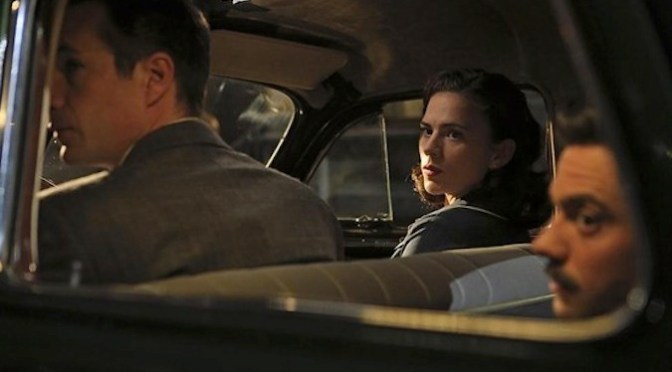
Agent Carter 1.4 – “The Blitzkrieg Button”

In this episode Peggy Carter is given the all-enviable task of taking the lunch order at the S.S.R. precinct, and the fourth hour of Agent Carter only sporadically raises the excitement level above that low threshold. The sentiment was more or less the same during the previous episode “Time and Tide”: with only eight episodes in total, is there really enough time to spend on lunch order gags and Stan Lee cameos?

The good thing is that the executive producers of Agent Carter did confirm that the show is not a miniseries after all, despite that being the impression nearly everyone was under up until this point, and that a second season is a possibility. If so, a slower approach can certainly work. Still, though, even as each episode is full of stuff to like, it seems as if Agent Carter is less interested in telling a cohesive story and more interested in tying everything back to the Marvel Cinematic Universe.

Continue reading Agent Carter 1.4 – “The Blitzkrieg Button”

Agent Carter 1.3 – “Time and Tide”

Not exactly a rock ’em sock ’em hour for Agent Carter in the third episode “Time and Tide”, which is a shame considering the season/series is only slated for eight episodes in total. That’s not a lot of time to gather a head of steam, and while Agents of S.H.I.E.L.D. took a solid fifteen episodes before really breaking interesting ground Agent Carter has no such luxury. It’s fortunate, then, that Hayley Atwell and James D’Arcy remain so watchable in this otherwise droll episode.

Following the death of the mysterious Brannis at the end of “Bridge and Tunnel”, Peggy is left with a partial symbol and a whole host of questions regarding the theft of Howard Stark’s inventions. The symbol kind of looks like a heart, and so Peggy goes digging. She consults the Book of Symbols on her bedside (sigh) and makes a shocking discov — oh, no, sorry. This doesn’t seem to lead anywhere. Okay. Move along.

Continue reading Agent Carter 1.3 – “Time and Tide”

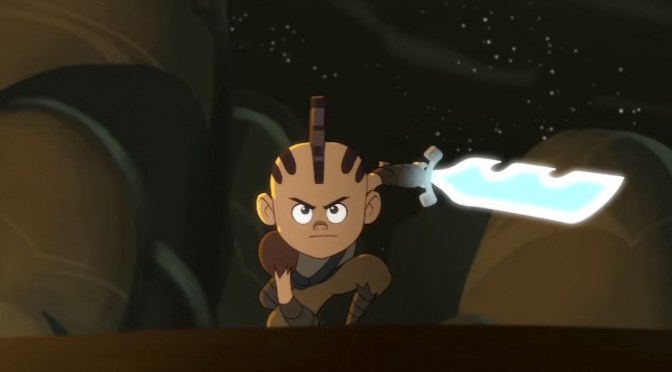
Niko and the Sword of Light 1.1

Much has been written about Amazon’s Pilot Season, particularly its live-action slate–and with good reason, judging from potentially great new shows like The Man in the High Castle. As for the animated fare, critics have been criminally silent–possibly with good reason, judging from titles like The Stinky & Dirty Show. But their first mistake is lumping those shows together with Niko and the Sword of Light. (Their second mistake is probably assuming that animation has nothing new to offer.)

Niko started out as a carefully crafted motion comic. Actually, it started as a labor of love by a group of storyboard artists, concept designers, and animators from several high profile studios. But thanks to a successful Kickstarter campaign, Niko’s journey can now be purchased and experienced on iPads everywhere. These adventures follow the last human boy as he seeks to rid his savage land of the darkness that’s consumed it. With the help of a sword (of light, naturally) and a strange host of creatures he meets along the way, Niko braves countless enemies and discovers more mysteries about his past. Continue reading Niko and the Sword of Light 1.1