Face Off: Othello (1952) and O (2001)

Motion State Face Offs pit two films, franchises, or television series against each another for no reason other than because we can.

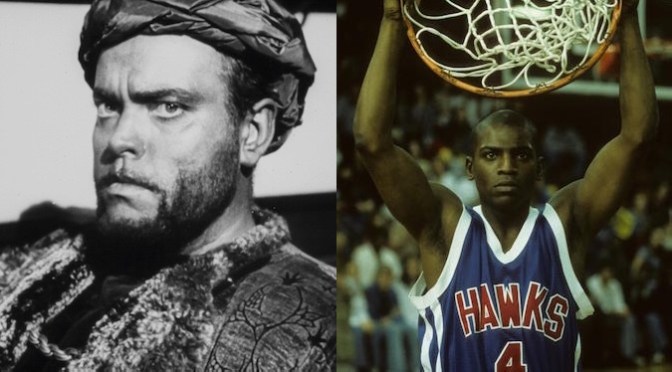
In sharp contrast to the veritable torrent of Hamlet adaptations, it’s somewhat surprising that a Shakespeare tragedy as popular as Othello has so few major film versions. The first is Orson Welles’s 1952 adaptation, featuring the man himself in both the title role and the director’s chair. The most recent, oddly enough, at least as far as explicit-made-for-film versions, is 2001’s O, a modern update that you may or may not consider a true film adaptation of the play. Sure, there are a ton of films that fall in the middle ground. Do filmed theatrical productions count? Do modern updates like O count, and if so, do we consider films that have an even more tenuous link to the play?

Why do we care? might be the actual question on your tongue right now, but if you’ve ever enjoyed Shakespeare at all you’re probably aware of the fact that no two adaptations of the same play are ever the same. How has Othello changed from the first film adaptation to the most recent version? Is there anything that remained from the Welles version, working its way in to the Shakespeare tale such that O becomes an adaptation of both? If this is interesting to you, then this article will explore all of that; if you’re not interested, this article will still explore all of that.

Continue reading Face Off: Othello (1952) and O (2001)

Hateship Loveship (2013)

Generally speaking, when one goes into a movie, they have a certain set of expectations. If it’s a horror movie, they expect to be scared; if it’s a thriller, they expect to be on the edge of their seat; if it’s a love story, they expect to be moved, and so on and so forth. If you see Hateship Loveship, here’s my best piece of advice: don’t have any expectations.

Hateship Loveship is advertised as a rom-com, but it is far from it. In fact, it might as well be genre-less. This doesn’t mean it’s bad – in fact, it’s pretty good once you can accept that it’s not a comedy at all – but it does mean that if you go in to it expecting it to be your traditional quirky, funny love story, you’re going to end up disappointed.

Continue reading Hateship Loveship (2013)

Better Call Saul 2.10 – “Klick”

For a season finale as understated as “Klick”, concluding the second-season run of a show as understated as Better Call Saul, an awful lot happened in one hour. Time and again we find ourselves referring to Saul in terms of a balancing act — between comedy and drama, between moral and immoral, between sympathetic and pathetic, between action and inaction. “Klick” lived in a few of those spaces, none more obvious than the space between subtlety and downright ridiculousness. Saul on the whole thrives in this balancing act, and in part it’s forced to do so by the predecessor Breaking Bad. Saul has to balance restraint with forward progress, treading lightly so as to remain interesting while not intruding on Bad‘s storylines.

Take the first scene of “Klick”, veering toward the latter on the scale spanning subtlety and ridiculousness. Jimmy and Chuck sit by their ailing mother’s hospital bed, Mrs. McGill lying unconscious as she closes in on death. It’s been a while, apparently, and so Jimmy recommends they go get hoagies. Chuck declines — he won’t leave his mother, not now. Jimmy? Yeah: Jimmy wants a hoagie. So Jimmy goes to get a hoagie. When he’s alone with his silent mother Chuck breaks down, perhaps remembering how Jimmy screwed his father over right before his expiration date. Chuck cries because if his mother dies then it will just be him and Jimmy, which in Chuck’s mind is tantamount to it just being him.

Continue reading Better Call Saul 2.10 – “Klick”

The League of Extraordinary Gentlemen (2003)

“The planet of the imagination is as old as we are.”

A writer may find that having a particular way with words is somewhat valuable to the craft, potentially essential, undeniably rare, exhilaratingly natural. Some may be taken aback by the words of others and seek to do the same with their own, maybe even coming to take it for granted if that way with words becomes a familiar way. Writing is sharpening, and just as a pitcher pitches to improve his pitching so too does a writer write to improve his writing. Some, like Ezra Pound, recognize that words are tools and there is a correct tool for a particular job. There is in fact a correct way to tell a particular story. Some, like Alan Moore, recognize that all of that is a crock of bullshit.

Which is not to insinuate that something like The League of Extraordinary Gentlemen is not well-written, at least in the comic format of Moore’s original publication. It is. As with the impressive majority of Moore’s works League seems leagues beyond the typical comic, nurtured with a higher degree of care or just drawn from a more inspired place. It operates on a higher plane. This cannot be said truthfully of the film version, though by now that’s sort of a preconditioned assumption.

Continue reading The League of Extraordinary Gentlemen (2003)

Suffragette (2015)

Oh Carey Mulligan. How my heart yearns for you and your perfect period-piece face.

In Suffragette, a movie about the women’s rights movement in Britain in the early 20th century, Mulligan is joined by Helena Bonham Carter and Meryl Streep as part of a hugely accomplished female cast who act out their roles with some seriously personal vested interest.

The film opens with Mulligan, who plays Maud, working in a shirt and laundry factory, a setting that immediately invokes memories of the early scenes of Les Mis and has you wondering if Anne Hathaway might make a guest appearance. In fact, the whole tone of the movie is very Mis-esque: bleak, but empowering; infuriating, but undeniably true. However, to compare the two very separate events in European history is relatively moot, so I will draw no further parallels except to say the setting may seem eerily similar, and the fight, similarly astonishing.

Continue reading Suffragette (2015)

Better Call Saul 2.9 – “Nailed”

As Breaking Bad approached conclusion in September 2013 someone asked me if I sympathized with Walt. I danced around the question because that’s the whole point, in a way, isn’t it? You see where Walt’s coming from, and yet he’s doing some bad shit, and yet it’s for a good reason, and yet maybe it’s also for a bad reason, and yet who’s to say what’s good or bad anyway, and yet how could you not think this is bad? And on and on. The morality of that series — shifting, malleable, sometimes overwhelming, sometimes trivial — isn’t intended to be “solved” by the end of Walt’s arc.

And in much the same manner the warring positions of Jimmy McGill and his older brother Chuck are both simultaneously completely understandable, at least at this point in Better Call Saul. “Nailed” continued to make this disagreement more and more explicit, a fact which itself follows an interesting trajectory over the course of the first two seasons. It was only in “Pimento“, last season’s penultimate episode, that we really discovered the animosity Chuck had for his younger brother.

Continue reading Better Call Saul 2.9 – “Nailed”

Dope (2015)

As the Academy Awards have shown us, there are a lot of important elements that go into a great movie: costumes, acting, production, story, etc. In the case of Dope, the most standout category is certainly the soundtrack, featuring killer mixes from the best in the ’90s hip-hop game to current hip-hop and R&B rockstars. Busta Rhymes, Santigold, A Tribe Called Quest, and Public Enemy are just a few of the radio masters that come to mind, but trust me — if you see this movie for nothing else, see it (or I guess hear it) for the soundtrack.

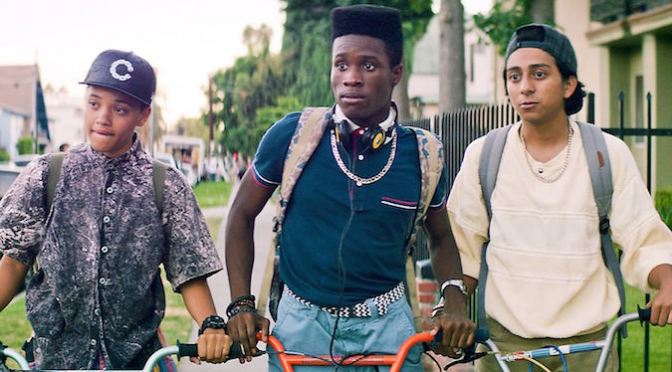
Beyond the soundtrack, Dope delivers on being a fun movie with some important messages about what it’s like growing up as an outsider, and defying the expectations of your neighborhood and culture. The film starts off by introducing us to Malcolm, a straight-A student in Inglewood, California working towards the end of his junior year to get into his top college selection. Malcolm, joined by his best friends Jib and Diggy, struggle to get by as the “nerds” of the school, often falling victim to bullying, petty robbery, and of course, verbal abuse.

Continue reading Dope (2015)

Film & TV News: April 8

News

  • The first trailer for the Star Wars anthology film Rogue One took the internet by storm yesterday, providing the first glimpse of the hotly-anticipated pseudo-spinoff. Two new Star Wars movies within a year of each other, both reinvigorating the franchise after years of dormancy and prequel strife — both Force Awakens and Rogue One are led by tiny gutsy British women, and you’re trying to tell me they’re not related?
  • Cillian Murphy has joined Christopher Nolan’s Dunkirk, marking the fifth collaboration between actor and director following the Dark Knight trilogy and Inception. He’s joining an impeccable cast that includes Kenneth Branagh, Tom Hardy, Mark Rylance and a handful of newcomers. If any team can turn a fresh eye onto a very famous part of history, it’s this one.
  • World’s Most Perfect Human Charlize Theron has been cast in the eighth installment of the Fast & Furious franchise, but for some strange reason they’re not calling it Fast & Furiosa.
  • Relax, you guys: Sherlock Season 4 is now filming.

Continue reading Film & TV News: April 8

Daredevil – Season 2

It’s incredibly tempting to write two completely separate reviews of the second season of Daredevil. The most superficial reason for this urge is simply because that’s more or less the way the season is divided: Part One, the first five or six episodes, focuses on the gun-toting, villain-slaughtering Punisher. Part Two focuses on Elektra, the long-ago flame and now-returned firestarter of Matt Murdock. Not long after the second season received the greenlight after a rollicking first season, these were the only two words you needed to mark your excitement: Punisher and Elektra.

The former was exciting mostly because the three preceding attempts to bring Punisher to life — the 1989 Dolph Lundgren version, the 2004 Thomas Jane version, and the pitiful 2008 movie War Zone with Ray Stevenson — all pretty much sucked. Marvel Studios hoovered up the rights to the character and soon announced that he’d appear in a supporting role in Daredevil, signifying an understandable hesitation to give the dude yet another full-length feature after three straight misfires. The latter inclusion was exciting because Elektra is an inextricable part of the Daredevil mythos, per Frank Miller’s incredible must-read run on the comics series in the early ’80s and, yeah, okay, fine, per Jennifer Garner in two movies. Basically this was a time for redemption for both characters, just as the Daredevil series itself is a redemption for the title character.

Continue reading Daredevil – Season 2

Face Off: Hercules (1997) and Superman I/II (1978/80)

Motion State Face Offs pit two films, franchises, or television series against each another for no reason other than because we can.

As the leading voice in movie reviews, we at Motion State Review judge films based on a wide variety of factors — dialogue, acting, cinematography, whether or not Nic Cage is in it, etc. But perhaps the most important quality a movie can have, in this contributor’s humble opinion, is originality. Sometimes, we do not recognize a movie’s level of originality unless it is noticeably unoriginal (Avatar rehashing Pocahontas, to name one; seriously they are the same movie). Other times, you can see a movie a dozen times before realizing that maybe you have seen the same exact thing somewhere else. Such was the case as when I traveled to Athens and watched the Disney movie Hercules for the first time in several years, because a true movie critic travels thousands of miles just to watch an animated movie that takes place there. I expected to get a heavy dose of nostalgia while watching; instead I got a heavy dose of…Superman?

In the same way that Avatar and Pocahontas are similar enough that any high school teacher would claim plagiarism, so, too, I found, were Hercules and the first two Christopher Reeve Superman movies. Heck, they’re about one Superman solo song away from being the same movie (which would be awesome in the next Man of Steel flick, as long as Henry Cavill’s singing voice is as fantastic as his acting). But, let’s make one thing clear about who’s stealing from whom: the myth of Hercules came just slightly (a few thousand years) before the character of Superman was invented.

Continue reading Face Off: Hercules (1997) and Superman I/II (1978/80)

Never judge a book by its movie