Tag Archives: True Detective

The Red Road 1.1 – “Arise My Love, Shake Off This Dream”

Though True Detective devoured nearly all of last year’s television glory, the SundanceTV series The Red Road deserves mention in the same breath. Massively overlooked but strong enough to be renewed for a second season (which premieres April 2015), the show centers on a small New Jersey town in the foothills of the Ramapo Mountains. Decades of rough history between the town locals and the Lenape Native American tribe begins to flare up again, and two men — Officer Harold Jensen (Martin Henderson) and ex-convict Phillip Kopus (Jason Momoa) — become wrapped up in the middle.

Created by Aaron Guzikowski (writer of Prisoners), The Red Road brings that rough history into the present in a way that few series dare. At times it’s made explicit, especially in scenes recounting the death of Harold’s brother-in-law as members of the Lenape tribe (maybe even Kopus himself) stood by. Those scenes are compelling, but it’s the mysterious, unseen aura of Us vs. Them that really gives The Red Road serious clout, vibing uneasily in every sequence. Is it racism? Or is it simpler, illogical and obdurate hatred, free of any and all motivation, free as a virus in the mountainside community?

Continue reading The Red Road 1.1 – “Arise My Love, Shake Off This Dream”

Film & TV News: February 16

News

-Writers Guild Awards went to The Grand Budapest Hotel (Original Screenplay), The Imitation Game (Adapted Screenplay), True Detective (Drama Series and New Series), Louie (Comedy Series) and Olive Kitteridge (Long Form Adapted).

-The ridiculously stacked 40th Anniversary Special of Saturday Night Live aired last night, and it was a pretty great time. Highlights included Bill Murray’s “Love Theme from Jaws” and Dan Aykroyd stuffing fish into a blender.

-Spider-Man will join the Marvel Cinematic Universe at last, coming in the wake of a deal between Marvel and Sony. The webslinger will have a solo film and could possibly crop up in Captain America: Civil War. The good people at Collider have dutifully summarized Spidey’s history in the Civil War comics, which is worth checking out for a little background info on what may come to pass in the MCU. Better yet: go read the comics.

-Jon Stewart announced his departure from The Daily Show after more than 16 years as host. He’ll be missed.

Continue reading Film & TV News: February 16

The Affair 1.7

After last week’s episode of The Affair I had an acid flashback to the first season of Homeland. Appearances to the contrary as Noah and Alison lounge around Montauk for the summer, The Affair moves pretty quickly. They meet, they imagine themselves with each other, they make love, they make love a lot more, and then they fall in love. They also bring the affair to a screeching halt along the way, essentially calling it quits last week and then going one step further this week by telling their respective spouses about the whole thing. The Affair just deployed an entire series worth of plot in the first seven episodes.

Nevermind what season two or three or four could hold — what the hell could possibly even go down in the final three episodes of this rookie season? Aside from simply knowing that three more hours of story will be told, this seventh episode is concerned with that uncertain ending too. “Looks like you got away with it,” taunts Oscar as he proceeds to blackmail Noah. But no one, not Noah nor we viewers, actually believe that to be true.

Continue reading The Affair 1.7

Prisoners (2013)

I’m not typically a genre purist. I don’t believe an artist should be constrained to single genres, and I have a great admiration for movies that blur the lines to create something fresh. There are two very different, but very good movies in Prisoners that, in this case, don’t exactly result in synergy. The first is about two families dealing with the disappearance of their daughters. It’s haunting, gut-wrenching, and hyper-realistic. To me, this is the stuff of reality. The second is about the mysterious detective trying to catch the abductor. It’s creepy, riveting, and grotesque. This is the stuff of crime thrillers. Frankly, each one would be nearly perfect on its own. But together, in the form of Prisoners, they feel like a cheap blow below the belt.

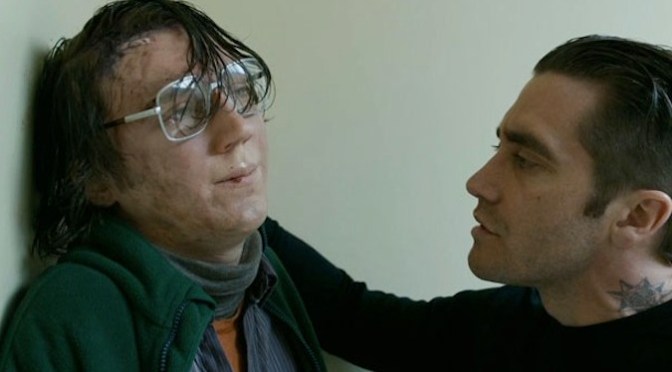
Anna’s parents, played by Hugh Jackman and Maria Bello, attend Thanksgiving dinner at Joy’s parents’, played by Terrence Howard and Viola Davis. When the two girls don’t return from playing outside, and it starts to rain, and a mysterious RV is spotted, the families go into panic mode. Days later, with the authorities on the case 24/7 and vigils being held for the missing girls, the families continue mourning and start resigning to the bad news that’s likely to come. But Keller Dover (Jackman) never really leaves panic mode. There was one suspect–the child-like, catatonic owner of the RV (Paul Dano)–but the cops had to let him go. So Keller does what any frustrated father who’s built like Wolverine would do and takes matters into his own hands. Next thing you know, he’s leading Terrence Howard into an abandoned apartment complex where the suspect is chained to a sink and badly beaten. Continue reading Prisoners (2013)

The Affair 1.4

There were a couple new story elements and plot revelations in the fourth hour of The Affair, but like the third episode this one didn’t have nearly the same degree of crackle-and-pop as the opening segments. Let’s hope that’s not a new trend, and let’s dive right into episode four.

I’m somewhat surprised it’s taken me this long to mention any parallels to True Detective, as the structure alone is pretty much identical to that of The Affair – future-set interrogations framing a series of flashbacks that may or may not be true, an overbearing sense that the past and the present are linked by something we viewers just can’t grasp yet, etc. Now, though, the comparison is both unavoidable and deeper than the structure. The fifth episode of that first season (“The Secret Fate of All Life”) is the first time that the verbal recounting of the old case by Matthew McConaughey’s Rust Cohle is in direct conflict with what we’re actually seeing. Likewise, the memories of Noah and Alison are now starting to seem more and more dubious (or are they? Dun dun dun).

Continue reading The Affair 1.4

Olive Kitteridge 1.1 – “Pharmacy”

We’re getting to the point where anything produced by HBO is pretty much guaranteed to be a worthwhile watch. A history of cutting funding for the likes of Deadwood, Rome and even The Wire at one point shows the premium service isn’t afraid to ditch something they’re not 100% confident in, no matter how good the early episodes are. Olive Kitteridge, of course, isn’t really a show – the four-hour miniseries spanned two nights earlier this week and will probably play on a loop for the next week, but after that no más. Still, the HBO association is evident in a high production value and a deep care taken with the characters and material that few other channels can afford to provide.

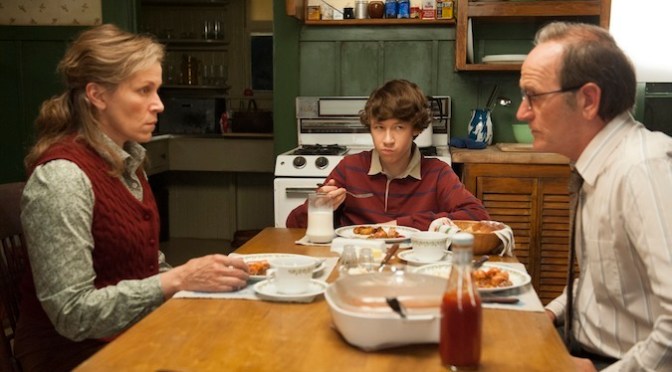
Frances McDormand plays the titular Olive, aging middle-school teacher in smalltown Maine, mother of a bratty son and wife of an irrepressibly optimistic husband (played by the always-brilliant Richard Jenkins). We meet Olive as she walks through the forest, gray ratty hair stemming out from her pale skull, and she calmly lays out a picnic blanket and removes a loaded gun from her coat. We suddenly backtrack to twenty-five years earlier, but the tone is set in that initial sequence: Ollie is unhappy, gazing longingly at the gnarled branches reaching toward the hazy sky, and maybe we’re about to see why.

Continue reading Olive Kitteridge 1.1 – “Pharmacy”

Evidence of Blood (1998)

A late-’90s made-for-TV flick by no-name director Andrew Mondshein starring hardbody sex idols David Strathairn and Mary McDonnell? Sign me up!

While there’s literally not one thing to get excited about when looking over Evidence of Blood on paper, it passes with a push from a realistic script and fairly believable twist ending. Strathairn stars as crime novelist Jack Kinley, who returns to his smalltown home (as all such protagonists seem to do) and gets embroiled in a decades-old murder mystery (as all such protagonists seem to do). McDonnell and the rest of the supporting cast sport drawling Southern accents and go around wondering why city boy Kinley can’t just let the past be the past, for Chrissake.

Also notable here is the overused protagonist-has-suppressed-the-one-thing-that-cracks-the-case trope, wherein Kinley’s childhood nightmares end up informing the whodunit in a highly convenient way. Was that trope overused in 1998, though? Does it matter?

The script, again, is realistic to a fault and quite solid as far as made-for-TV flicks go – and sad, then, that the aforementioned “quirk” of the protagonist is not only unrealistic but also jarring in such an otherwise true-to-life landscape. These “quirks” are super prevalent today, apparent in Dr. House and every “gifted” crime investigator on CSI and NCIS and LAPD Whatever. Hell, even Matthew McConaughey’s Rust Cohle from True Detective had spells of hallucinations amidst his obsessive and manic mannerisms.

Is no main character interesting enough without these kinds of fabricated “connections” ingrained somewhere in their psyche? That screenwriter Dalene Young and/or book author Thomas H. Cook (maybe it worked better in the novel?) succumbed to this trope is ultimately what sets this writer-solving-a-mystery story below stronger efforts of similar sensibility, like Midnight in the Garden of Good and Evil.

The framing and cinematography may also be what set Evidence of Blood aside as TV fodder rather than something fit for theatrical release, and Kinley’s dreams and premonitions fade in and out of the reality of the story with barely a trace of care or subtlety. They just happen. In better hands, the weak points in the story could still have been fashioned into compelling viewing, which is to say that in better hands Evidence of Blood could have been a heck of a lot more affecting.