True Detective 1.1 – “The Long Bright Dark”

This review appeared shortly after the initial premiere of True Detective in early 2014 — slight edits have been made since the original posting.

Touch darkness, says the promotional poster for HBO’s latest series True Detective, and darkness touches you back. A tagline like this is all too generic these days, paired with a moody title card or a black-and-white shot of the strong-willed protagonist of a new film or television series. True Detective’s ad campaign has all of that — but one thing to take away from the pilot episode, which aired Sunday night in the US, is that the weighty tagline is rightfully deserved. Spoilers follow for the first episode “The Long Bright Dark”.

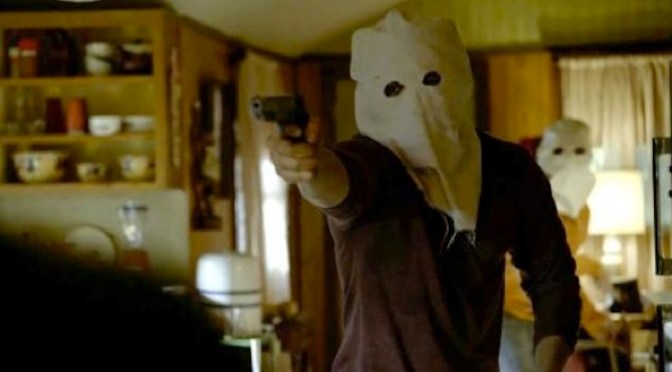
Conceived as an anthology series (more on that in a bit), True Detective’s first season stars Matthew McConaughey and Woody Harrelson as newly-paired State Police Detectives in backwater Louisiana. The year is 1995, and the detectives are still operating in an awkward alliance as they begin an investigation into a gruesome murder. The victim’s name is Dora Lange, and it’s already clear that her case is a driving element of this season — and yet the vast majority of “The Long Bright Dark” is spent with McConaughey and Harrelson, and it’s also clear that this is a show that will focus on the character above the plot. The tension in the partnership is nothing revelatory for a cop show: McConaughey’s Rust Cohle is the unconventional but brilliant loner, Harrelson’s Martin Hart is the by-the-numbers family man looking to succeed in his position. These parts are acted perfectly, though, and McConaughey especially deserves to ride high on the wave of critical praise he’s received for recent roles such as this.

Continue reading True Detective 1.1 – “The Long Bright Dark”

Film & TV News: April 20

News

  • Plot details for Star Wars: Rogue One reveal that the rumored Death Star connection is in fact at the center of the 2016 spinoff. This means the events will take place between Revenge of the Sith and A New Hope, which is simultaneously exciting and worrying.
  • Tribeca Film Festival continues this week, closing on April 26th. Western-themed highlights of this year’s festival include William Monahan’s Mojave and the Michael Fassbender frontier flick Slow West.
  • John Michael McDonagh’s follow-up to last year’s excellent Cavalry, a New Mexico-set black comedy called War on Everyone, began filming this week. Check out the first image over at Empire.

Continue reading Film & TV News: April 20

The Red Road 2.3 – “Intruders”

At the end of last week’s episode of The Red Road, titled “Graves“, a supporting character from the first season shuffled off his mortal coil in a somewhat predictable fashion. He speaks in absolutes and says the things a fictional character in a fictional story says before electing to leave the world. There’s a cool shot of Jean getting into her car and backing out of the driveway that’s soon wasted by an inserted shot of the guy raising a gun to his head, and had the gunshot gone off in the background of that car shot it might have been a bit easier to swallow. But as “Graves” ended the whole episode felt a bit tired, and that sequence in particular felt a bit like a writer’s room getting rid of a character they had no idea what to do with.

In “Intruders” that death takes on a bit more meaning, as does the concept of a grave. But the episode offered little in the way of real intensity or development, continuing what’s becoming a disappointing trend in Red Road‘s second season. Kopus is still on lockdown, Junior is still roaming the wilderness and shooting squirrels, and Harold is still just strutting around being boring. Here’s to hoping that there’s something lurking behind this veneer of relative tedium that we just can’t see yet, because otherwise “Intruders” is a letdown at the halfway point of season two.

Continue reading The Red Road 2.3 – “Intruders”

Skokie: Invaded But Not Conquered (2013)

I spent an hour and a half on an online chat module last night with a Verizon guy named Sandeep, desperately trying to restore some suspiciously evaporated TV channels to my service. We did the typical dance around the issue for some time before actually starting in on solving it, and the overly-formal customer service lingo that obviously came off of a laminated index card really only extended the process. Our conversation ended as follows:

Sandeep: You are a valued customer.

Me: Thank you.

Sandeep: I sincerely hope your sirvice [sic] is now satisfactory.

Me: Thank you.

Sandeep: Do you have any further questions?

Me: Have you seen the new Star Wars trailer?

The other reason this took so long was that most of my attention was on Skokie: Invaded But Not Conquered, the documentary airing on one of the channels that didn’t decide to spontaneously vanish. I’m ashamed to say I really had never heard of the fanatic Frank Collin or the “Skokie Affair”, despite any knowledge of American neo-Nazi groups and other various followers of the American Nazi Party’s George Lincoln Rockwell. Collin was partly that — a follower of Rockwell’s — and partly an attention-seeking egomaniac with a knack for societal parasitism. In Skokie, Illinois, he found what he perceived to be the ideal host.

Continue reading Skokie: Invaded But Not Conquered (2013)

Daredevil – Season 1

If anyone has shown a dedication to the long game in big-budget storytelling lately, it’s Marvel. The latest addition to the ever-expanding Cinematic Universe is the Netflix series Daredevil, chronicling the early days of lawyer Matt Murdock and his crimefighting alter-ego. In many ways Daredevil is the best thing to happen to the MCU in a long time. Not only is it far superior to Marvel’s other television ventures Agents of S.H.I.E.L.D. and Agent Carter, but it often packs more of a punch — physically and emotionally — than the majority of the MCU films. The lack of cable television limitations or MPAA ratings means the show can be as dark as it needs to be. Most importantly, though, Daredevil shies away from the typical overblown grandiosity of many MCU ventures and opts instead for a very human drama.

It’s still a hero vs. villain thing we’re dealing with here, of course, but Daredevil is at its strongest when it plays away from that (striking the super– prefix from both hero and villain). Murdock gets his ass handed to him on a regular basis, Wilson Fisk is diabolical and yet relatable, and the street-level politics of the show are far more interesting than the end-of-the-universe Avengers stories. This is true of the comics, too, and as with live-action Daredevil it took a while to get the character right. There are a whole host of comic book influences for the Netflix series — primarily the Frank Miller tales The Man Without Fear and Born Again —which we’ll dive into now. Ye be warned: spoilers abound.

Continue reading Daredevil – Season 1

Assault on Precinct 13 (1976)

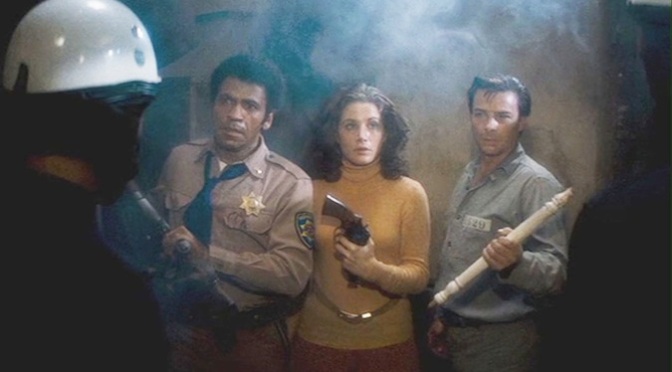
There’s a building on a quiet alley in a rundown part of the city that’s almost abandoned, draped in shadow and disrepair. Inside the building is a collection of individuals from vastly different walks of life. There is a supervising lieutenant freshly assigned to the job. There is a grief-stricken father in the throes of shock after discovering his murdered daughter. There are two dainty secretaries wearing sweaters (one orange, one yellow). There are three hardened criminals, one of whom is sick with a possible virus. Each of the people inside the building is an individual with an individual story. Outside is different. Outside is a creeping evil, a legion of hunters that is nonetheless a single faceless and motiveless mass, no individual stories to be found. The hunt is all.

…sounds like a horror movie, right? Like the kind John Carpenter might make? Even beyond Carpenter, this is not at all an unfamiliar formula for fright-fests — strangers unite against mysterious evil — serving as the entire premise of movies like Cube and Saw. The idea that something lurking out there will inevitably attack each stranger regardless of their differences is an inherently scary notion. And even though Assault on Precinct 13 isn’t necessarily a horror movie, it’s at its most effective when it operates like one.

Continue reading Assault on Precinct 13 (1976)

Better Call Saul 1.10 – “Marco”

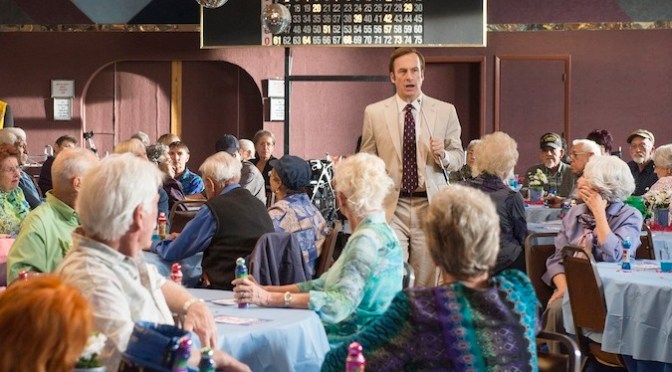
It’s been a week since the conclusion of the first season of Better Call Saul. “Pimento“, far and away the best single episode of the season (although I loved “Hero“), made sure Jimmy’s world was flipped upside down as we headed into the finale hour. Relationships that once meant the world to our morally-challenged lawyer are now seen in a different light, and people Jimmy once thought to be the scum of the earth are suddenly something else entirely.

It’s fitting, then, that “Marco” gives a name and a history to Jimmy’s one-time best friend Marco. In “Hero” we saw a glimpse of Slippin’ Jimmy’s adeptness in the short con game, and if he’s The Sting‘s Johnny Hooker then Marco is his Luther Coleman. After the events of “Pimento” Jimmy returned to his old stomping grounds and found Marco exactly where he left him, asleep at a bar in the middle of the afternoon, scraping by on a crappy job and a handful of half-assed scams.

Continue reading Better Call Saul 1.10 – “Marco”

Film & TV News: April 13

News

  • Stephen King’s The Dark Tower is getting “fast-tracked” — whatever that means nowadays — at Sony Pictures. The fantasy series has long been rumored for a film adaptation and had Ron Howard attached as director at one point, but now it sounds like it might actually get made.
  • As his latest film Furious 7 continues box office domination, director James Wan is now rumored for DC’s Aquaman film. According to a consortium of critics known as Me, if the DC Cinematic Universe has a more cohesive storyline then they should be able to stray in tone and mood from Zack Snyder’s pout-fests without seeming out-of-place. The more unique the directorial vision, the better.
  • The complete Star Wars saga is now available for the first time in Digital HD, just in time to watch all six movies a dozen more times before The Force Awakens comes out.

Continue reading Film & TV News: April 13

The Red Road 2.2 – “Graves”

A relatively quiet second episode of The Red Road‘s sophomore year provided a little more clarity with regards to the direction the show might take after a cracking first season. The impetus for much of the going-ons here is the murder of Mac, elder chief of the Lenape chapter of the Ramapo Mountains, which we saw at the end of the the second season opener “Gifts“. As suspected, Phillip Kopus is now the front-and-center suspect in Mac’s demise.

A recent interview with Jason Momoa touched on the “breaking” of the Kopus from the first season; Aaron Guzikowski, creator of Red Road and scribe behind Denis Villeneuve’s Prisoners, certainly seems to be heading in that direction with “Graves”. It’s interesting that Kopus more or less shuns the traditional trappings of his Lenape ancestry and yet seems to find himself cornered by it throughout the opening episodes of the second season. That disregard for the tribe led to Mac’s abandonment of him, which in turn presents a motive for people to attach to Kopus when Mac turns up dead. Even though the mountains have their own tribal police force, the method of attack on Kopus is the same as it has ever been, with a “half-assed lynch mob” (in Kopus’s disdainful estimation) beating him and covering him with tar.

Continue reading The Red Road 2.2 – “Graves”

Skyfall (2012)

For such a successful franchise of movies, there is no denying that of the 23 James Bond installments, a handful of the movies are nothing special on their own. That is to say, strip away the Bond allure and you’re left with a lot of movies that probably resemble a 2014 Kevin Costner film (3 Days to Kill, Jack Ryan: Shadow Recruit… you get the picture). But the most recent entry Skyfall certainly does not fit into this category of Bond movies. In many ways, Sam Mendes’ first Bond movie is not a typical Bond film; making it not just a great James Bond movie, but a great movie in general.

Mendes gives the viewer this sense early when Q says to Bond — but really to the audience as a sort of aside — “what did you expect, an exploding pen?” It’s Mendes way of saying, “what did you expect, a typical Bond movie?” In the case of Q, what he gives Bond — a fingerprint encoded gun — is even better. And in the case of Mendes, what he gives the viewer is also far better.

Continue reading Skyfall (2012)