
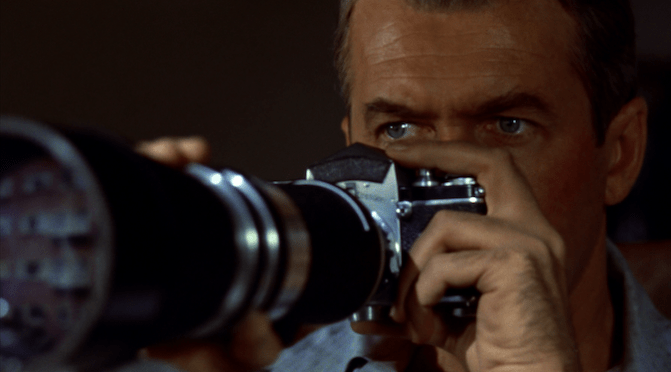
 Alfred Hitchcock was no stranger to the optical point-of-view shot, inserting a camera into the heads of his characters in nearly every film throughout his career. The Master of Suspense knew that this shortcut to conveying a character’s experience could be a powerful tool if used artfully. In Vertigo, this artfulness resulted in one of the greatest POV shots of all time, the discombobulating push-in-zoom-out (technically a “dolly zoom”) that simultaneously suggests our hero’s unbalanced frame of mind. More importantly, Hitchcock routinely tied these POV shot choices to significant narrative moments. In Vertigo this served to heighten the most intense action scenes by placing us directly in the action; elsewhere, the POV shot served to convey vital information, revelations, twists and — you guessed it! — suspense:
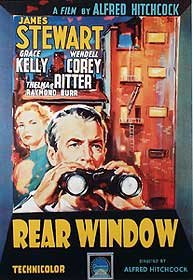
With Rear Window, Hitchcock structured an entire film around this single technique. It may not register on first viewing just how much of the movie is comprised of true POV shots, mostly because there’s a consistent pseudo-POV gaze out of Jeffries’ (Jimmy Stewart) apartment toward those of his neighbors. Insofar as such a thing can (or even should) have one unwavering, concrete definition, this analysis will define a “POV shot” as one that is truly mirroring the vantage of the character. There are a number of sweeping pans during Rear Window in which we see much the same thing Jeff is seeing, but many of these end up incorporating Jeff into the shot and are therefore technically objective, “false” POV shots.

 If you’re a connoisseur of modern helicopter cinema, then Mission: Impossible – Fallout is the event of the season. Not since Black Hawk Down has the Neo-Copterism movement asserted such a well-defined visual aesthetic, such elevated narrative and tonal language, such awesome fucking explosions. Everything a refined and learned copterhead cinephile could possibly desire finds fresh life here. There is an absurdist, Lynchian quality infused into the rhythmic weaving of two whirlybirds; there are rarefied, Brechtian attributes present in those characters left on the ground. There is a continuation of the leitmotif established in the first Mission: Impossible‘s chopper-chase finale. When read through the lens of the tenets of cinéma vérité, Fallout delivers a powerful indictment of those who don’t actually know how to fly such a machine. And, in a move sure to receive recognition come awards season, auteur director Christopher McQuarrie playfully inverts the male gaze by literally flipping Tom Cruise upside down in a helicopter.

 In many instances a film is like a con: it wants to hook you, it wants to make you personally invested in the outcome, and it wants you to walk away with a smile on your face and slightly less in your wallet. If the endeavor is a success, there will always be enough to suggest that the artist — the film artist or the con artist — knows a truth that you do not. If the endeavor is unsuccessful, the feeling of being cheated will linger and frustrate.
 One of the things that soured
 We’ve done a fair bit of writing about James Bond here at Motion State. From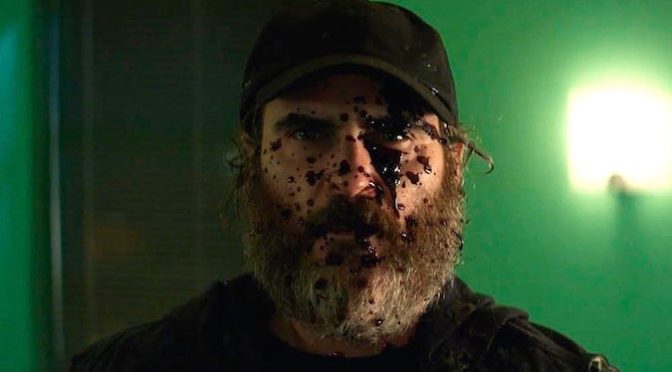
 There were a number of factors that prevented me from rushing out to see You Were Never Really Here on opening night. First was the weather, which is not really an excuse at all if you’re a New Englander like me. The second factor was the review snippet plastered on the poster that referred to the film as “Taxi Driver for a new century.” Do I enjoy Taxi Driver? I do. Do I enjoy “modern updates” to ’70s classics like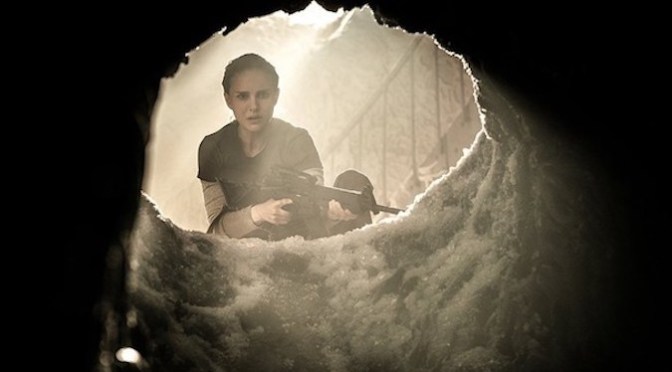
 In the climactic finale of Annihilation, there is a moment in which a shape-shifting alien bioclone with burning arms lovingly embraces a charred corpse in a lighthouse that has been struck by a meteor and overtaken by a mutated blight that threatens all life as we know it. Go ahead and read that sentence again if you have to. I dare you to try to come up with something so outlandish, so unsettling, so straight-up weird, much less deploy it at a crucial moment in a multimillion-dollar motion picture production. We live in a time where pretty much every sci-fi film with a budget this size (about $40 million) ends one way: explosions. The scripts all contain the same line: Big CGI Thing bursts into CGI flame. Heck, explosions probably typify the finale of most Hollywood films, sci-fi or otherwise, and the scripts for their inevitable sequels all contain the same line: Bigger CGI Thing bursts into bigger CGI flame.
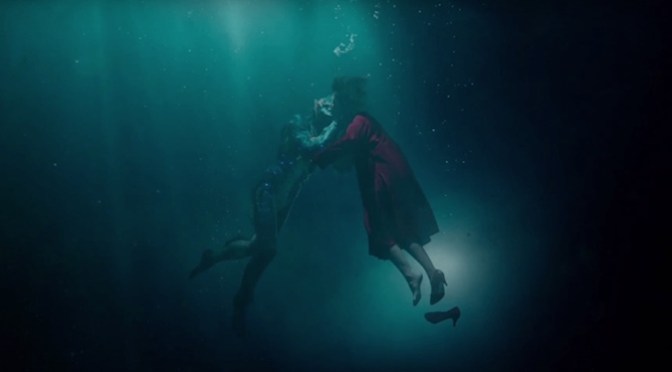
 I arrived late to the party for The Shape of Water, having finally caught the movie a few weeks ago after months and months of dodging reviews online. Guess I’d better add my voice to the fray, huh? Maybe a piece on how writer/director Guillermo del Toro’s creativity allowed him to get away with a smaller budget…but, no,
  Motion State Review