

Each Motion State Face Off pits two films, franchises, or television series against each another for no reason other than because we can.
In hindsight, Michael Crichton’s 1973 film Westworld was an uncomplicated affair. Sure, the premise required a bit of explaining — there’s a Wild West theme park staffed by lifelike robots, offering full immersion for wealthy tourists looking for romance or violence — but the plot was deceptively simple and the characters were drawn without a trace of ambiguity. The humans were the heroes and the malfunctioning robots were the villains. As we’ve detailed in our Writer Series on the works of Crichton, lots of good science fiction operates in exactly this way: classic stories playing out in strange, unfamiliar settings or time periods. No matter how unsettling the concept, how futuristic the design, how far-off the entire experience feels, Westworld is still a movie about a killer robot. And this is hardly groundbreaking, even in 1973, considering that the very first robot in cinema (from Houdini’s 1918 silent serial The Master Mystery) was already wreaking havoc on its human overlords:
In some ways, Killer Robot Cinema (evermore an acceptable genre classification on Motion State) has progressed a great deal since 1918. The murderous machines went from stacked-and-spraypainted cardboard boxes to sleek metal automatons to, finally, looking just like humans, which is presumably the pinnacle of droid design both in fiction and in real life. In some ways, though, killer robot cinema has hardly moved an inch. Humans are still playing God, still inventing advanced A.I. in robot form, and those robots are still turning around and killing them for it.
Continue reading Face Off: Westworld (1973) and Westworld (Series)
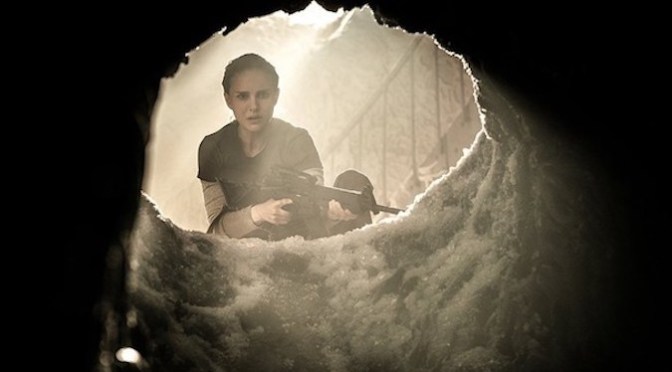
 In the climactic finale of Annihilation, there is a moment in which a shape-shifting alien bioclone with burning arms lovingly embraces a charred corpse in a lighthouse that has been struck by a meteor and overtaken by a mutated blight that threatens all life as we know it. Go ahead and read that sentence again if you have to. I dare you to try to come up with something so outlandish, so unsettling, so straight-up weird, much less deploy it at a crucial moment in a multimillion-dollar motion picture production. We live in a time where pretty much every sci-fi film with a budget this size (about $40 million) ends one way: explosions. The scripts all contain the same line: Big CGI Thing bursts into CGI flame. Heck, explosions probably typify the finale of most Hollywood films, sci-fi or otherwise, and the scripts for their inevitable sequels all contain the same line: Bigger CGI Thing bursts into bigger CGI flame.



 Motion State Review